



Reaction mechanism of the Me3AuPMe3–H2 plasma-enhanced ALD process
文献信息
发布日期
2020-05-15
DOI
10.1039/C9CP06855D
影响因子
3.676
作者
Michiel Van Daele, Matthew B. E. Griffiths, Matthias M. Minjauw, Seán T. Barry, Christophe Detavernier, Jolien Dendooven
查看原文
摘要
The reaction mechanism of the recently reported Me3AuPMe3–H2 plasma gold ALD process was investigated using in situ characterization techniques in a pump-type ALD system. In situ RAIRS and in vacuo XPS measurements confirm that the CH3 and PMe3 ligands remain on the gold surface after chemisorption of the precursor, causing self-limiting adsorption. Remaining surface groups are removed by the H2 plasma in the form of CH4 and likely as PHxMey groups, allowing chemisorption of new precursor molecules during the next exposure. The decomposition behaviour of the Me3AuPMe3 precursor on a Au surface is also presented and linked to the stability of the precursor ligands that govern the self-limiting growth during ALD. Desorption of the CH3 ligands occurs at all substrate temperatures during evacuation to high vacuum, occurring faster at higher temperatures. The PMe3 ligand is found to be less stable on a gold surface at higher substrate temperatures and is accompanied by an increase in precusor decomposition on a gold surface, indicating that the temperature dependent stability of the precursor ligands is an important factor to ensure self-limiting precursor adsorption during ALD. Remarkably, precursor decomposition does not occur on a SiO2 surface, in situ transmission absorption infrared experiments indicate that nucleation on a SiO2 surface occurs on Si–OH groups. Finally, we comment on the use of different co-reactants during PE-ALD of Au and we report on different PE-ALD growth with the reported O2 plasma and H2O process in pump-type versus flow-type ALD systems.
相关文献
An efficient and reusable carbon-supported platinum catalyst for aerobic oxidation of alcohols in water
Yun Hau Ng, Shigeru Ikeda, Takashi Harada, Yoshihiro Morita, Michio Matsumura
2008-05-07
Communication
DOI: 10.1039/B803912G
Azacalix[4]arene cation radicals: spin-delocalised doublet- and triplet-ground states observed in the macrocyclic m-phenylene system connected with nitrogen atoms
Koichi Ishibashi, Hirohito Tsue, Naoko Sakai, Satoshi Tokita, Kazuhiro Matsui, Jun Yamauchi, Rui Tamura
2008-04-11
Communication
DOI: 10.1039/B801127C
Gold-catalysed intramolecular trans-allylsilylation of alkynes forming 3-allyl-1-silaindenes
Takanori Matsuda, Sho Kadowaki, Yoshiyuki Yamaguchi, Masahiro Murakami
2008-05-20
Communication
DOI: 10.1039/B804721A
Bent phenyl groups in lithiosilanes—crystal structures and interpretation of this unanticipated feature
Carsten Strohmann, Christian Däschlein
2008-04-16
Communication
DOI: 10.1039/B802211A
Orthogonal ligation: a three piece assembly of a PNA–peptide–PNA conjugate
Fabienne Burlina, David D. Dixson, Robert P. Doyle, Gérard Chassaing, Christopher N. Boddy, Philip Dawson, John Offer
2008-04-14
Communication
DOI: 10.1039/B801242C
Coupling–isomerization–Claisen sequences – mechanistic dichotomies in hetero domino reactions‡
Daniel M. D'Souza, Frank Rominger, Thomas J. J. Müller
2006-09-12
Communication
DOI: 10.1039/B609669G
Hysteretic sorption of light gases by a porous metal–organic framework containing tris(para-carboxylated) triphenylphosphine oxide‡
Shaunt E. Oungoulian, Ji Woong Yoon, Young Kyu Hwang, Erica R. Wise, Jong-San Chang
2008-04-21
Communication
DOI: 10.1039/B802809E
A rare ligand bridged ferromagnetically coupled MnIV3 complex with a ground spin state of S = 9/2
Thushan Pathmalingam, Serge I. Gorelsky, Tara J. Burchell, Rodolphe Clérac, Muralee Murugesu
2008-04-16
Communication
DOI: 10.1039/B802279H
您可能还喜欢
化合物问答
如何储存1,2-环己二酮环乙缩醛(CAS号:4746-96-7)?
1,2-环己二酮环乙缩醛应储存在阴凉、干燥、通风良好的地方,避免阳光直射。建议使用密封容器保存,并保持环境温度在室温范围内,远离火源和热源。
4746-96-71,4-Dioxaspiro[4.5]d...
化合物问答
Ecopladib(CAS号:381683-92-7)的市场或研究趋势如何?
Ecopladib作为一种新型的药物,主要应用于治疗高胆固醇等疾病。目前,市场和研究趋势显示,Ecopladib因其独特的药理作用而受到关注。随着对心血管疾病治...
381683-92-7Ecopladib
化合物问答
2,3-Dimethyl-3H-imidazo[4,5-c]pyridine(CAS号:52538-09-7)通常如何合成?
2,3-二甲基-3H-咪唑[4,5-c]吡啶通常通过咪唑和2,3-二甲基吡啶的缩合反应合成。具体来说,将咪唑和2,3-二甲基吡啶在适当的溶剂中进行加热或加压反应...
52538-09-72,3-Dimethyl-3H-imid...
化合物问答
2,3,4,5-tetrahydro-1H-3-苯并氮杂环;盐酸盐(CAS号:17379-01-0)的市场或研究趋势如何?
该化合物在药物化学和有机合成中有一定的应用。近年来,随着对新型药物化合物的需求增加,该化合物的研究趋势主要集中在探索其生物活性,尤其是其在神经系统疾病治疗中的潜...
17379-01-02,3,4,5-Tetrahydro-1...
68-90-6(2-Ethyl-1-benzofura...
化合物问答
如何储存盐酸甘氨酸丁酯(CAS号:13048-99-2)?
盐酸甘氨酸丁酯应储存在阴凉、干燥、通风良好的地方,避免阳光直射和高温环境,温度应控制在25℃以下。储存容器应密封,避免与空气中的水分和酸性物质接触,以防发生水解...
13048-99-2Butyl glycinate hydr...
化合物问答
什么是2-Iodo-N,N-dimethylbenzamide(CAS号:54616-46-5)?
2-碘-N,N-二甲基苯胺是一种有机化合物,化学名为2-Iodo-N,N-dimethylbenzamide。其分子式为C<sub>9</sub>H<sub>1...
54616-46-52-Iodo-N,N-dimethylb...
16817-90-6N-Cyclohexylglycinam...
化合物问答
5-溴-2-(4H-1,2,4-三唑-4-基)吡啶(CAS号:959240-99-4)的市场或研究趋势如何?
随着医药、农药和新材料领域的发展,该化合物作为关键中间体的应用日益增多。特别是在药物合成中,由于其独特的化学性质,可以用于合成多种药物分子。未来的研究趋势可能集...
959240-99-45-Bromo-2-(4H-1,2,4-...
化合物问答
2,4-二溴-6-三氟甲基嘧啶(CAS号:785778-00-9)通常如何合成?
2,4-二溴-6-三氟甲基嘧啶通常通过溴化反应合成。首先,将6-三氟甲基嘧啶与溴化剂(如液溴)在适当的溶剂(如二氯甲烷、四氢呋喃)中反应,加入适当的催化剂(如四...
785778-00-92,4-Dibromo-6-(trifl...
来源期刊
Physical Chemistry Chemical Physics

CiteScore:
5.5
自引率:
10.3%
年发文量:
3036
Physical Chemistry Chemical Physics (PCCP) is an international journal co-owned by 19 physical chemistry and physics societies from around the world. This journal publishes original, cutting-edge research in physical chemistry, chemical physics and biophysical chemistry. To be suitable for publication in PCCP, articles must include significant innovation and/or insight into physical chemistry; this is the most important criterion that reviewers and Editors will judge against when evaluating submissions. The journal has a broad scope and welcomes contributions spanning experiment, theory, computation and data science. Topical coverage includes spectroscopy, dynamics, kinetics, statistical mechanics, thermodynamics, electrochemistry, catalysis, surface science, quantum mechanics, quantum computing and machine learning. Interdisciplinary research areas such as polymers and soft matter, materials, nanoscience, energy, surfaces/interfaces, and biophysical chemistry are welcomed if they demonstrate significant innovation and/or insight into physical chemistry. Joined experimental/theoretical studies are particularly appreciated when complementary and based on up-to-date approaches.
推荐化合物

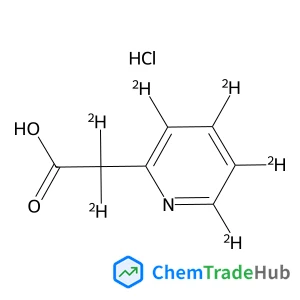
2,2-dideuterio-2-(3,4,5,6-tetradeuterio-2-pyridyl)acetic acid;hydrochloride
CAS号:
1329799-67-8
分子式:
C7H2ClD6NO2
推荐供应商




免责声明
本页面提供的学术期刊信息仅供参考和研究使用。我们与任何期刊出版商均无关联,也不处理投稿事宜。如有投稿相关咨询,请直接联系相关期刊出版商。
如发现页面信息有误,请发送邮件至 support@chemtradehub.com 联系我们。我们将及时核实并处理您的问题。