









An integrated approach between neutron diffraction and elemental imaging through neutron resonance transmission imaging: preliminary results on Chinese bimetallic sword fragments
文献信息
发布日期
2019-10-14
DOI
10.1039/C9JA00300B
影响因子
4.023
作者
Anna Fedrigo, Davide Raspino, Francesco Grazzi, Antonella Scherillo
查看原文
摘要
In this work, neutron diffraction (ND) and neutron resonance transmission imaging (NRTI) are applied for the material characterization of composite artefacts, two bimetallic sword fragments from ancient China, in order to highlight the presence and distribution of phases and elements in the objects. The investigation was carried out at the INES beamline, a time-of-flight powder diffractometer operating at the ISIS neutron and muon source in the UK. ND was applied to identify and quantify crystalline phases, while NRTI, by means of a position sensitive n-GEM based neutron detector, provided us with the distribution of different elements in the objects. NRTI demonstrates the possibility of enhancing several elements (e.g. Fe, Cu, Ag, Sn, Sb, As, Co, Cr, In, and Mn) in neutron transmission images, achieving a spatial resolution of about 1.6 mm. Elemental mapping was performed by selecting some of the most intense neutron resonances (up to several keV) in the absorption spectra.
相关文献
Phase transitions in hydrophobe/phospholipid mixtures: hints at connections between pheromones and anaesthetic activity
Silvia Borsacchi, Marco Geppi, Sara Macchi, Emiliano Fratini, Moira Ambrosi
2016-05-06
Paper
DOI: 10.1039/C6CP00659K
Understanding the STM images of epitaxial graphene on a reconstructed 6H-SiC(0001) surface: the role of tip-induced mechanical distortion of graphene
Jacques Cousty, Christophe Lubin, François Thoyer
2016-03-07
Paper
DOI: 10.1039/C5CP07571H
Distribution pattern and allocation of defects in hydrogenated ZnO thin films
Vitaly Gurylev, Chung-Yi Su, Tsong-Pyng Perng
2016-05-12
Paper
DOI: 10.1039/C6CP01768A
How protonation and deprotonation of 9-methylguanine alter its singlet O2 addition path: about the initial stage of guanine nucleoside oxidation
Huayu Teng
2016-05-10
Paper
DOI: 10.1039/C6CP01350C
Mechanisms and energetics for N-glycosidic bond cleavage of protonated adenine nucleosides: N3 protonation induces base rotation and enhances N-glycosidic bond stability
R. R. Wu, M. T. Rodgers
2016-05-20
Paper
DOI: 10.1039/C6CP01445C
D–A–D-type narrow-bandgap small-molecule photovoltaic donors: pre-synthesis virtual screening using density functional theory
Yeongrok Gim, Daekyeom Kim, Minkyu Kyeong, Seunghwan Byun, Yuri Park, Sooncheol Kwon, Heejoo Kim, Yves Lansac, Yun Hee Jang
2016-04-29
Paper
DOI: 10.1039/C5CP07536J
Characterization of water dissociation on α-Al2O3(102): theory and experiment
Jonas Wirth, Harald Kirsch, Sebastian Wlosczyk, Yujin Tong, Peter Saalfrank, R. Kramer Campen
2016-04-18
Paper
DOI: 10.1039/C6CP01397J
Nuclear size effects in vibrational spectra
Adel Almoukhalalati, Avijit Shee, Trond Saue
2016-05-09
Paper
DOI: 10.1039/C6CP01913G
Structural investigations on a linear isolated depsipeptide: the importance of dispersion interactions
A. Stamm, D. Bernhard, M. Gerhards
2016-05-05
Paper
DOI: 10.1039/C6CP01675H
Charge carrier kinetics of carbon nitride colloid: a femtosecond transient absorption spectroscopy study
Huiyu Zhang, Yaping Chen, Rong Lu, Ruiyu Li, Anchi Yu
2016-05-05
Paper
DOI: 10.1039/C6CP01600F
您可能还喜欢
化合物问答
什么是3-表南美楝属二醇(CAS号:19942-04-2)?
3-表南美楝属二醇是一种具有特定立体化学结构的化合物,其分子式为C31H52O2,属于甾醇类化合物。它具有光学活性,是一种复杂的有机分子,主要存在于一些植物中。
19942-04-2(3S,5R,8R,9R,10R,13R...
化合物问答
3-羧基-5-碘苯甲酸甲酯(CAS号:50765-22-5)应用于哪些行业?
3-羧基-5-碘苯甲酸甲酯主要应用于医药行业,作为合成某些药物中间体的重要原料。此外,它还可能用于聚合物的改性、传感器的制备以及半导体材料的制备等领域。
50765-22-5Methyl 3-hydroxy-5-i...
化合物问答
什么是3-Bromoindolin-2-one(CAS号:22942-87-6)?
3-Bromoindolin-2-one是一种含有溴代基团的吲哚酮衍生物,分子式为C9H7BrNO。它是一种无色固体,具有一定的挥发性,熔点为158-159°C...
22942-87-63-Bromoindolin-2-one
化合物问答
如何处理含有L-Lysyl-L-phenylalanyl-L-isoleucylglycyl-L-leucyl-L-methioninamide(CAS号:2990-43-4)的废料?
对于含有该化合物的废液,应先进行中和处理,然后根据其毒性和活性选择合适的处置方法。可以考虑焚烧处理或由专业的化学品废物处理公司进行无害化处理。处理过程中需注意环...
2990-43-4L-Lysyl-L-phenylalan...
化合物问答
ANGIOTENSIN 1/2 + A (2 - 8)(CAS号:51833-76-2)的物理化学性质是什么?
ANGIOTENSIN 1/2 + A (2 - 8)是一种蛋白质类化合物,具有典型的蛋白质性质。它的分子量约为5900 Da。该化合物在水中具有一定的溶解性,...
51833-76-2ANGIOTENSIN 1/2 + A ...
化合物问答
如何储存2-甲基硫代嘧啶-5-硼酸频那酯(CAS号:940284-18-4)?
应将该化合物存放在阴凉干燥、通风良好的地方,避免阳光直射。建议将化合物密封保存在避光的、干燥的容器中,远离火源和高温环境。
940284-18-42-(Methylthio)-5-(4,...
化合物问答
什么是苏丹红IV氘代物 标准品(CAS号:1014689-18-9)?
苏丹红IV氘代物 标准品是一种含有氘代标记的苏丹红IV化合物,是一种用于化合物分析、结构确证以及代谢研究的标准物质。
1014689-18-91-[(E)-{2-Methyl-4-[...
化合物问答
(+)-2-Amino-6-propionamido-d3-tetrahydrobenzothiazole(CAS号:1217680-69-7)适用哪些法规指南?
该化合物需要遵循《全球化学品统一分类和标签制度》(GHS)中的分类和标签要求,具体分类需依据其毒性和物理化学性质。此外,还需要符合《欧盟化学品注册、评估、授权和...
1217680-69-7(+)-2-Amino-6-propio...
化合物问答
如何储存2-氨基-2-(2-吡啶)乙酸乙酯(CAS号:55243-15-7)?
2-氨基-2-(2-吡啶)乙酸乙酯应储存于阴凉、干燥、通风良好的环境中,避免高温和光照。应使用密封容器储存,并远离易燃物、氧化剂和其他危险化学品。
55243-15-7Ethyl 2-amino-2-(pyr...
化合物问答
3-羟基-4-甲氧基吡啶-2-羧酸(CAS号:210300-09-7)的主要用途是什么?
3-羟基-4-甲氧基吡啶-2-羧酸主要用于合成其他有机化合物,如药物合成、农药合成和染料合成等。此外,它还可用作中间体和试剂,在化学研究领域也有一定的应用。
210300-09-73-Hydroxy-4-methoxy-...
来源期刊
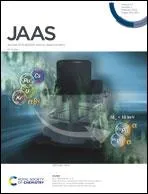
Journal of Analytical Atomic Spectrometry
CiteScore:
6.2
自引率:
25.8%
年发文量:
254
The Journal of Analytical Atomic Spectrometry (JAAS) is the central journal for publishing innovative research on fundamentals, instrumentation, and methods in the determination, speciation and isotopic analysis of (trace) elements within all fields of application. This includes, but is not restricted to, the most recent progress, developments and achievements in all forms of atomic and elemental detection, isotope ratio determination, molecular analysis, plasma-based analysis and X-ray techniques. The journal welcomes full papers, communications, technical notes, critical and tutorial review articles, editorials, and comments, in addition to the Atomic Spectrometry Updates (ASU) literature reviews that are prepared by an expert panel. Submissions are welcome in the following areas, but note this list reflects the current scope and authors are strongly encouraged to contact the Editorial team if they believe that their work offers potentially new and emerging research relevant to the journal remit: Fundamental studies in the following. New and existing sources for atomic emission, absorption, fluorescence and mass spectrometry and those that provide both atomic and molecular information Sample introduction techniques for solids, liquids, gases Improvements in sensitivity, selectivity, precision, accuracy and/or robustness Isotope ratio measurements, including techniques for improving precision and mass bias correction Single channel and multichannel simultaneous detection systems Chemometrics, statistics, calibration techniques and internal standardisation Theoretical and numerical modelling of fundamental processes related to all of the above methodologies Novel or improved methodologies in areas of application including, but not limited to the following. Biosciences, including elemental, speciation and isotopic analysis in biological systems, immunoassays based on metal-labeled antibodies, bio-imaging, and nanoparticle toxicology Geochemistry Environmental science Materials science, including engineered nanoparticles and quantum dots Metrology, including reference materials Forensic analysis Food and agricultural sciences Energy Archaeometry Molecular analysis. Molecular sources for elemental and isotopic analysis Atomic sources for molecular analysis Atomic and molecular techniques simultaneously used for complementary chemical information All contributions are judged on originality and quality of scientific content, and appropriateness of length to content of new science.
推荐化合物
![(1S)-1,5-Anhydro-2-O-alpha-L-arabinopyranosyl-1-[5-hydroxy-7-({6-O-[3-(4-hydroxy-3-methoxyphenyl)propanoyl]-beta-D-glucopyranosyl}oxy)-2-(4-hydroxyphenyl)-4-oxo-4H-chromen-6-yl]-D-glucitol structure](https://cnstatic.chemtradehub.com/structs/225/2252345-81-4-bcff.webp "(1S)-1,5-Anhydro-2-O-alpha-L-arabinopyranosyl-1-[5-hydroxy-7-({6-O-[3-(4-hydroxy-3-methoxyphenyl)propanoyl]-beta-D-glucopyranosyl}oxy)-2-(4-hydroxyphenyl)-4-oxo-4H-chromen-6-yl]-D-glucitol structure")
推荐供应商




免责声明
本页面提供的学术期刊信息仅供参考和研究使用。我们与任何期刊出版商均无关联,也不处理投稿事宜。如有投稿相关咨询,请直接联系相关期刊出版商。
如发现页面信息有误,请发送邮件至 support@chemtradehub.com 联系我们。我们将及时核实并处理您的问题。