


Synthesis of carbohydrate building blocks via regioselective uniform protection/deprotection strategies
文献信息
发布日期
2019-05-02
DOI
10.1039/C9OB00573K
影响因子
3.876
作者
Tinghua Wang, Alexei V. Demchenko
查看原文
摘要
Discussed herein is the synthesis of partially protected carbohydrates by manipulating only one type of a protecting group for a given substrate. The first focus of this review is the uniform protection of an unprotected starting material in a way that only one (or two) hydroxyl group remains unprotected. The second focus involves regioselective partial deprotection of uniformly protected compounds in a way that only one (or two) hydroxyl group becomes liberated.
期刊推荐

Organic Process Research & Development

Russian Journal of Coordination Chemistry

Journal of Saudi Chemical Society

Journal of Peptide Science

Current Opinion in Colloid & Interface Science

Russian Journal of Bioorganic Chemistry

Crystallography Reports

Chemical Communications

Journal of Natural Medicines

Russian Journal of Organic Chemistry
相关文献
Temperature dependence of the conversion efficiency of photochromic perylene bisimide dithienylcyclopentene triads embedded in a polymer
Johann Thurn, Johannes Maier, Martti Pärs, Katja Gräf, Mukundan Thelakkat, Jürgen Köhler
2017-09-12
Paper
DOI: 10.1039/C7CP03634E
Langmuir–Blodgett films of perylene bisimide derivatives and fluorescent recognition of diamines
Congdi Shang, Li Wang, Yanqin An, Ping Chen, Xingmao Chang, Yanyu Qi, Rui Kang, Yu Fang
2017-08-14
Paper
DOI: 10.1039/C7CP04235C
Quercetin and its analogues: optical and acido–basic properties
David Biedermann, Kateřina Valentová, Vladimír Křen, Martin Kubala
2017-09-07
Paper
DOI: 10.1039/C7CP03845C
Running out of lithium? A route to differentiate between capacity losses and active lithium losses in lithium-ion batteries
Florian Holtstiege, Andrea Wilken, Tobias Placke
2017-09-12
Paper
DOI: 10.1039/C7CP05405J
Effect of Cr-doping on the electronic structure and work function of α-Fe2O3 thin films
Li Chen, Hongmei Liu, Zhishan Mi, Changmin Shi, Lijie Qiao
2017-09-05
Paper
DOI: 10.1039/C7CP02472J
Self-assembled bundled TiO2 nanowire arrays encapsulated with indium tin oxide for broadband absorption in plasmonic photocatalysis
Xingce Fan, Zhengwei Luo, Xiangyu Hou, Xiaozhi Yang, Teng Qiu, Paul K. Chu
2017-09-14
Paper
DOI: 10.1039/C7CP04196A
Theoretical study on geometric, electronic and catalytic performances of Fe dopant pairs in graphene
Yanan Tang, Huadou Chai, Weiguang Chen, Xiao Cui, Yaqiang Ma, Mingyu Zhao
2017-09-08
Paper
DOI: 10.1039/C7CP05683D
The emergent intramolecular hydrogen bonding effect on the electronic structures of organic electron acceptors
Takashi Takeda, Yasutaka Suzuki, Jun Kawamata, Shin-ichiro Noro, Takayoshi Nakamura, Tomoyuki Akutagawa
2017-08-07
Communication
DOI: 10.1039/C7CP04402J
您可能还喜欢
化合物问答
2-(甲基磺酰基)嘧啶-5-胺(CAS号:56621-92-2)适用哪些法规指南?
该化合物适用的法规指南包括GHS(全球化学品统一分类和标签制度)分类为特定目标器官毒性-单次接触类别3;根据欧盟REACH法规,该化合物需要进行注册和评估;在美...
56621-92-22-(Methylsulfonyl)py...
化合物问答
在合成中是否有4-(4-氯苯基)-1H-咪唑(CAS号:35512-29-9)的替代品?
在合成中,可以考虑使用一些类似的化合物作为4-(4-氯苯基)-1H-咪唑的替代品,如4-(4-溴苯基)-1H-咪唑或4-(4-甲氧基苯基)-1H-咪唑。这些化合...
35512-29-94-(4-Chlorophenyl)-1...
化合物问答
什么是N~2~-甲基丙氨酸酰胺(CAS号:32012-16-1)?
N~2~-甲基丙氨酸酰胺是一种有机化合物,其化学名为2-(Methylamino)propanamide。它是一种酰胺类化合物,分子式为C4H10N2O,相对分...
32012-16-12-(Methylamino)propa...
化合物问答
如何处理含有N-苄基-3-氨基氧杂环丁烷草酸盐(CAS号:1956341-96-0)的废料?
处理含有N-苄基-3-氨基氧杂环丁烷草酸盐(CAS号:1956341-96-0)的废料时,应首先确保遵循相关法规要求,如GHS和REACH等。通常,废液应先进行...
1956341-96-0N-Benzyloxetan-3-ami...
化合物问答
4-bromo-2-chloro-6-methylbenzoic acid(CAS号:877149-07-0)的物理化学性质是什么?
4-溴-2-氯-6-甲基苯甲酸是一种固体化合物,具有较高的熔点和较低的沸点。它的分子量为261.03 g/mol。该化合物在水中几乎不溶,在有机溶剂中溶解度适中...
877149-07-04-Bromo-2-chloro-6-m...
化合物问答
2-[(2,5-二氯-4-嘧啶)氨基]-N-甲基苯甲酰胺(CAS号:761440-08-8)通常如何合成?
该化合物通常通过缩合反应合成,典型的方法是将2,5-二氯嘧啶与N-甲基苯甲酰胺在碱性条件下进行偶联反应。常用的碱包括NaH、LDA等强碱。该合成路线具有较高的选...
761440-08-82-[(2,5-dichloropyri...
4752-10-71,4-Dichlorophthalaz...
化合物问答
在合成中是否有3,5-二溴-4-甲基苯胺(CAS号:13194-73-5)的替代品?
3,5-二溴-4-甲基苯胺在某些合成路线中可能没有直接替代品。然而,在某些应用场景下,可以考虑使用其他类似结构的化合物如3,5-二溴-4-硝基苯胺或3,5-二碘...
13194-73-53,5-Dibromo-4-methyl...
化合物问答
2-氯喹啉-4-羧酸甲酯(CAS号:62482-26-2)的主要用途是什么?
2-氯喹啉-4-羧酸甲酯主要用于有机合成和药物合成领域,作为中间体或原料。它在合成某些药物和染料时具有重要作用。此外,该化合物还可能用于某些特定的化学研究中。
62482-26-2Methyl 2-chloro-4-qu...
化合物问答
i>]吡啶(CAS号:474708-88-8)安全吗?
6-溴-8-氯咪唑[1,2-a]吡啶在操作过程中需要谨慎以确保安全。该化合物具有一定的毒性,吸入其蒸气或粉尘可能导致呼吸道刺激。处理时应佩戴适当的防护装备,如手...
474708-88-86-Bromo-8-chloroimid...
来源期刊
Organic & Biomolecular Chemistry

CiteScore:
3.4
自引率:
10.3%
年发文量:
1041
Organic & Biomolecular Chemistry (OBC) publishes original and high impact research and reviews in organic chemistry. We welcome research that shows new or significantly improved protocols or methodologies in total synthesis, synthetic methodology or physical and theoretical organic chemistry as well as research that shows a significant advance in the organic chemistry or molecular design aspects of chemical biology, catalysis, supramolecular and macromolecular chemistry, theoretical chemistry, mechanism-oriented physical organic chemistry, medicinal chemistry or natural products. Articles published in the journal should report new work which makes a highly-significant impact in the field. Routine and incremental work is generally not suitable for publication in the journal. More details about key areas of our scope are below. In all cases authors should include in their article clear rationale for why their research has been carried out.
推荐化合物
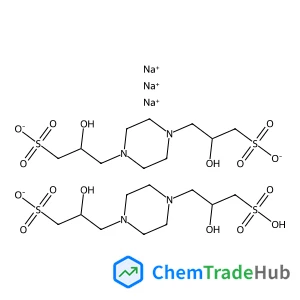
3,3'-(Piperazine-1,4-diyl)bis(2-hydroxypropane-1-sulfonic acid) Sodium Salt
CAS号:
108321-08-0
分子式:
C20H41N4Na3O16S4
![(1R,3S,5R)-2-{[(2-Methyl-2-propanyl)oxy]carbonyl}-2-azabicyclo[3.1.0]hexane-3-carboxylic acid structure](https://cnstatic.chemtradehub.com/structs/197/197142-34-0-6a44.webp "(1R,3S,5R)-2-{[(2-Methyl-2-propanyl)oxy]carbonyl}-2-azabicyclo[3.1.0]hexane-3-carboxylic acid structure")
推荐供应商





免责声明
本页面提供的学术期刊信息仅供参考和研究使用。我们与任何期刊出版商均无关联,也不处理投稿事宜。如有投稿相关咨询,请直接联系相关期刊出版商。
如发现页面信息有误,请发送邮件至 support@chemtradehub.com 联系我们。我们将及时核实并处理您的问题。