


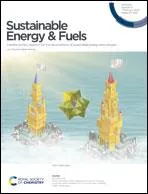
Solvent selection and Pt decoration towards enhanced photocatalytic CO2 reduction over CsPbBr3 perovskite single crystals
文献信息
发布日期
2020-02-10
DOI
10.1039/C9SE01218D
影响因子
6.367
作者
Yi-Xin Chen, Yang-Fan Xu, Xu-Dong Wang, Hong-Yan Chen, Dai-Bin Kuang
查看原文
摘要
The photocatalytic reduction of CO2 into chemical fuels is one of the most important artificial photosynthesis processes, which can simulate the natural photosynthesis in green plants, and it will be a crucial procedure in the carbon neutral economy. In the current study, we report that inorganic CsPbBr3 perovskite submicron single crystals can exhibit photocatalytic reduction of CO2 directly on their surface with high stability and selectivity in several nonaqueous solvents. The solvent effects have been well studied, which finally leads to an approximately 25-fold enhancement in the photocatalytic reaction rate by substituting toluene with ethyl acetate. The loading of a Pt co-catalyst via a photochemical deposition process further doubled the electron yield rate, which finally reached 5.6 μmol g−1 h−1, thereby implying that the optimization of the reaction media and surface catalytic activity are of key importance for the superior photocatalytic performance of halide perovskite materials.
期刊推荐
Journal of Asian Natural Products Research
Journal of Chemical Sciences
Electroanalysis
Critical Reviews in Solid State and Materials Sciences
Chinese Journal of Chemistry
Cellulose
Colloid Journal
Acta Metallurgica Sinica-English Letters
Biocatalysis and Biotransformation
Bioorganic & Medicinal Chemistry Letters
相关文献
Effective reinforcement of electrical conductivity and strength of carbon nanotube fibers by silver-paste-liquid infiltration processing
X. H. Zhong, R. Wang, Y. Y. Wen
2013-01-11
Paper
DOI: 10.1039/C3CP44085K
A new type of low-cost counter electrode catalyst based on platinum nanoparticles loaded onto silicon carbide (Pt/SiC) for dye-sensitized solar cells
Sining Yun, Liang Wang, Chunyu Zhao, Yanxiang Wang, Tingli Ma
2013-02-01
Communication
DOI: 10.1039/C3CP44048F
On the inclusion of alkanes into the monolayer of aliphatic alcohols at the water/alkane vapor interface: a quantum chemical approach
Yuri B. Vysotsky, Elena S. Fomina, Elena A. Belyaeva, Valentin B. Fainerman, Dieter Vollhardt
2012-11-30
Paper
DOI: 10.1039/C2CP43713A
Symmetrisation schemes for global optimisation of atomic clusters
Mark T. Oakley, Roy L. Johnston, David J. Wales
2013-01-14
Paper
DOI: 10.1039/C3CP44332A
Tunable photoluminescence from nc-Si/a-SiNx:H quantum dot thin films prepared by ICP-CVD
Basudeb Sain, Debajyoti Das
2013-01-17
Paper
DOI: 10.1039/C3CP43875A
The first atomistic modelling-aided reproduction of morphologically defective single walled carbon nanohorns
Sylwester Furmaniak, Artur P. Terzyk, Katsumi Kaneko, Piotr A. Gauden, Piotr Kowlaczyk, Tsutomu Itoh
2012-11-28
Paper
DOI: 10.1039/C2CP43371K
A red-emissive aminobenzopyrano-xanthene dye: elucidation of fluorescence emission mechanisms in solution and in the aggregate state
Shinichiro Kamino, Miho Murakami, Asana Tatsumi, Noriyuki Nagaoka, Yoshinao Shirasaki, Keiko Watanabe, Kengo Yoshida, Jun Horigome, Seiji Komeda
2012-12-05
Paper
DOI: 10.1039/C2CP43503A
您可能还喜欢
化合物问答
4-((4-甲基哌嗪-1-基)甲基)苯硼酸(CAS号:763120-62-3)的市场或研究趋势如何?
随着有机硼化学的发展,该化合物在催化、药物合成、材料科学等领域展现出潜在的应用价值。近年来,其在药物前体合成中的应用越来越受到关注。市场趋势显示,随着科研投入的...
763120-62-3{4-[(4-Methyl-1-pipe...
化合物问答
如何储存2,4,5-三甲基-1-硝基苯(CAS号:610-91-3)?
2,4,5-三甲基-1-硝基苯应储存在阴凉、干燥且通风良好的地方,避免阳光直射。储存在密封的金属容器中,远离火源和热源。储存温度应控制在25°C以下,湿度不宜过...
610-91-31,2,4-Trimethyl-5-ni...
化合物问答
处理2,5-二碘噻吩(CAS号:625-88-7)时应注意哪些实验室安全事项?
在处理2,5-二碘噻吩时,应穿戴适当的个人防护装备(PPE),包括实验室外套、手套和防护眼镜。在通风橱中进行操作以避免吸入蒸气。如果发生泄漏,应立即疏散人员并使...
625-88-72,5-Diiodothiophene
化合物问答
在合成中是否有6-bromo-3-chloro-1H-indole(CAS号:57916-08-2)的替代品?
在合成6-溴-3-氯-1H-吲哚(CAS号:57916-08-2)时,可以考虑使用一些类似的化合物作为替代品,如6-氯-3-氯-1H-吲哚或3-氯-1H-吲哚,...
57916-08-26-bromo-3-chloro-1H-...
化合物问答
在合成中是否有(R)-(-)-1-(1-萘基)乙基异氰酸酯(CAS号:42340-98-7)的替代品?
可以考虑使用类似结构的化合物,如1-[(1R)-1-(2-氨基乙基)萘-1-基]乙基异氰酸酯作为替代品。此外,还可以寻找其他类型的异氰酸酯衍生物,如苯基异氰酸酯...
42340-98-71-[(1R)-1-Isocyanato...
化合物问答
3-氨基苯甲酰苯胺(CAS号:14315-16-3)适用哪些法规指南?
3-氨基苯甲酰苯胺适用于多项法规指南,包括但不限于GHS(全球化学品统一分类和标签制度)分类为皮肤腐蚀/刺激类别2,以及潜在的皮肤过敏性类别1。在欧盟地区,它受...
14315-16-33-Amino-N-phenylbenz...
化合物问答
β-环柠檬醛-D5(CAS号:26309-95-5)通常如何合成?
β-环柠檬醛-D5可通过不对称合成方法获得。常见的合成路线包括以环己酮为原料,经过选择性氧化、还原、保护基引入等步骤,最终得到目标化合物。该合成过程中通常使用多...
26309-95-5[(2,2-Dimethylpropan...
34915-68-9Bunitrolol
化合物问答
如何处理含有BIO-1211(CAS号:187735-94-0)的废料?
对于含有BIO-1211(CAS号:187735-94-0)的废料,首先应进行分类收集,确保符合环保要求。然后,可以考虑通过焚烧或其他专业处理方法进行处置。在处...
187735-94-0BIO-1211
化合物问答
如何处理含有4-氯-2-氟-3-甲基苯酚(CAS号:1351668-24-0)的废料?
含有该化合物的废液应收集至专用容器中,避免与其他化学品混合。可采用焚烧或送交专业废弃物处理公司处理。处理过程中需遵守当地环保法规,确保不产生二次污染。处理前应进...
1351668-24-04-Chloro-2-fluoro-3-...
来源期刊
推荐化合物
![(1S,2R,4S)-1,7,7-Trimethylbicyclo[2.2.1]heptan-2-ol structure](https://cnstatic.chemtradehub.com/structs/464/464-45-9-f88b.webp "(1S,2R,4S)-1,7,7-Trimethylbicyclo[2.2.1]heptan-2-ol structure")
推荐供应商



免责声明
本页面提供的学术期刊信息仅供参考和研究使用。我们与任何期刊出版商均无关联,也不处理投稿事宜。如有投稿相关咨询,请直接联系相关期刊出版商。
如发现页面信息有误,请发送邮件至 support@chemtradehub.com 联系我们。我们将及时核实并处理您的问题。