



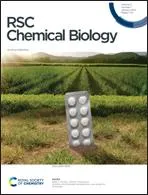

Site-specific modification and segmental isotope labelling of HMGN1 reveals long-range conformational perturbations caused by posttranslational modifications
文献信息
发布日期
2021-01-05
DOI
10.1039/D0CB00175A
影响因子
0
作者
Gerhard Niederacher, Debra Urwin, Yasmin Dijkwel, David J. Tremethick, K. Johan Rosengren, Christian F. W. Becker, Anne C. Conibear
查看原文
摘要
Interactions between histones, which package DNA in eukaryotes, and nuclear proteins such as the high mobility group nucleosome-binding protein HMGN1 are important for regulating access to DNA. HMGN1 is a highly charged and intrinsically disordered protein (IDP) that is modified at several sites by posttranslational modifications (PTMs) – acetylation, phosphorylation and ADP-ribosylation. These PTMs are thought to affect cellular localisation of HMGN1 and its ability to bind nucleosomes; however, little is known about how these PTMs regulate the structure and function of HMGN1 at a molecular level. Here, we combine the chemical biology tools of protein semi-synthesis and site-specific modification to generate a series of unique HMGN1 variants bearing precise PTMs at their N- or C-termini with segmental isotope labelling for NMR spectroscopy. With access to these precisely-defined variants, we show that PTMs in both the N- and C-termini cause changes in the chemical shifts and conformational populations in regions distant from the PTM sites; up to 50–60 residues upstream of the PTM site. The PTMs investigated had only minor effects on binding of HMGN1 to nucleosome core particles, suggesting that they have other regulatory roles. This study demonstrates the power of combining protein semi-synthesis for introduction of site-specific PTMs with segmental isotope labelling for structural biology, allowing us to understand the role of PTMs with atomic precision, from both structural and functional perspectives.
相关文献
Aleuritic (9,10,16-trihydroxypalmitic) acid self-assembly on mica
José Alejandro Heredia-Guerrero, Miguel Angel San-Miguel, Mark S. P. Sansom, Antonio Heredia, José Jesús Benítez
2010-07-06
Paper
DOI: 10.1039/C0CP00163E
Self-promotion mechanism for CO electrooxidation on gold
Paramaconi Rodriguez, Marc T. M. Koper
2010-06-24
Paper
DOI: 10.1039/B926365A
Tuning the surface potential of gold substrates arbitrarily with self-assembled monolayers with mixed functional groups
Wei-Chun Lin, Szu-Hsian Lee, Ying-Yu Chen, Yu-Chin Lin, Che-Hung Kuo
2009-05-13
Paper
DOI: 10.1039/B902044F
Theoretical investigation of germane and germylenedecomposition kinetics
Daniela Polino, Alessandro Barbato, Carlo Cavallotti
2010-07-07
Paper
DOI: 10.1039/C002221G
Anion clusters of naphthalene and solvents: structure, ion core, and intermolecular interactions
Sang Hak Lee, Jeong Hyun Kim, Inho Chu, Jae Kyu Song
2009-08-25
Paper
DOI: 10.1039/B903626A
A molecular dynamics simulation study of LiFePO4/electrolyte interfaces: structure and Li+ transport in carbonate and ionic liquid electrolytes
Grant D. Smith, Oleg Borodin, Salvy P. Russo, Robert J. Rees, Anthony F. Hollenkamp
2009-08-27
Paper
DOI: 10.1039/B912820D
Acceleration of the Z to Ephotoisomerization of penta-2,4-dieniminium by hydrogen out-of-plane motion: theoretical study on a model system of retinal protonated Schiff base
Masato Sumita, Mikhail N. Ryazantsev, Kazuya Saito
2009-06-09
Paper
DOI: 10.1039/B900882A
A new ZnO nanotetrapods/SnO2nanoparticles composite photoanode for high efficiency flexible dye-sensitized solar cells
Wei Chen, Yongcai Qiu, Shihe Yang
2010-07-06
Paper
DOI: 10.1039/C000584C
Vibrational relaxation of NO (v = 1–16) with NO, N2O, NO2, He and Ar studied by time-resolved Fourier transform infrared emission
Gus Hancock, Marc Morrison, Mark Saunders
2009-07-23
Paper
DOI: 10.1039/B909195E
您可能还喜欢
化合物问答
4-[[6-(3-苯基苯基)-7H-嘌呤-2-基]氨基]苯磺酰胺(CAS号:2079895-42-2)适用哪些法规指南?
该化合物需遵循REACH法规以确保其安全使用和管理。同时,根据其潜在的生物降解性和毒性,也需要符合GHS分类中的相应要求。此外,若用于医药或食品相关领域,则还需...
2079895-42-24-{[6-(3-Biphenylyl)...
化合物问答
反式-度骨化醇(CAS号:74007-20-8)的物理化学性质是什么?
反式-度骨化醇是一种脂溶性维生素D3的衍生物,呈无色或白色结晶性粉末,不溶于水,溶于乙醇、丙酮、氯仿等有机溶剂。其分子式为C28H44O,分子量为404.65。...
74007-20-8trans-Doxercalcifero...
化合物问答
莲花掌苷(CAS号:59282-56-3)的市场或研究趋势如何?
莲花掌苷作为一种天然产物,近年来在抗炎、抗癌等生物活性研究方面显示出一定的潜力,因此市场需求逐渐增长。市场动态方面,随着天然产物开发的深入,预计该化合物的研究会...
59282-56-3Lindleyin
化合物问答
2-溴-6-(吡咯烷-1-基)吡啶-4-硼酸频那醇酯(CAS号:1150271-64-9)应用于哪些行业?
2-溴-6-(吡咯烷-1-基)吡啶-4-硼酸频那醇酯在医药领域有着广泛的应用,它可以用作药物合成中的中间体。此外,它还可以用于有机合成,特别是在构建复杂杂环化合...
1150271-64-92-Bromo-6-(1-pyrroli...
化合物问答
什么是methyl 2-(4-bromophenyl)-3-methylbutanoate(CAS号:1061284-70-5)?
methyl 2-(4-溴苯基)-3-甲基丁酸甲酯是一种化学物质,分子式为C12H13BrO2。它是一种有机化合物,具有一定的挥发性和易燃性。
1061284-70-52-(4-Bromo-phenyl)-3...
化合物问答
CJC1-295(CAS号:863288-34-0)的物理化学性质是什么?
CJC1-295是一种具有复杂肽链结构的化合物,其分子量约为1875 Da。该化合物在水中具有一定的溶解性,但在有机溶剂中的溶解性不佳。它是一种反应活性化合物,...
863288-34-0L-tyrosyl-D-alanyl-L...
化合物问答
三正丁基锍碘(CAS号:18146-62-8)的市场或研究趋势如何?
三正丁基锍碘作为一种重要的有机硫化合物,主要用于有机合成中作为亲电试剂。近年来,由于其在合成中的广泛应用,市场对其需求持续增长。此外,随着绿色化学的发展,对其替...
18146-62-8Tributylsulfonium io...
化合物问答
雌二醇-[13C3]同位素内标(CAS号:1261254-48-1)通常如何合成?
雌二醇-[13C3]同位素内标通常通过在雌二醇分子中引入[13C3]同位素来合成。常见的方法是通过化学标记反应,如与[13C3]标记的甲基溴化物进行亲核取代反应...
1261254-48-117beta-Estradiol-2,3...
化合物问答
N1-(2-吡啶甲基)-N2-(2-甲基-1-萘基)草酰胺(CAS号:2611225-93-3)的物理化学性质是什么?
N1-(2-吡啶甲基)-N2-(2-甲基-1-萘基)草酰胺为固体化合物,具有良好的结晶形态,分子量为340.34 g/mol。该化合物在水中的溶解度较低,但在有...
2611225-93-3N-(2-Methyl-1-naphth...
化合物问答
如何处理含有十五碳烯酸甲酯(顺-10)(C15:1)标准品(CAS号:90176-52-6)的废料?
含有十五碳烯酸甲酯(顺-10)(C15:1)标准品的废料应首先进行适当收集和储存,避免与其他化学品混合。然后,可采用焚烧或交由专业废物处理公司进行处理。处理过程...
90176-52-6(Z)-10-Pentadecenoic...
来源期刊
推荐化合物

![1,2-Diphenyl-4-[2-(phenylsulfinyl)ethyl]-3,5-pyrazolidinedione structure](https://cnstatic.chemtradehub.com/structs/57-/57-96-5-efcc.webp "1,2-Diphenyl-4-[2-(phenylsulfinyl)ethyl]-3,5-pyrazolidinedione structure")
推荐供应商





免责声明
本页面提供的学术期刊信息仅供参考和研究使用。我们与任何期刊出版商均无关联,也不处理投稿事宜。如有投稿相关咨询,请直接联系相关期刊出版商。
如发现页面信息有误,请发送邮件至 support@chemtradehub.com 联系我们。我们将及时核实并处理您的问题。