


Does addition of 1-octanol as a phase modifier provide radical scavenging radioprotection for N,N,N′,N′-tetraoctyldiglycolamide (TODGA)?
文献信息
发布日期
2020-10-19
DOI
10.1039/D0CP04310A
影响因子
3.676
作者
Gregory P. Horne, Christopher A. Zarzana, Cathy Rae, Andrew R. Cook, Stephen P. Mezyk, Peter R. Zalupski, Andreas Wilden, Bruce J. Mincher
查看原文
摘要
To mitigate third phase formation in next generation used nuclear fuel reprocessing technologies, the addition of 1-octanol has been trialed. However, contradictory reports on the radiolytic effect of 1-octanol incorporation on separation ligand degradation need to be resolved. Here, 50 mM N,N,N′,N′-tetraoctyldiglycolamide (TODGA) dissolved in n-dodecane was gamma irradiated in the presence and absence of 1-octanol (2.5–10 vol%) and a 3.0 M HNO3 aqueous phase. Radiation-induced TODGA degradation exhibited pseudo-first-order decay kinetics as a function of absorbed gamma dose for all investigated solution and solvent system formulations. The addition of 1-octanol afforded diametrically different effects on the rate of TODGA degradation depending on solvent system formulation. For organic-only irradiations, 1-octanol promoted TODGA degradation (d = 0.0057 kGy−1 for zero 1-octanol present vs. ∼0.0073 kGy−1 for 7.5–10 vol%) attributed to a favourable hydrogen atom abstraction reaction free energy (−0.31 eV) and the ability of 1-octanol to access a higher yield of n-dodecane radical cation (RH˙+) at sub-nanosecond timescales. This was rationalized by determination of the rate coefficient (k) for the reaction of 1-octanol with RH˙+, k = (1.23 ± 0.07) × 1010 M−1 s−1. In contrast, irradiation in the presence of 1-octanol and a 3.0 M HNO3 aqueous phase afforded significant radioprotection (d = 0.0054 kGy−1 for zero 1-octanol present vs. ≤ 0.0044 kGy−1 for >2.5 vol%) that increases with 1-octanol concentration, relative to the single phase, organic-only solutions. This effect was attributed to the extraction of sufficiently high concentrations of HNO3 and H2O into the organic phase by TODGA and 1-octanol as adducts which interfere with the hydrogen atom abstraction process between the 1-octanol radical and TODGA. Our findings suggest that the addition of 1-octanol as a phase modifier will enhance the radiation robustness of TODGA-based separation technologies under envisioned solvent system conditions in the presence of aqueous HNO3.
期刊推荐
Journal of Chemical Sciences
Critical Reviews in Solid State and Materials Sciences

Colloid Journal
Biocatalysis and Biotransformation
Chinese Journal of Chemistry
NDT & E International
Acta Metallurgica Sinica-English Letters

Herald of the Russian Academy of Sciences

Polycyclic Aromatic Compounds
Topics in Catalysis
相关文献
Why Turing mechanism is an obstacle to stationary periodic patterns in bounded reaction-diffusion media with advection
Arik Yochelis, Moshe Sheintuch
2010-03-17
Communication
DOI: 10.1039/B921918H
Designing meso- and macropore architectures in hybrid organic–inorganic membranes by combining surfactant and breath figure templating (BFT)
Ozlem Sel, Christel Laberty-Robert, Thierry Azais, Clément Sanchez
2009-03-27
Paper
DOI: 10.1039/B821506E
Computer simulations of micelle fission
Juanjuan Gao, Shuangyang Li, Xianren Zhang, Wenchuan Wang
2010-02-11
Paper
DOI: 10.1039/B918449J
Surprisingly high, bulk liquid-like mobility of silica-confined ionic liquids
Ronald Göbel, Peter Hesemann, Jens Weber, Eléonore Möller, Alwin Friedrich, Sabine Beuermann
2009-03-17
Paper
DOI: 10.1039/B821833A
Ab initio study of the magnetic exchange coupling constants of a structural model [CaMn3IIIMnII] of the oxygen evolving center in photosystem II
Heike Fliegl, Karin Fink, Christopher E. Anson
2009-03-12
Paper
DOI: 10.1039/B819444K
Ligand-dependent blinking of zinc-blende CdSe/ZnS core/shell nanocrystals
Yongwook Kim, Hyunung Yu, Dae Won Moon, Sung Jun Lim, Wonjung Kim, Hye-Joo Yoon, Seung Koo Shin
2009-03-03
Paper
DOI: 10.1039/B822351C
The structure of oxotitanium phthalocyanine: a gas-phase electron diffraction and computational study
Alexander V. Zakharov, Sergei A. Shlykov, Yuriy A. Zhabanov, Georgy V. Girichev
2009-03-06
Paper
DOI: 10.1039/B820914F
您可能还喜欢
化合物问答
如何处理含有顺-二(2,2'-联吡啶)二氯化钌(II)二水合物(CAS号:67776-38-9)的废料?
处理含有该化合物的废料时,应先收集并分类,然后根据其危险特性选择合适的处理方法。推荐采用焚烧或由专业机构进行安全处理,以确保符合环保法规的要求。处理过程中应佩戴...
67776-38-93-{[(2R,3R,4S,5R,6R)...
化合物问答
4-amino-2-bromo-3-iodopyridine(CAS号:1300750-77-9)的市场或研究趋势如何?
4-氨基-2-溴-3-碘吡啶主要应用于药物合成和研究领域,尤其是在抗病毒和抗癌药物的研发中。随着新型药物的需求增加,该化合物的研究趋势较好。市场方面,由于其特殊...
1300750-77-92-bromo-3-iodopyridi...
化合物问答
4-乙酰基氨基-2-氨基-苯甲酸(CAS号:43134-76-5)的市场或研究趋势如何?
当前,4-乙酰基氨基-2-氨基-苯甲酸(CAS号:43134-76-5)在医药和化工领域有一定的应用。随着药物研发的进展,该化合物在新型药物设计中的应用可能增加...
43134-76-54-Acetamido-2-aminob...
化合物问答
庚a氟-1-(1-碘-1,2,2,2-四氟乙氧基)丙烷(CAS号:107432-46-2)的市场或研究趋势如何?
该化合物目前主要用于特定的工业应用,如氟聚合物的合成。市场趋势显示,由于其独特的结构和性能,未来可能在新型氟材料和特种化学品领域有更多的应用。研究趋势方面,主要...
107432-46-21,1,1,2,2,3,3-Heptaf...
化合物问答
在合成中是否有Propargyl-PEG13-bromide(CAS号:2055105-25-2)的替代品?
可以考虑使用1,3-丁二烯-1-炔-3-基-聚乙二醇-13-溴化物作为Propargyl-PEG13-bromide的替代品,因为两者在结构上相似,均可用于合成...
2055105-25-2Propargyl-peg13-brom...
化合物问答
2-氨基-6-甲氧基嘌呤(CAS号:20535-83-5)安全吗?
2-氨基-6-甲氧基嘌呤在正常使用条件下相对安全,但在操作时仍需注意防护措施,如佩戴手套和护目镜,避免吸入或接触皮肤和眼睛。
20535-83-56-Methoxy-7H-purin-2...
化合物问答
2-甲基-3-溴苯乙酸乙酯(CAS号:1261862-72-9)适用哪些法规指南?
该化合物根据其化学性质和潜在危害,可能适用于GHS(全球化学品统一分类和标签制度)的分类标准。具体分类需依据其毒性和燃烧危险性进行评估。此外,欧洲化学品管理局(...
1261862-72-9Ethyl (3-bromo-2-met...
化合物问答
4,4-二甲基吡咯烷-3-羧酸盐酸盐(CAS号:1351343-41-3)应用于哪些行业?
4,4-二甲基吡咯烷-3-羧酸盐酸盐在医药、聚合物和传感器领域有应用。在医药领域,它可以作为某些药物的中间体;在聚合物领域,它可用作某些聚合物的稳定剂;在传感器...
1351343-41-34,4-Dimethyl-3-pyrro...
化合物问答
处理5-Hydroxy-7-methoxy-2-(4-methoxyphenyl)-4-oxo-4H-chromen-6-yl 2-O-beta-D-xylopyranosyl-beta-D-glucopyranoside(CAS号:149998-39-0)时应注意哪些实验室安全事项?
处理该化合物时应注意使用个人防护装备(如手套、护目镜和实验服),在通风橱中操作。避免直接接触皮肤和吸入,泄漏时应立即清理并使用适当的吸收材料。参考安全数据表(S...
149998-39-05-Hydroxy-7-methoxy-...
化合物问答
7-甲基-1,2,3,4-四氢-吖啶-9-甲酸(CAS号:345621-27-4)的市场或研究趋势如何?
该化合物在医药研究中具有潜在应用价值,特别是在抗癌药物研发方面。随着研究的深入,对其合成方法的优化和生物活性的进一步探索将成为研究热点。
345621-27-47-Methyl-1,2,3,4-tet...
来源期刊
Physical Chemistry Chemical Physics

CiteScore:
5.5
自引率:
10.3%
年发文量:
3036
Physical Chemistry Chemical Physics (PCCP) is an international journal co-owned by 19 physical chemistry and physics societies from around the world. This journal publishes original, cutting-edge research in physical chemistry, chemical physics and biophysical chemistry. To be suitable for publication in PCCP, articles must include significant innovation and/or insight into physical chemistry; this is the most important criterion that reviewers and Editors will judge against when evaluating submissions. The journal has a broad scope and welcomes contributions spanning experiment, theory, computation and data science. Topical coverage includes spectroscopy, dynamics, kinetics, statistical mechanics, thermodynamics, electrochemistry, catalysis, surface science, quantum mechanics, quantum computing and machine learning. Interdisciplinary research areas such as polymers and soft matter, materials, nanoscience, energy, surfaces/interfaces, and biophysical chemistry are welcomed if they demonstrate significant innovation and/or insight into physical chemistry. Joined experimental/theoretical studies are particularly appreciated when complementary and based on up-to-date approaches.
推荐化合物
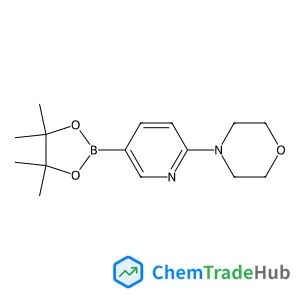
4-(5-(4,4,5,5-tetramethyl-1,3,2-dioxaborolan-2-yl)pyridin-2-yl)morpholine
CAS号:
485799-04-0
分子式:
C15H23BN2O3
推荐供应商




免责声明
本页面提供的学术期刊信息仅供参考和研究使用。我们与任何期刊出版商均无关联,也不处理投稿事宜。如有投稿相关咨询,请直接联系相关期刊出版商。
如发现页面信息有误,请发送邮件至 support@chemtradehub.com 联系我们。我们将及时核实并处理您的问题。