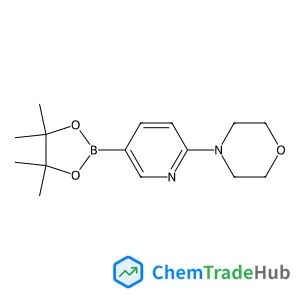
4-(5-(4,4,5,5-tetramethyl-1,3,2-dioxaborolan-2-yl)pyridin-2-yl)morpholine
CAS号:
485799-04-0
分子式:
C15H23BN2O3
Tong Yu, Jiani Ma, Shoutao Zhang
Two-dimensional Mo2C materials (1T and 2H phases) have emerged as promising electrocatalysts for the hydrogen evolution reaction (HER) due to their low cost, inherent metallicity, and high stability. Unfortunately, the catalytic activity of Mo2C is lower than that of Pt, and it needs to be substantially improved for practical applications. It is necessary and urgent to consider the effect of synergetic interactions among defects, functions, and strain on the HER activity. In this study, the geometric structures, electronic properties, and the HER activity of the Mo2C monolayer, with vacancy defects (i.e. Mo and C), oxygen functionalization, and strain, are studied by using first-principles calculations. According to our results, the combination of Mo vacancies, which can be obtained under C-rich conditions, and oxygen functionalization is the most effective way to improve the HER activity of 1T- and 2H-Mo2C. Considering the abundant active sites and optimal Gibbs free energy of hydrogen adsorption, the 1T phase we obtained shows excellent HER activity even at high H coverage and improves the utilization of active sites, for which the HER activity is comparable to that of Pt. This can be attributed to the fact that oxygen atoms gain more electrons from Mo2C, which weakens the strength of the O–H bond. Our work provides not only an opportunity to better understand the catalytic mechanism, but also a guide to achieving high HER activity of a Mo2C monolayer.
Heteroatom Chemistry

Biocatalysis and Biotransformation
Bioorganic & Medicinal Chemistry

NDT & E International
Herald of the Russian Academy of Sciences

Critical Reviews in Solid State and Materials Sciences
Acta Metallurgica Sinica-English Letters
Chinese Journal of Chemistry
Journal of Asian Natural Products Research
Main Group Chemistry
A. Chaudhuri, D. C. Jackson, T. J. Lerotholi, Robert G. Jones, T.-L. Lee, B. Detlefs, D. P. Woodruff
DOI: 10.1039/B921281G
Timothy J. Patey, Robert Büchel, Frank Krumeich, Jia-Zhao Wang, Hua-Kun Liu, Sotiris E. Pratsinis, Petr Novák
DOI: 10.1039/B821389P
Huan-Chang Tseng, Jiann-Shing Wu, Rong-Yeu Chang
DOI: 10.1039/B919672B
Arik Yochelis, Moshe Sheintuch
DOI: 10.1039/B921918H
Rajib Pramanik, Souravi Sarkar, Chiranjib Ghatak, Palash Setua, Nilmoni Sarkar
DOI: 10.1039/B922867E
Ilko Bald, Sigrid Weigelt, Xiaojing Ma, Pengyang Xie, Ramesh Subramani, Mingdong Dong, Chen Wang, Wael Mamdouh, Jianguo Wang, Flemming Besenbacher
DOI: 10.1039/B924098E
Alexander V. Zakharov, Sergei A. Shlykov, Yuriy A. Zhabanov, Georgy V. Girichev
DOI: 10.1039/B820914F
H. Takei, T. Yamaguchi
DOI: 10.1039/B924233N
Christoph T. Nottbohm, Sebastian Wiegmann, André Beyer, Armin Gölzhäuser
DOI: 10.1039/B923863H
处理含有该化合物的废料时,应先收集并分类,然后根据其危险特性选择合适的处理方法。推荐采用焚烧或由专业机构进行安全处理,以确保符合环保法规的要求。处理过程中应佩戴...
4-氨基-2-溴-3-碘吡啶主要应用于药物合成和研究领域,尤其是在抗病毒和抗癌药物的研发中。随着新型药物的需求增加,该化合物的研究趋势较好。市场方面,由于其特殊...
当前,4-乙酰基氨基-2-氨基-苯甲酸(CAS号:43134-76-5)在医药和化工领域有一定的应用。随着药物研发的进展,该化合物在新型药物设计中的应用可能增加...
该化合物目前主要用于特定的工业应用,如氟聚合物的合成。市场趋势显示,由于其独特的结构和性能,未来可能在新型氟材料和特种化学品领域有更多的应用。研究趋势方面,主要...
可以考虑使用1,3-丁二烯-1-炔-3-基-聚乙二醇-13-溴化物作为Propargyl-PEG13-bromide的替代品,因为两者在结构上相似,均可用于合成...
2-氨基-6-甲氧基嘌呤在正常使用条件下相对安全,但在操作时仍需注意防护措施,如佩戴手套和护目镜,避免吸入或接触皮肤和眼睛。
该化合物根据其化学性质和潜在危害,可能适用于GHS(全球化学品统一分类和标签制度)的分类标准。具体分类需依据其毒性和燃烧危险性进行评估。此外,欧洲化学品管理局(...
4,4-二甲基吡咯烷-3-羧酸盐酸盐在医药、聚合物和传感器领域有应用。在医药领域,它可以作为某些药物的中间体;在聚合物领域,它可用作某些聚合物的稳定剂;在传感器...
处理该化合物时应注意使用个人防护装备(如手套、护目镜和实验服),在通风橱中操作。避免直接接触皮肤和吸入,泄漏时应立即清理并使用适当的吸收材料。参考安全数据表(S...
该化合物在医药研究中具有潜在应用价值,特别是在抗癌药物研发方面。随着研究的深入,对其合成方法的优化和生物活性的进一步探索将成为研究热点。

Physical Chemistry Chemical Physics (PCCP) is an international journal co-owned by 19 physical chemistry and physics societies from around the world. This journal publishes original, cutting-edge research in physical chemistry, chemical physics and biophysical chemistry. To be suitable for publication in PCCP, articles must include significant innovation and/or insight into physical chemistry; this is the most important criterion that reviewers and Editors will judge against when evaluating submissions. The journal has a broad scope and welcomes contributions spanning experiment, theory, computation and data science. Topical coverage includes spectroscopy, dynamics, kinetics, statistical mechanics, thermodynamics, electrochemistry, catalysis, surface science, quantum mechanics, quantum computing and machine learning. Interdisciplinary research areas such as polymers and soft matter, materials, nanoscience, energy, surfaces/interfaces, and biophysical chemistry are welcomed if they demonstrate significant innovation and/or insight into physical chemistry. Joined experimental/theoretical studies are particularly appreciated when complementary and based on up-to-date approaches.