


Formulation and clinical translation of [177Lu]Lu-trastuzumab for radioimmunotheranostics of metastatic breast cancer
文献信息
发布日期
2020-11-14
DOI
10.1039/D0MD00319K
影响因子
0
作者
Mohini Guleria, Rohit Sharma, Jeyachitra Amirdhanayagam, Haladhar D. Sarma, Venkatesh Rangarajan
查看原文
摘要
Trastuzumab (Herceptin®) is an approved immunotherapeutic agent used for the treatment of metastatic breast cancer over-expressing HER2 antigen receptors. The aim of the present work is to standardize the formulation protocol of [177Lu]Lu-trastuzumab addressing various reaction parameters, evaluating the efficacy of the radiolabeled product by in vitro investigations, scaling-up the preparation for administration in patients and performing preliminary clinical studies in patients suffering from metastatic breast cancer. Trastuzumab was conjugated with a suitable bi-functional chelating agent namely, p-NCS-benzyl-DOTA. On average 6.15 ± 0.92 p-NCS-benzyl-DOTA molecules were observed to be attached to each trastuzumab moiety. [177Lu]Lu-trastuzumab could be prepared with >95% radiochemical purity (% RCP) employing the optimized radiolabeling procedure. In vitro studies revealed the affinity of [177Lu]Lu-trastuzumab towards HER2 +ve cancer cell lines as well as against HER2 protein (Kd = 13.61 nM and 11.36 nM, respectively). The value for percentage immunoreactive fraction (% IRF) for [177Lu]Lu-trastuzumab was observed to be 76.92 ± 2.80. Bio-distribution studies in Swiss mice revealed non-specific uptake in the blood, liver, lungs and heart followed by gradual clearance of activity predominantly through the hepatobiliary route. Preliminary clinical studies carried out in 8 cancer patients with immunohistochemically proven HER2 positive metastatic breast cancer revealed preferential localization of [177Lu]Lu-trastuzumab in breast cancer lesions, which was in concordance with [18F]FDG-PET scans recorded earlier in the same patient indicating the potential of the agent towards radioimmunotheranostic applications.
相关文献
Clarifying the impacts of surface hydroxyls on CO oxidation on CeO2(100) surfaces: a DFT+U study
Hui Zhou, Dong Wang, Xue-Qing Gong
2020-03-09
Paper
DOI: 10.1039/D0CP00204F
Common cancer mutations R175H and R273H drive the p53 DNA-binding domain towards aggregation-prone conformations
Le Li, Xuhua Li, Yiming Tang, Zenghui Lao, Jiangtao Lei, Guanghong Wei
2020-03-26
Paper
DOI: 10.1039/C9CP06671C
Incorporation of trivalent cations in NaX zeolite nanocrystals for the adsorption of O2 in the presence of CO2
Sarah Komaty, Ayoub Daouli, Michael Badawi, Clément Anfray, Moussa Zaarour, Samuel Valable, Svetlana Mintova
2020-04-14
Paper
DOI: 10.1039/D0CP00111B
Versatile surface-active ionic liquid: construction of microemulsions and their applications in light harvesting
Pratap Bahadur, Debes Ray, V. K. Aswal
2020-03-24
Paper
DOI: 10.1039/C9CP06842B
Orientation independent vibrational dynamics of lipid-bound interfacial water
Malte Deiseroth, Mischa Bonn
2020-04-02
Paper
DOI: 10.1039/D0CP01099E
Phosphorus-based metal-free Z-scheme 2D van der Waals heterostructures for visible-light photocatalytic water splitting: a first-principles study
Junyu Lang
2020-03-30
Paper
DOI: 10.1039/D0CP00637H
Prediction of aqueous free energies of solvation using coupled QM and MM explicit solvent simulations
J. Samuel Arey
2020-03-30
Paper
DOI: 10.1039/D0CP00582G
Identifying reaction pathways in phase space via asymptotic trajectories
Yutaka Nagahata, R. M. Benito, Rigoberto Hernandez
2020-03-25
Paper
DOI: 10.1039/C9CP06610A
Oxygen surface exchange kinetics of Ba0.5Sr0.5Co0.8Fe0.2O3−δ
V. A. Eremin, M. V. Ananyev, H. J. M. Bouwmeester, E. Kh. Kurumchin, Ch.-Y. Yoo
2020-04-29
Paper
DOI: 10.1039/C9CP06650K
您可能还喜欢
化合物问答
3 - (二氟甲基)-1 -氟苯(CAS号:26029-52-7)适用哪些法规指南?
3 - (二氟甲基)-1 -氟苯需遵循联合国全球化学品统一分类和标签制度(GHS),包括急性毒性、皮肤腐蚀/刺激、严重眼损伤/眼刺激等分类。同时,该化合物还需符...
26029-52-71-(Difluoromethyl)-3...
化合物问答
3,5-二甲基苯胺(CAS号:108-69-0)通常如何合成?
3,5-二甲基苯胺通常通过乙苯的氨解反应合成。反应中使用硫酸作为催化剂,反应温度为120-130°C。乙苯在硫酸存在下与氨反应,生成3,5-二甲基苯胺和苯胺副产...
108-69-03,5-Dimethylaniline
化合物问答
3-甲基异噻唑-5-胺(CAS号:24340-76-9)安全吗?
3-甲基异噻唑-5-胺在适当使用和储存条件下是相对安全的,但在操作时应注意防护措施。应避免吸入粉尘,避免与皮肤和眼睛直接接触。在操作过程中,应穿戴适当的防护装备...
24340-76-93-Methyl-1,2-thiazol...
化合物问答
3-(1,3-Thiazol-2-yl)-1H-indole(CAS号:135531-86-1)通常如何合成?
3-(1,3-噻唑-2-基)-1H-吲哚通常通过多步合成方法制备。首先,由噻唑-2-基溴化物和吲哚进行偶联反应,得到中间体。然后,通过还原反应将中间体转化为所需...
135531-86-13-(1,3-Thiazol-2-yl)...
化合物问答
4-溴-2-氟苯甲基氯(CAS号:85510-82-3)的主要用途是什么?
4-溴-2-氟苯甲基氯主要用于有机合成中间体,特别是在医药、农药和染料等领域。作为一种具有特定结构的化合物,它在合成复杂有机分子时扮演重要角色。
85510-82-34-Bromo-1-(chloromet...
化合物问答
处理Fmoc-β-(3-噻吩基)-D-Ala-OH(CAS号:220497-90-5)时应注意哪些实验室安全事项?
处理Fmoc-β-(3-噻吩基)-D-Ala-OH时,应佩戴防护手套、护目镜和实验服。操作应在通风橱内进行。如发生泄露,应立即用大量水冲洗,并通知实验室管理人员...
220497-90-5N-[(9H-Fluoren-9-ylm...
化合物问答
氮化硅(CAS号:12033-89-5)通常如何合成?
氮化硅通常通过氮化硅的直接反应合成,即在高温下将四氯化硅与氨气反应。具体步骤是将四氯化硅和氨气混合并加热至1300-1700℃,在该条件下,四氯化硅与氨气反应生...
12033-89-5Trisilicon tetranitr...
化合物问答
Cetirizine EP Impurity B DiHCl(CAS号:1000690-91-4)通常如何合成?
Cetirizine EP Impurity B DiHCl通常通过一锅法合成,首先将4-氯苯基-苯甲基氯甲酸酯与1-哌嗪乙酸反应,生成相应的酸,然后与盐酸反应...
1000690-91-4{4-[(4-Chlorophenyl)...
化合物问答
如何储存1-哌啶-4-基丁-1-酮(CAS号:3509-15-7)?
1-哌啶-4-基丁-1-酮应储存在阴凉、干燥的地方,避免阳光直射。存储容器应密封,并确保通风良好。建议储存温度不超过25℃,湿度保持在相对较低的水平。
3509-15-71-Piperidin-4-ylbuta...
化合物问答
如何处理含有VORUCICLIB(CAS号:1000023-04-0)的废料?
含有VORUCICLIB的废料应进行专业的收集和处理,包括使用适当的容器进行隔离,避免与其他化学品接触。处理方法通常包括化学中和、沉淀反应或吸附过程,随后进行焚...
1000023-04-02-[2-Chloro-4-(trifl...
来源期刊
推荐化合物
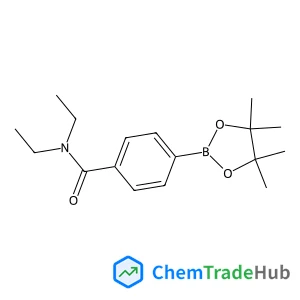
N,N-Diethyl-4-(4,4,5,5-tetramethyl-1,3,2-dioxaborolan-2-yl)benzamide
CAS号:
325142-99-2
分子式:
C17H26BNO3
推荐供应商





免责声明
本页面提供的学术期刊信息仅供参考和研究使用。我们与任何期刊出版商均无关联,也不处理投稿事宜。如有投稿相关咨询,请直接联系相关期刊出版商。
如发现页面信息有误,请发送邮件至 support@chemtradehub.com 联系我们。我们将及时核实并处理您的问题。