







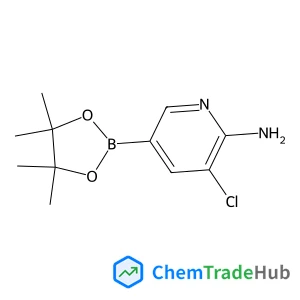
3-Chloro-5-(4,4,5,5-tetramethyl-1,3,2-dioxaborolan-2-yl)-2-pyridinamine
CAS号:
1032758-99-8
分子式:
C11H16BClN2O2
Alison Jones, Carys A. Davies, Samuel Fitch, Juma'a R. Al Dulayymi, James Gibbons, A. Prysor Williams, Mark S. Baird
Background: mycobacterial cells contain complex mixtures of mycolic acid esters. These can be used as antigens recognised by antibodies in the serum of individuals with active tuberculosis, caused by Mycobacterium tuberculosis. In high burden populations, a significant number of false positives are observed; possibly these antigens are also recognised by antibodies generated by other mycobacterial infections, particularly ubiquitous ‘environmental mycobacteria’. This suggests similar responses may be observed in a low burden TB population, particularly in groups regularly exposed to mycobacteria. Methods: ELISA using single synthetic trehalose mycolates corresponding to major classes in many mycobacteria was used to detect antibodies in serum of individuals with no known mycobacterial infection, comprising farmers, abattoir workers, and rural and urban populations. Results: serum from four Welsh or Scottish cohorts showed lower (with some antigens significantly lower) median responses than those reported for TB negatives from high-burden TB populations, and significantly lower responses than those with active TB. A small fraction, particularly older farmers, showed strong responses. A second study examined BCG vaccinated and non-vaccinated farmers and non-farmers. Farmers gave significantly higher median responses than non-farmers with three of five antigens, while there was no significant difference between vaccinated or non-vaccinated for either farmer or non-farmer groups. Conclusions: this initial study shows that serodiagnosis with mycobacterial lipid antigens can detect antibodies in a population sub-group that is significantly exposed to mycobacteria, in an assay that is not interfered with by vaccination. Given the links between mycobacterial exposure and a range of immune system diseases, further understanding such responses may provide a new opportunity for monitoring public health and directing treatment.
Xianming Cheng, Yane Zheng
DOI: 10.1039/C7CP08376A
I. Alcón
DOI: 10.1039/C7CP08076J
Morten Lund Rasmussen, Hamid Hashemi, Hao Wu, Peter Glarborg, Matteo Pelucchi, Tiziano Faravelli, Paul Marshall
DOI: 10.1039/C7CP07552A
Riley J. Hickman, Robert A. Lang, Tao Zeng
DOI: 10.1039/C8CP01394B
Mantas Šimėnas, Aneta Ciupa, Gediminas Usevičius, Kęstutis Aidas, Daniel Klose, Gunnar Jeschke, Mirosław Mączka, Georg Völkel, Andreas Pöppl, Jūras Banys
DOI: 10.1039/C8CP01426D
Dinesh Mishra, Vladislav Lobodin, Chengqi Zhang, Fadi Aldeek, Eric Lochner, Hedi Mattoussi
DOI: 10.1039/C7CP08682B
Jinshi Dong, Jun Wang, Jianqiang Wang, Guanghao Cheng, Tianming Huang
DOI: 10.1039/C8CP00111A
Yu Gao, Haichao Liu, Shitong Zhang, Qiang Gu, Yue Shen, Yunpeng Ge, Bing Yang
DOI: 10.1039/C8CP00834E
Mohammad A. Halim, Christian Clavier, Xavier Dagany, Michel Kerleroux, Philippe Dugourd, Robert C. Dunbar, Rodolphe Antoine
DOI: 10.1039/C8CP00404H
3 - (二氟甲基)-1 -氟苯需遵循联合国全球化学品统一分类和标签制度(GHS),包括急性毒性、皮肤腐蚀/刺激、严重眼损伤/眼刺激等分类。同时,该化合物还需符...
3,5-二甲基苯胺通常通过乙苯的氨解反应合成。反应中使用硫酸作为催化剂,反应温度为120-130°C。乙苯在硫酸存在下与氨反应,生成3,5-二甲基苯胺和苯胺副产...
3-甲基异噻唑-5-胺在适当使用和储存条件下是相对安全的,但在操作时应注意防护措施。应避免吸入粉尘,避免与皮肤和眼睛直接接触。在操作过程中,应穿戴适当的防护装备...
3-(1,3-噻唑-2-基)-1H-吲哚通常通过多步合成方法制备。首先,由噻唑-2-基溴化物和吲哚进行偶联反应,得到中间体。然后,通过还原反应将中间体转化为所需...
4-溴-2-氟苯甲基氯主要用于有机合成中间体,特别是在医药、农药和染料等领域。作为一种具有特定结构的化合物,它在合成复杂有机分子时扮演重要角色。
处理Fmoc-β-(3-噻吩基)-D-Ala-OH时,应佩戴防护手套、护目镜和实验服。操作应在通风橱内进行。如发生泄露,应立即用大量水冲洗,并通知实验室管理人员...
氮化硅通常通过氮化硅的直接反应合成,即在高温下将四氯化硅与氨气反应。具体步骤是将四氯化硅和氨气混合并加热至1300-1700℃,在该条件下,四氯化硅与氨气反应生...
Cetirizine EP Impurity B DiHCl通常通过一锅法合成,首先将4-氯苯基-苯甲基氯甲酸酯与1-哌嗪乙酸反应,生成相应的酸,然后与盐酸反应...
1-哌啶-4-基丁-1-酮应储存在阴凉、干燥的地方,避免阳光直射。存储容器应密封,并确保通风良好。建议储存温度不超过25℃,湿度保持在相对较低的水平。
含有VORUCICLIB的废料应进行专业的收集和处理,包括使用适当的容器进行隔离,避免与其他化学品接触。处理方法通常包括化学中和、沉淀反应或吸附过程,随后进行焚...
![Methyl 4-({[(2-methyl-2-propanyl)oxy]carbonyl}amino)bicyclo[2.2.2]octane-1-carboxylate structure](https://cnstatic.chemtradehub.com/structs/943/943845-74-7-b7e5.webp "Methyl 4-({[(2-methyl-2-propanyl)oxy]carbonyl}amino)bicyclo[2.2.2]octane-1-carboxylate structure")
![5-Methyl-4,5,6,7-tetrahydropyrazolo[1,5-a]pyrazin-2-amine structure](https://cnstatic.chemtradehub.com/structs/122/1227210-33-4-8d64.webp "5-Methyl-4,5,6,7-tetrahydropyrazolo[1,5-a]pyrazin-2-amine structure")
![2,6-Bis({(2R)-2-[hydroxy(diphenyl)methyl]-1-pyrrolidinyl}methyl)-4-methylphenol structure](https://cnstatic.chemtradehub.com/structs/877/877395-58-9-70bf.webp "2,6-Bis({(2R)-2-[hydroxy(diphenyl)methyl]-1-pyrrolidinyl}methyl)-4-methylphenol structure")




