






Tunable hydantoin and base binary organocatalysts in ring-opening polymerizations
文献信息
发布日期
2020-07-28
DOI
10.1039/D0PY00812E
影响因子
5.582
作者
Lei Zhang, Fangyuan Zhou, Zhenjiang Li, Bo Liu, Rui Yan, Jie Li, Yongzhu Hu, Chan Zhang, Zikun Luo, Kai Guo
查看原文
摘要
A (thio)hydantoin (HHyd) and organic superbase binary cocatalyst is illustrated as a tunable catalytic tool that enabled the efficient ring-opening polymerization (ROP) of various cyclic ester monomers. A series of designed HHyd molecules with diverse substitutions on the imidazolidine-2,4-dione ring at N1, N3, C5, and C2 allowed the fine tuning of the acidity, steric demand, and nucleophilicity of the (thio)hydantoinate cocatalyst. A partner organic superbase abstracted either the N1–H or N3–H proton of HHyd, leading to a conjugate acid acting as a H-bond donor in electrophilic activations. Commercial Brønsted organic bases, including tertiary amines, amidines, guanidines, and phosphazene, were evaluated for HHyd/base cocatalysis. The amidine DBU and guanidines TMG, TBD, and MTBD were screened as effective bases. Two minimal hydantoins, 1,5,5-trimethylimidazolidine-2,4-dione (HHyd2) and 3,5,5-trimethylimidazolidine-2,4-dione (HHyd3), partnered with DBU showed optimal performances, with near-quantitative conversions and narrow dispersities, in the ROPs of various cyclic ester monomers. HHyd2/DBU obviated the potential for epimerization and/or transesterification in the ROP of L-lactide (LLA). The controlled/living nature of the ROP of trimethylene carbonate (TMC) was validated. ROPs of TMC in solvents at room temperature and in bulk at 90 °C were successful: a short reaction time (6 h vs. 0.5 h), high conversion (92% vs. 97%), and narrow dispersity (1.13 vs. 1.12) were observed (solvent vs. bulk). Homopolymers and diblock copolymers of P(TMC-b-LLA) were prepared. The controlled/living nature of the ROPs was supported through kinetics and chain extension experiments, and MALDI-ToF-MS characterizations. A cooperative activation mechanism was proposed and validated using NMR titrations, in which the hydantoinate activated the chain end and the conjugate acid activated the monomer. The high relative cell viability (>90%) of poly(trimethylene carbonate) samples containing the cocatalyst HHyd2/DBU tested via MTT assays on HaCat cells confirmed the desirable biosafety and biocompatibility.
相关文献
Human-level blood cell counting on lens-free shadow images exploiting deep neural networks
DaeHan Ahn, JiYeong Lee, SangJun Moon, Taejoon Park
2018-10-03
Paper
DOI: 10.1039/C8AN01056K
An up-converting phosphor technology-based lateral flow assay for point-of-collection detection of morphine and methamphetamine in saliva
Qiushi Hu, Qiaozhen Wei, Pingping Zhang, Shuang Li, Lei Xue, Ruifu Yang, Lei Zhou
2018-08-01
Paper
DOI: 10.1039/C8AN00651B
Optimal voltage for nanoparticle detection with thin nanopores
2018-08-16
Paper
DOI: 10.1039/C8AN01270A
An efficient two-photon fluorescent probe for measuring γ-glutamyltranspeptidase activity during the oxidative stress process in tumor cells and tissues
Peng Wang, Jing Zhang, Hong-Wen Liu, Xiao-Xiao Hu, Xia Yin, Xiao-Bing Zhang
2017-04-12
Paper
DOI: 10.1039/C7AN00229G
Digital enzyme assay using attoliter droplet array
Takao Ono, Takanori Ichiki
2018-09-17
Paper
DOI: 10.1039/C8AN01152D
Efficient synthesis of riboflavin-imprinted magnetic nanoparticles by boronate affinity-based surface imprinting for the selective recognition of riboflavin
Daojin Li, Zijun Bie, Fangfang Wang, Enhui Guo
2018-09-06
Paper
DOI: 10.1039/C8AN01044G
Determination of the transfer function of an atmospheric pressure drift tube ion mobility spectrometer for nanoparticle measurements
David T. Buckley, Christopher J. Hogan, Jr.
2017-04-25
Paper
DOI: 10.1039/C7AN00328E
Simultaneous viscosity and density measurement of small volumes of liquids using a vibrating microcantilever
A. F. Payam, W. Trewby, K. Voïtchovsky
2017-03-20
Paper
DOI: 10.1039/C6AN02674E
Quantitative NMR of quadrupolar nucleus as a novel analytical method: hydrolysis behaviour analysis of aluminum ion
Genki Sakata, Minoru Mizuhata
2017-04-19
Paper
DOI: 10.1039/C7AN00067G
Interaction study of cancer cells and fibroblasts on a spatially confined oxygen gradient microfluidic chip to investigate the tumor microenvironment
Wei Sun, Yuqing Chen, Yuerong Wang, Pei Luo, Min Zhang, Hongyang Zhang, Ping Hu
2018-10-01
Paper
DOI: 10.1039/C8AN01216D
您可能还喜欢
化合物问答
(5-氨基吡唑-3-基)乙酸(CAS号:174891-10-2)的物理化学性质是什么?
(5-氨基吡唑-3-基)乙酸是一种无色至白色固体,分子量为174.15 g/mol。它在水中具有较好的溶解性,在有机溶剂中的溶解度较低。该化合物具有较好的反应活...
174891-10-2(3-Amino-1H-pyrazol-...
化合物问答
3-氟-4,5-二氯苯胺(CAS号:35754-38-2)适用哪些法规指南?
3-氟-4,5-二氯苯胺受到多项法规指南的约束,包括但不限于GHS(全球化学品统一分类和标签制度)的危险分类标准、欧盟的REACH法规(注册、评估、授权和限制)...
35754-38-23,4-Dichloro-5-fluor...
化合物问答
什么是(R)-(+)-2,2',6,6'-四甲氧基-4,4'-联(二(3,5-二甲苯基基)膦基)-3,3'-二联吡啶(CAS号:442905-33-1)?
这是一种有机化合物,化学名为(R)-(+)-2,2',6,6'-四甲氧基-4,4'-联(二(3,5-二甲苯基基)膦基)-3,3'-二联吡啶,CAS号为44290...
442905-33-14,4'-Bis[bis(3,5-dim...
化合物问答
1-氨基-2-氰基萘(CAS号:3100-67-2)应用于哪些行业?
1-氨基-2-氰基萘在医药、聚合物、传感器和半导体等行业中有应用。在医药领域,它可用作中间体合成某些药物。在聚合物行业,它可以用于制备具有特定性能的聚合物。此外...
3100-67-21-Amino-2-naphthonit...
化合物问答
如何处理含有1-溴-4-(异丙氧基甲基)苯(CAS号:98446-84-5)的废料?
处理含1-溴-4-(异丙氧基甲基)苯的废料时,首先应确保废液收集在防渗漏的容器中,避免泄露。然后,可以考虑采用化学降解法或物理吸附法进行处理。在特定条件下,可通...
98446-84-51-Bromo-4-(isopropox...
化合物问答
6-Chloro-8-(trifluoromethyl)chroman-4-one(CAS号:1344889-75-3)的主要用途是什么?
6-氯-8-三氟甲基-2,3-二氢-4H-色喃-4-酮主要用于有机合成中的中间体,也可作为研究试剂使用。
1344889-75-36-Chloro-8-(trifluor...
化合物问答
7-乙氧基-2-萘酚(CAS号:57944-44-2)通常如何合成?
7-乙氧基-2-萘酚通常通过N-乙氧基化反应合成,首先将2-萘酚与乙醇钠在乙醇中反应生成7-乙氧基-2-萘酚钠盐,再通过酸化进一步得到7-乙氧基-2-萘酚。该合...
57944-44-27-Ethoxy-2-naphthol
化合物问答
4-(1,1-二氧硫代吗啉)丁醇(CAS号:59801-41-1)适用哪些法规指南?
该化合物需遵循一系列的法规指南,包括但不限于GHS全球统一分类和标签制度,其分类可能包括易燃液体和可能危害水生环境。在欧洲,还需遵循REACH法规,确保物质和混...
59801-41-14-(4-Hydroxybutyl)th...
化合物问答
4-甲氧基苄基叠氮甲酸酯(CAS号:25474-85-5)的物理化学性质是什么?
4-甲氧基苄基叠氮甲酸酯是一种无色液体,具有一定的挥发性。其分子量为198.16,熔点为-69°C,沸点为105°C。该化合物在水中溶解度较低,在有机溶剂如乙醇...
25474-85-54-Methoxybenzyl carb...
化合物问答
如何处理含有4-氯-2-氟嘧啶(CAS号:51422-00-5)的废料?
含有4-氯-2-氟嘧啶的废料应按照危险废物处理。首先,应收集并分类这些废料,避免与其他废物混合。然后,可以采用焚烧处理或者交由专业机构进行处置。在处理过程中,需...
51422-00-54-Chloro-2-fluoropyr...
来源期刊
Polymer Chemistry

CiteScore:
8.6
自引率:
7.3%
年发文量:
457
Polymer Chemistry welcomes submissions in all areas of polymer science that have a strong focus on macromolecular chemistry. Manuscripts may cover a broad range of fields, yet no direct application focus is required.
推荐化合物
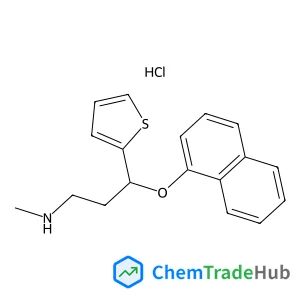
N-Methyl-3-(1-naphthyloxy)-3-(2-thienyl)-1-propanamine hydrochloride (1:1)
CAS号:
1188266-11-6
分子式:
C18H20ClNOS
推荐供应商





免责声明
本页面提供的学术期刊信息仅供参考和研究使用。我们与任何期刊出版商均无关联,也不处理投稿事宜。如有投稿相关咨询,请直接联系相关期刊出版商。
如发现页面信息有误,请发送邮件至 support@chemtradehub.com 联系我们。我们将及时核实并处理您的问题。