





Boosting or moderating surface-initiated Cu(0)-mediated controlled radical polymerization with external additives
文献信息
发布日期
2020-10-16
DOI
10.1039/D0PY01061H
影响因子
5.582
作者
Wei Li, Wenbo Sheng, Rainer Jordan, Tao Zhang
查看原文
摘要
Surface-initiated Cu(0)-mediated controlled radical polymerization (SI-CuCRP) has been proved to be a powerful method for the fabrication of polymer brushes with various architectures. A key factor in the SI-CuCRP process is the copper disproportionation/comproportionation equilibrium, yet little is known about how the equilibrium works in controlling polymer brush growth, especially under external additives. In this work, the regulation of such equilibrium in SI-CuCRP via external additives is reported in more detail. We find that the polymer brush growth rate can be enhanced via decreasing the ligand concentration or adding NaBr, while it can be reduced by adding ascorbic acid. In addition, the concentration of CuBr2 regulates the ratio of [CuI]/[CuII] to tune the polymer growth kinetics and grafting density over a wide range, which is independent of the distance between the copper plate and initiator-modified substrate. Besides, ultrafast polymerization (surface-initiated hydrogel formation) can be achieved when the ratio of [CuBr2] : [ligand] reaches 1 : 2. This work gives a deeper insight into the SI-CuCRP process and facilitates the fabrication of polymer brushes on demand.
期刊推荐
相关文献
Atmospheric chemistry of CF3CN: kinetics and products of reaction with OH radicals, Cl atoms and O3
Joanna Ohide, Theis I. Sølling, Ole John Nielsen
2022-01-07
Paper
DOI: 10.1039/D1CP05288H
Oxide-ion diffusion in brownmillerite-type Ca2AlMnO5+δ from first-principles calculations
Akihide Kuwabara, Craig A. J. Fisher, Hiroki Moriwake
2021-12-02
Paper
DOI: 10.1039/D1CP05174A
Excited-state dynamics of dipyrrolyldiketone difluoroboron complexes
Ryota Sato, Hajime Okajima, Shinya Sugiura, Yohei Haketa, Yusuke Kinoshita, Hitoshi Tamiaki, Akira Sakamoto, Hiromitsu Maeda, Yoichi Kobayashi
2021-12-20
Paper
DOI: 10.1039/D1CP04804J
31P nuclear spin singlet lifetimes in a system with switchable magnetic inequivalence: experiment and simulation
David E. Korenchan, Jiaqi Lu, Malcolm H. Levitt, Alexej Jerschow
2021-08-17
Paper
DOI: 10.1039/D1CP03085J
RPnet: a reverse-projection-based neural network for coarse-graining metastable conformational states for protein dynamics
Hanlin Gu, Wei Wang, Siqin Cao, Ilona Christy Unarta, Yuan Yao
2021-12-08
Paper
DOI: 10.1039/D1CP03622J
Experimental and theoretical studies on glucose conversion in ethanol solution to 5-ethoxymethylfurfural and ethyl levulinate catalyzed by a Brønsted acid
Shijie Wang, Yihang Chen, Yu Jia, Guizhuan Xu, Qianhui Guo, Hongge Tao, Caihong Zou, Kai Li
2021-08-31
Paper
DOI: 10.1039/D1CP02986J
Lithium and sodium intercalation in a 2D NbSe2 bilayer-stacked homostructure: comparative study of ionic adsorption and diffusion behavior
Darwin Barayang Putungan, Jer-Lai Kuo
2021-08-15
Paper
DOI: 10.1039/D1CP02290C
Spontaneous desorption of protein from self-assembled monolayer (SAM)-coated gold nanoparticles induced by high temperature
Xinwen Ou, Ming Yi, Jingyuan Li
2021-12-21
Paper
DOI: 10.1039/D1CP04000F
Testing quantum speedups in exciton transport through a photosynthetic complex using quantum stochastic walks
Naini Dudhe, Pratyush Kumar Sahoo, Colin Benjamin
2021-12-28
Paper
DOI: 10.1039/D1CP02727A
Modelling quenching mechanisms of disordered molecular systems in the presence of molecular aggregates
Giacomo Fanciullo, Irene Conti, Pascal Didier, Andrey Klymchenko, Jérémie Léonard, Marco Garavelli
2021-12-13
Paper
DOI: 10.1039/D1CP04260B
您可能还喜欢
化合物问答
2-(甲基磺酰基)嘧啶-5-胺(CAS号:56621-92-2)适用哪些法规指南?
该化合物适用的法规指南包括GHS(全球化学品统一分类和标签制度)分类为特定目标器官毒性-单次接触类别3;根据欧盟REACH法规,该化合物需要进行注册和评估;在美...
56621-92-22-(Methylsulfonyl)py...
化合物问答
在合成中是否有4-(4-氯苯基)-1H-咪唑(CAS号:35512-29-9)的替代品?
在合成中,可以考虑使用一些类似的化合物作为4-(4-氯苯基)-1H-咪唑的替代品,如4-(4-溴苯基)-1H-咪唑或4-(4-甲氧基苯基)-1H-咪唑。这些化合...
35512-29-94-(4-Chlorophenyl)-1...
化合物问答
什么是N~2~-甲基丙氨酸酰胺(CAS号:32012-16-1)?
N~2~-甲基丙氨酸酰胺是一种有机化合物,其化学名为2-(Methylamino)propanamide。它是一种酰胺类化合物,分子式为C4H10N2O,相对分...
32012-16-12-(Methylamino)propa...
化合物问答
如何处理含有N-苄基-3-氨基氧杂环丁烷草酸盐(CAS号:1956341-96-0)的废料?
处理含有N-苄基-3-氨基氧杂环丁烷草酸盐(CAS号:1956341-96-0)的废料时,应首先确保遵循相关法规要求,如GHS和REACH等。通常,废液应先进行...
1956341-96-0N-Benzyloxetan-3-ami...
化合物问答
4-bromo-2-chloro-6-methylbenzoic acid(CAS号:877149-07-0)的物理化学性质是什么?
4-溴-2-氯-6-甲基苯甲酸是一种固体化合物,具有较高的熔点和较低的沸点。它的分子量为261.03 g/mol。该化合物在水中几乎不溶,在有机溶剂中溶解度适中...
877149-07-04-Bromo-2-chloro-6-m...
化合物问答
2-[(2,5-二氯-4-嘧啶)氨基]-N-甲基苯甲酰胺(CAS号:761440-08-8)通常如何合成?
该化合物通常通过缩合反应合成,典型的方法是将2,5-二氯嘧啶与N-甲基苯甲酰胺在碱性条件下进行偶联反应。常用的碱包括NaH、LDA等强碱。该合成路线具有较高的选...
761440-08-82-[(2,5-dichloropyri...
4752-10-71,4-Dichlorophthalaz...
化合物问答
在合成中是否有3,5-二溴-4-甲基苯胺(CAS号:13194-73-5)的替代品?
3,5-二溴-4-甲基苯胺在某些合成路线中可能没有直接替代品。然而,在某些应用场景下,可以考虑使用其他类似结构的化合物如3,5-二溴-4-硝基苯胺或3,5-二碘...
13194-73-53,5-Dibromo-4-methyl...
化合物问答
2-氯喹啉-4-羧酸甲酯(CAS号:62482-26-2)的主要用途是什么?
2-氯喹啉-4-羧酸甲酯主要用于有机合成和药物合成领域,作为中间体或原料。它在合成某些药物和染料时具有重要作用。此外,该化合物还可能用于某些特定的化学研究中。
62482-26-2Methyl 2-chloro-4-qu...
化合物问答
i>]吡啶(CAS号:474708-88-8)安全吗?
6-溴-8-氯咪唑[1,2-a]吡啶在操作过程中需要谨慎以确保安全。该化合物具有一定的毒性,吸入其蒸气或粉尘可能导致呼吸道刺激。处理时应佩戴适当的防护装备,如手...
474708-88-86-Bromo-8-chloroimid...
来源期刊
Polymer Chemistry

CiteScore:
8.6
自引率:
7.3%
年发文量:
457
Polymer Chemistry welcomes submissions in all areas of polymer science that have a strong focus on macromolecular chemistry. Manuscripts may cover a broad range of fields, yet no direct application focus is required.
推荐化合物
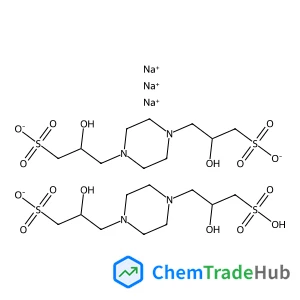
3,3'-(Piperazine-1,4-diyl)bis(2-hydroxypropane-1-sulfonic acid) Sodium Salt
CAS号:
108321-08-0
分子式:
C20H41N4Na3O16S4
推荐供应商





免责声明
本页面提供的学术期刊信息仅供参考和研究使用。我们与任何期刊出版商均无关联,也不处理投稿事宜。如有投稿相关咨询,请直接联系相关期刊出版商。
如发现页面信息有误,请发送邮件至 support@chemtradehub.com 联系我们。我们将及时核实并处理您的问题。