







![(1R,3S,5R)-2-{[(2-Methyl-2-propanyl)oxy]carbonyl}-2-azabicyclo[3.1.0]hexane-3-carboxylic acid structure](https://cnstatic.chemtradehub.com/structs/197/197142-34-0-6a44.webp "(1R,3S,5R)-2-{[(2-Methyl-2-propanyl)oxy]carbonyl}-2-azabicyclo[3.1.0]hexane-3-carboxylic acid structure")
8-Arylnaphthyl substituent retarding chain transfer in insertion polymerization with unsymmetrical α-diimine systems
文献信息
发布日期
2020-10-21
DOI
10.1039/D0PY01231A
影响因子
5.582
作者
Shuaikang Li, Shengyu Dai
查看原文
摘要
Late transition metal olefin polymerization catalysts based on the imine structure are usually constructed with bulky arylamines as the basic unit. In this contribution, a flexible compact alkyl amine and a series of rigid bulky anilines were introduced into the α-diimine catalytic system at the same time. Thus, a series of unsymmetrical α-diimine ligands bearing an n-butyl moiety and diarylmethyl or 8-arylnaphthyl moiety as well as the corresponding nickel and palladium complexes were designed, synthesized and characterized. These unsymmetrical α-diimine nickel and palladium complexes were investigated for ethylene polymerization and copolymerization with methyl acrylate (MA). Under the synergistic effect of compact alkyl substituents and bulky aryl substituents, the nickel complexes showed moderate to high activities and generated low to high molecular weight polyethylene with various branching densities. Similar polymerization results were also observed in the corresponding palladium system. The aryl orientation in rigid bulky aryl substituents has significant effects on the polymerizations and copolymerizations in terms of activity, the molecular weight of the obtained polyethylene and copolymer, and the incorporation ratio of MA.
相关文献
Phonon transport in Janus monolayer MoSSe: a first-principles study
2018-02-15
Paper
DOI: 10.1039/C8CP00350E
Ternary CBe4Au4 cluster: a 16-electron system with quasi-planar tetracoordinate carbon
Lin-Yan Feng, Hua-Jin Zhai
2018-02-13
Paper
DOI: 10.1039/C7CP08420J
All-atom molecular dynamics simulations of spin labelled double and single-strand DNA for EPR studies
C. Prior, L. Danilāne, V. S. Oganesyan
2018-04-16
Paper
DOI: 10.1039/C7CP08625C
Correction: Insights into the enhanced CeN triple bond in the HCeN molecule
Zhen Pu, Wenjie Yu, Soumendra K. Roy, Chaoyang Li, Bingyun Ao, Tianwei Liu, Maobing Shuai, Xuefeng Wang
2018-05-21
Correction
DOI: 10.1039/C8CP91766C
The structure–electrochemical property relationship of quinone electrodes for lithium-ion batteries
Licheng Miao, Luojia Liu, Zhenfeng Shang, Yixin Li, Yong Lu, Fangyi Cheng, Jun Chen
2018-04-17
Paper
DOI: 10.1039/C8CP00597D
Reverse electrodialysis in bilayer nanochannels: salinity gradient-driven power generation
Rui Long, Zhengfei Kuang, Zhichun Liu, Wei Liu
2018-02-19
Paper
DOI: 10.1039/C7CP08394G
Theoretical insights into the reactivity of Fe-based catalysts for water oxidation: the role of electron-withdrawing groups
Penglin Xu, Shaojin Hu, Hou-Dao Zhang, Xiao Zheng
2018-04-30
Paper
DOI: 10.1039/C8CP00687C
Intramolecular singlet fission in a face-to-face stacked tetracene trimer
Xuemin Wang, Rui Wang, Li Shen, Zhaofeng Tang, Congying Wen, Bin Dong, Heyuan Liu, Chunfeng Zhang, Xiyou Li
2018-02-02
Paper
DOI: 10.1039/C7CP07841B
您可能还喜欢
化合物问答
2-(甲基磺酰基)嘧啶-5-胺(CAS号:56621-92-2)适用哪些法规指南?
该化合物适用的法规指南包括GHS(全球化学品统一分类和标签制度)分类为特定目标器官毒性-单次接触类别3;根据欧盟REACH法规,该化合物需要进行注册和评估;在美...
56621-92-22-(Methylsulfonyl)py...
化合物问答
在合成中是否有4-(4-氯苯基)-1H-咪唑(CAS号:35512-29-9)的替代品?
在合成中,可以考虑使用一些类似的化合物作为4-(4-氯苯基)-1H-咪唑的替代品,如4-(4-溴苯基)-1H-咪唑或4-(4-甲氧基苯基)-1H-咪唑。这些化合...
35512-29-94-(4-Chlorophenyl)-1...
化合物问答
什么是N~2~-甲基丙氨酸酰胺(CAS号:32012-16-1)?
N~2~-甲基丙氨酸酰胺是一种有机化合物,其化学名为2-(Methylamino)propanamide。它是一种酰胺类化合物,分子式为C4H10N2O,相对分...
32012-16-12-(Methylamino)propa...
化合物问答
如何处理含有N-苄基-3-氨基氧杂环丁烷草酸盐(CAS号:1956341-96-0)的废料?
处理含有N-苄基-3-氨基氧杂环丁烷草酸盐(CAS号:1956341-96-0)的废料时,应首先确保遵循相关法规要求,如GHS和REACH等。通常,废液应先进行...
1956341-96-0N-Benzyloxetan-3-ami...
化合物问答
4-bromo-2-chloro-6-methylbenzoic acid(CAS号:877149-07-0)的物理化学性质是什么?
4-溴-2-氯-6-甲基苯甲酸是一种固体化合物,具有较高的熔点和较低的沸点。它的分子量为261.03 g/mol。该化合物在水中几乎不溶,在有机溶剂中溶解度适中...
877149-07-04-Bromo-2-chloro-6-m...
化合物问答
2-[(2,5-二氯-4-嘧啶)氨基]-N-甲基苯甲酰胺(CAS号:761440-08-8)通常如何合成?
该化合物通常通过缩合反应合成,典型的方法是将2,5-二氯嘧啶与N-甲基苯甲酰胺在碱性条件下进行偶联反应。常用的碱包括NaH、LDA等强碱。该合成路线具有较高的选...
761440-08-82-[(2,5-dichloropyri...
4752-10-71,4-Dichlorophthalaz...
化合物问答
在合成中是否有3,5-二溴-4-甲基苯胺(CAS号:13194-73-5)的替代品?
3,5-二溴-4-甲基苯胺在某些合成路线中可能没有直接替代品。然而,在某些应用场景下,可以考虑使用其他类似结构的化合物如3,5-二溴-4-硝基苯胺或3,5-二碘...
13194-73-53,5-Dibromo-4-methyl...
化合物问答
2-氯喹啉-4-羧酸甲酯(CAS号:62482-26-2)的主要用途是什么?
2-氯喹啉-4-羧酸甲酯主要用于有机合成和药物合成领域,作为中间体或原料。它在合成某些药物和染料时具有重要作用。此外,该化合物还可能用于某些特定的化学研究中。
62482-26-2Methyl 2-chloro-4-qu...
化合物问答
i>]吡啶(CAS号:474708-88-8)安全吗?
6-溴-8-氯咪唑[1,2-a]吡啶在操作过程中需要谨慎以确保安全。该化合物具有一定的毒性,吸入其蒸气或粉尘可能导致呼吸道刺激。处理时应佩戴适当的防护装备,如手...
474708-88-86-Bromo-8-chloroimid...
来源期刊
Polymer Chemistry

CiteScore:
8.6
自引率:
7.3%
年发文量:
457
Polymer Chemistry welcomes submissions in all areas of polymer science that have a strong focus on macromolecular chemistry. Manuscripts may cover a broad range of fields, yet no direct application focus is required.
推荐化合物
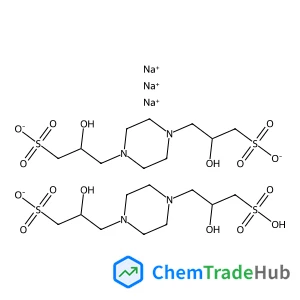
3,3'-(Piperazine-1,4-diyl)bis(2-hydroxypropane-1-sulfonic acid) Sodium Salt
CAS号:
108321-08-0
分子式:
C20H41N4Na3O16S4
推荐供应商





免责声明
本页面提供的学术期刊信息仅供参考和研究使用。我们与任何期刊出版商均无关联,也不处理投稿事宜。如有投稿相关咨询,请直接联系相关期刊出版商。
如发现页面信息有误,请发送邮件至 support@chemtradehub.com 联系我们。我们将及时核实并处理您的问题。