







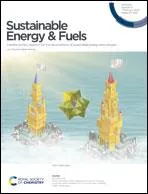
Organic functional materials: recent advances in all-inorganic perovskite solar cells
文献信息
发布日期
2020-03-20
DOI
10.1039/D0SE00214C
影响因子
6.367
作者
Bingbing Fan, Bing Zheng, Zhibing Yang, Penggang Yin, Lijun Huo
查看原文
摘要
Although the power conversion efficiency (PCE) of organic–inorganic hybrid perovskite solar cells (PSCs) is comparable to those of commercial solar cells, a challenging problem of instability hampers their further commercialization. In recent years, in comparison with organic–inorganic hybrid PSCs, cesium-based all-inorganic perovskites show better light, moisture and especially thermal stability, and therefore they have exhibited great potential and received widespread attention. However, an unavoidable issue is that the PCE of all-inorganic PSCs still lags behind that of hybrid perovskite devices. To solve this problem, some organic or inorganic interlayer materials are introduced into all-inorganic PSCs as additive, passivation agent and charge transport materials to improve device performance. Compared to inorganic materials, organic materials present some advantages, such as energy level controllability, molecular structure diversity, and surface wettability modifications. Thus, the PCE of all-inorganic PSCs has been significantly improved through the use of organic materials. In this review, we summarized the recent strategies for improving the performance of all-inorganic PSCs through organic interlayer materials, including crystallization control, defect passivation, interface engineering, and expanding the light harvesting capability. Finally, a perspective on challenges and opportunities is proposed in the field.
相关文献
Anchoring sites to the STM tip can explain multiple peaks in single molecule conductance histograms
S. Alexis Paz, Martin E. Zoloff Michoff, Christian F. A. Negre, Jimena A. Olmos-Asar, Marcelo M. Mariscal, Cristián G. Sánchez, Ezequiel P. M. Leiva
2012-11-22
Paper
DOI: 10.1039/C2CP43811A
Organic ultra-thin film transistors with a liquid gate for extracellular stimulation and recording of electric activity of stem cell-derived neuronal networks
Tobias Cramer, Beatrice Chelli, Mauro Murgia, Marianna Barbalinardo, Eva Bystrenova, Dago M. de Leeuw, Fabio Biscarini
2013-01-16
Paper
DOI: 10.1039/C3CP44251A
Influence of hydroxyl groups on the adsorption of HCHO on TiO2-B(100) surface by first-principles study
K. M. Liew, Chunxu Pan
2013-01-08
Paper
DOI: 10.1039/C3CP43549K
Effective reinforcement of electrical conductivity and strength of carbon nanotube fibers by silver-paste-liquid infiltration processing
X. H. Zhong, R. Wang, Y. Y. Wen
2013-01-11
Paper
DOI: 10.1039/C3CP44085K
Method/basis set dependence of NICS values among metallic nano-clusters and hydrocarbons
Zahra Badri, Cina Foroutan-Nejad, Parviz Rashidi-Ranjbar
2012-02-03
Paper
DOI: 10.1039/C2CP23205G
An advanced sodium-ion rechargeable battery based on a tin–carbon anode and a layered oxide framework cathode
Seung-Taek Myung, Min-Woo Jang, Jusef Hassoun
2013-01-22
Paper
DOI: 10.1039/C3CP00070B
The nature of phase separation in a Ru–Sn–O ternary oxide electrocatalyst
Xin Wang, Fenyong Deng, Zhongzhi Tang, Bo Wu
2013-01-16
Paper
DOI: 10.1039/C3CP44528C
A new type of low-cost counter electrode catalyst based on platinum nanoparticles loaded onto silicon carbide (Pt/SiC) for dye-sensitized solar cells
Sining Yun, Liang Wang, Chunyu Zhao, Yanxiang Wang, Tingli Ma
2013-02-01
Communication
DOI: 10.1039/C3CP44048F
Electron attachment to the dipeptide dialanine: influence of methylation on site selective dissociation reactions
Benjamin Puschnigg, Stefan E. Huber, Michael Probst, Katrin Tanzer, Violaine Vizcaino, Filipe Ferreira da Silva, Paul Scheier, Paulo Limão-Vieira, Stephan Denifl
2013-01-22
Paper
DOI: 10.1039/C3CP44230F
Dual reaction channels for photocatalytic oxidation of phenylmethanol on anatase
Ye-Fei Li, Zhi-Pan Liu
2012-11-22
Communication
DOI: 10.1039/C2CP44137C
您可能还喜欢
化合物问答
4-((4-甲基哌嗪-1-基)甲基)苯硼酸(CAS号:763120-62-3)的市场或研究趋势如何?
随着有机硼化学的发展,该化合物在催化、药物合成、材料科学等领域展现出潜在的应用价值。近年来,其在药物前体合成中的应用越来越受到关注。市场趋势显示,随着科研投入的...
763120-62-3{4-[(4-Methyl-1-pipe...
化合物问答
如何储存2,4,5-三甲基-1-硝基苯(CAS号:610-91-3)?
2,4,5-三甲基-1-硝基苯应储存在阴凉、干燥且通风良好的地方,避免阳光直射。储存在密封的金属容器中,远离火源和热源。储存温度应控制在25°C以下,湿度不宜过...
610-91-31,2,4-Trimethyl-5-ni...
化合物问答
处理2,5-二碘噻吩(CAS号:625-88-7)时应注意哪些实验室安全事项?
在处理2,5-二碘噻吩时,应穿戴适当的个人防护装备(PPE),包括实验室外套、手套和防护眼镜。在通风橱中进行操作以避免吸入蒸气。如果发生泄漏,应立即疏散人员并使...
625-88-72,5-Diiodothiophene
化合物问答
在合成中是否有6-bromo-3-chloro-1H-indole(CAS号:57916-08-2)的替代品?
在合成6-溴-3-氯-1H-吲哚(CAS号:57916-08-2)时,可以考虑使用一些类似的化合物作为替代品,如6-氯-3-氯-1H-吲哚或3-氯-1H-吲哚,...
57916-08-26-bromo-3-chloro-1H-...
化合物问答
在合成中是否有(R)-(-)-1-(1-萘基)乙基异氰酸酯(CAS号:42340-98-7)的替代品?
可以考虑使用类似结构的化合物,如1-[(1R)-1-(2-氨基乙基)萘-1-基]乙基异氰酸酯作为替代品。此外,还可以寻找其他类型的异氰酸酯衍生物,如苯基异氰酸酯...
42340-98-71-[(1R)-1-Isocyanato...
化合物问答
3-氨基苯甲酰苯胺(CAS号:14315-16-3)适用哪些法规指南?
3-氨基苯甲酰苯胺适用于多项法规指南,包括但不限于GHS(全球化学品统一分类和标签制度)分类为皮肤腐蚀/刺激类别2,以及潜在的皮肤过敏性类别1。在欧盟地区,它受...
14315-16-33-Amino-N-phenylbenz...
化合物问答
β-环柠檬醛-D5(CAS号:26309-95-5)通常如何合成?
β-环柠檬醛-D5可通过不对称合成方法获得。常见的合成路线包括以环己酮为原料,经过选择性氧化、还原、保护基引入等步骤,最终得到目标化合物。该合成过程中通常使用多...
26309-95-5[(2,2-Dimethylpropan...
34915-68-9Bunitrolol
化合物问答
如何处理含有BIO-1211(CAS号:187735-94-0)的废料?
对于含有BIO-1211(CAS号:187735-94-0)的废料,首先应进行分类收集,确保符合环保要求。然后,可以考虑通过焚烧或其他专业处理方法进行处置。在处...
187735-94-0BIO-1211
化合物问答
如何处理含有4-氯-2-氟-3-甲基苯酚(CAS号:1351668-24-0)的废料?
含有该化合物的废液应收集至专用容器中,避免与其他化学品混合。可采用焚烧或送交专业废弃物处理公司处理。处理过程中需遵守当地环保法规,确保不产生二次污染。处理前应进...
1351668-24-04-Chloro-2-fluoro-3-...
来源期刊
推荐化合物
![(2S)-{[(9H-Fluoren-9-ylmethoxy)carbonyl]amino}(phenyl)acetic acid structure](https://cnstatic.chemtradehub.com/structs/102/102410-65-1-4aa7.webp "(2S)-{[(9H-Fluoren-9-ylmethoxy)carbonyl]amino}(phenyl)acetic acid structure")
推荐供应商


免责声明
本页面提供的学术期刊信息仅供参考和研究使用。我们与任何期刊出版商均无关联,也不处理投稿事宜。如有投稿相关咨询,请直接联系相关期刊出版商。
如发现页面信息有误,请发送邮件至 support@chemtradehub.com 联系我们。我们将及时核实并处理您的问题。