







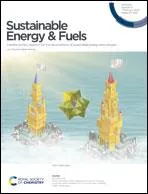
Anchoring Au nanoparticles on Bi ultrathin nanosheets for use as an efficient heterogeneous catalyst for ambient-condition electrochemical ammonia synthesis
文献信息
发布日期
2020-07-01
DOI
10.1039/D0SE00764A
影响因子
6.367
作者
You Xu, Tianlun Ren, Shanshan Yu, Kaili Ren, Mingzhen Wang, Ziqiang Wang, Xiaonian Li, Liang Wang, Hongjing Wang
查看原文
摘要
The electrochemical nitrogen reduction reaction (NRR) represents an emerging alternative for realizing ammonia (NH3) synthesis from earth-abundant N2 under ambient conditions. In this work, we describe the fabrication of a two-component heterogeneous composite composed of Au nanoparticles anchored on Bi nanosheets (denoted as Au/Bi NSs) and demonstrate their efficient performance for NRR electrocatalysis. The Au/Bi NSs are readily obtained by in situ electrochemical conversion of the pre-synthesized composite precursors composed of Au nanoparticles anchored on BiOCl nanoplates. Benefitting from the synergistic effect of Bi and Au components, the resultant Au/Bi NSs exhibit efficient NRR electrocatalytic activity in N2-saturated 0.1 M HCl solution, achieving a NH3 yield rate of 20.39 μg h−1 mgcat.−1 and a faradaic efficiency of 15.53% at −0.3 V (vs. the reversible hydrogen electrode). This research may motivate further study of electrocatalytic N2-to-NH3 conversion and open up new opportunities for the synthesis of other heterogeneous catalysts.
相关文献
The evaporation kinetics of pure water droplets at varying drying rates and the use of evaporation rates to infer the gas phase relative humidity
Yong-yang Su, Rachael E. H. Miles, Zhi-ming Li, Jonathan P. Reid, Jiang Xu
2018-08-31
Paper
DOI: 10.1039/C8CP05250F
Computational study of the carbonyl–ene reaction between formaldehyde and propylene encapsulated in coordinatively unsaturated metal–organic frameworks M3(btc)2 (M = Fe, Co, Ni, Cu and Zn)
Thana Maihom, Michael Probst, Jumras Limtrakul
2019-01-15
Paper
DOI: 10.1039/C8CP06841K
Hydrogen bond network structures of protonated short-chain alcohol clusters
Asuka Fujii, Natsuko Sugawara, Po-Jen Hsu, Takuto Shimamori, Ying-Cheng Li, Toru Hamashima, Jer-Lai Kuo
2018-03-05
Perspective
DOI: 10.1039/C7CP08072G
Influence of Cu adatoms on the molecular assembly of 4,4′-bipyridine on Cu(111)
M.-A. Dubois, O. Guillermet, S. Gauthier, G. Zhan, Y. Makoudi, F. Palmino, X. Bouju, A. Rochefort
2018-05-07
Paper
DOI: 10.1039/C8CP01184B
Stability of hydrolytic arsenic species in aqueous solutions: As3+vs. As5+
Giuseppe Cassone, Donatella Chillé, Claudia Foti, Ottavia Giuffré, Rosina Celeste Ponterio, Jiri Sponer, Franz Saija
2018-08-27
Paper
DOI: 10.1039/C8CP04320E
Quantitative structure–property relationship approach to predicting xylene separation with diverse exchanged faujasites
Y. Khabzina, C. Laroche, J. Pérez-Pellitero, D. Farrusseng
2018-08-28
Paper
DOI: 10.1039/C8CP04042G
The effect of hydration on the electronic structure and stability of the superalkali cation Li3+
Jia-Huan Hou, Di Wu, Jia-Yuan Liu, Si-Yi Li, Dan Yu, Ying Li
2018-05-02
Paper
DOI: 10.1039/C8CP00862K
Effect of oscillation dynamics on long-range electron transfer in a helical peptide monolayer
Daisuke Matsushita, Hirotaka Uji, Shunsaku Kimura
2018-05-23
Paper
DOI: 10.1039/C8CP02315H
Dissociative adsorption of a multifunctional compound on a semiconductor surface: a theoretical study of the adsorption of hydroxylamine on Ge(100)
Hyunkyung Park, Do Hwan Kim
2018-05-07
Paper
DOI: 10.1039/C8CP00246K
Percolation behaviors of ionic and electronic transfers in Li3−2xCoxN
E. Panabière, N. Emery, O. Dubrunfaut, J. P. Pereira-Ramos
2019-01-08
Paper
DOI: 10.1039/C8CP06770H
您可能还喜欢
化合物问答
什么是3-表南美楝属二醇(CAS号:19942-04-2)?
3-表南美楝属二醇是一种具有特定立体化学结构的化合物,其分子式为C31H52O2,属于甾醇类化合物。它具有光学活性,是一种复杂的有机分子,主要存在于一些植物中。
19942-04-2(3S,5R,8R,9R,10R,13R...
化合物问答
3-羧基-5-碘苯甲酸甲酯(CAS号:50765-22-5)应用于哪些行业?
3-羧基-5-碘苯甲酸甲酯主要应用于医药行业,作为合成某些药物中间体的重要原料。此外,它还可能用于聚合物的改性、传感器的制备以及半导体材料的制备等领域。
50765-22-5Methyl 3-hydroxy-5-i...
化合物问答
什么是3-Bromoindolin-2-one(CAS号:22942-87-6)?
3-Bromoindolin-2-one是一种含有溴代基团的吲哚酮衍生物,分子式为C9H7BrNO。它是一种无色固体,具有一定的挥发性,熔点为158-159°C...
22942-87-63-Bromoindolin-2-one
化合物问答
如何处理含有L-Lysyl-L-phenylalanyl-L-isoleucylglycyl-L-leucyl-L-methioninamide(CAS号:2990-43-4)的废料?
对于含有该化合物的废液,应先进行中和处理,然后根据其毒性和活性选择合适的处置方法。可以考虑焚烧处理或由专业的化学品废物处理公司进行无害化处理。处理过程中需注意环...
2990-43-4L-Lysyl-L-phenylalan...
化合物问答
ANGIOTENSIN 1/2 + A (2 - 8)(CAS号:51833-76-2)的物理化学性质是什么?
ANGIOTENSIN 1/2 + A (2 - 8)是一种蛋白质类化合物,具有典型的蛋白质性质。它的分子量约为5900 Da。该化合物在水中具有一定的溶解性,...
51833-76-2ANGIOTENSIN 1/2 + A ...
化合物问答
如何储存2-甲基硫代嘧啶-5-硼酸频那酯(CAS号:940284-18-4)?
应将该化合物存放在阴凉干燥、通风良好的地方,避免阳光直射。建议将化合物密封保存在避光的、干燥的容器中,远离火源和高温环境。
940284-18-42-(Methylthio)-5-(4,...
化合物问答
什么是苏丹红IV氘代物 标准品(CAS号:1014689-18-9)?
苏丹红IV氘代物 标准品是一种含有氘代标记的苏丹红IV化合物,是一种用于化合物分析、结构确证以及代谢研究的标准物质。
1014689-18-91-[(E)-{2-Methyl-4-[...
化合物问答
(+)-2-Amino-6-propionamido-d3-tetrahydrobenzothiazole(CAS号:1217680-69-7)适用哪些法规指南?
该化合物需要遵循《全球化学品统一分类和标签制度》(GHS)中的分类和标签要求,具体分类需依据其毒性和物理化学性质。此外,还需要符合《欧盟化学品注册、评估、授权和...
1217680-69-7(+)-2-Amino-6-propio...
化合物问答
如何储存2-氨基-2-(2-吡啶)乙酸乙酯(CAS号:55243-15-7)?
2-氨基-2-(2-吡啶)乙酸乙酯应储存于阴凉、干燥、通风良好的环境中,避免高温和光照。应使用密封容器储存,并远离易燃物、氧化剂和其他危险化学品。
55243-15-7Ethyl 2-amino-2-(pyr...
化合物问答
3-羟基-4-甲氧基吡啶-2-羧酸(CAS号:210300-09-7)的主要用途是什么?
3-羟基-4-甲氧基吡啶-2-羧酸主要用于合成其他有机化合物,如药物合成、农药合成和染料合成等。此外,它还可用作中间体和试剂,在化学研究领域也有一定的应用。
210300-09-73-Hydroxy-4-methoxy-...
来源期刊
推荐化合物
![2-Methyl-2-propanyl 4-oxo-3,9-diazabicyclo[4.2.1]nonane-9-carboxylate structure](https://cnstatic.chemtradehub.com/structs/131/1312456-05-5-9a15.webp "2-Methyl-2-propanyl 4-oxo-3,9-diazabicyclo[4.2.1]nonane-9-carboxylate structure")
2-Methyl-2-propanyl 4-oxo-3,9-diazabicyclo[4.2.1]nonane-9-carboxylate
CAS号:
1312456-05-5
分子式:
C12H20N2O3
![N-[2,6-Di(9-anthryl)-4-oxido-8,9,10,11,12,13,14,15-octahydrodinaphtho[2,1-d:1',2'-f][1,3,2]dioxaphosphepin-4-yl]-1,1,1-trifluoromethanesulfonamide structure](https://cnstatic.chemtradehub.com/structs/122/1227374-64-2-cdb5.webp "N-[2,6-Di(9-anthryl)-4-oxido-8,9,10,11,12,13,14,15-octahydrodinaphtho[2,1-d:1',2'-f][1,3,2]dioxaphosphepin-4-yl]-1,1,1-trifluoromethanesulfonamide structure")
推荐供应商



免责声明
本页面提供的学术期刊信息仅供参考和研究使用。我们与任何期刊出版商均无关联,也不处理投稿事宜。如有投稿相关咨询,请直接联系相关期刊出版商。
如发现页面信息有误,请发送邮件至 support@chemtradehub.com 联系我们。我们将及时核实并处理您的问题。