



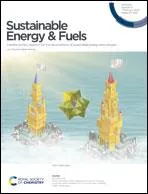
Perceiving the temperature coefficients of carbon-based perovskite solar cells
文献信息
发布日期
2020-10-19
DOI
10.1039/D0SE00782J
影响因子
6.367
作者
Shubhranshu Bhandari, Anurag Roy, Aritra Ghosh, Tapas Kumar Mallick, Senthilarasu Sundaram
查看原文
摘要
Perovskite solar cells (PSCs) have emerged in a “catfish effect” of other established photovoltaic technologies with the rapid development of high-power conversion efficiency (PCE) and low-cost fabrication. Among various kinds of PSCs, organic hole transport layer (HTL)-free carbon-based PSCs (c-PSCs) have been considered as the most promising devices due to their excellent stability. However, temperature becomes one of the crucial factors in determining the pace of PSC commercialization. Temperature stress at the interface between the perovskite film and the charge transport layer is an essential factor in determining the performance of c-PSCs. This work assesses the correlation between the temperature coefficient (TC) and different photovoltaic parameters for HTL-free c-PSCs. To evaluate different photovoltaic parameters of the c-PSC as a function of temperature, two different testing approaches namely under steady temperature (ST) and transient temperature (TT) conditions have been considered across a wide temperature window (5–75 °C) under 1 Sun 1.5 AM. Here TT testing involves subjecting a single c-PSC to a continuous temperature treatment, whereas ST testing consists of specific temperature treatment of an individual c-PSC. The maximum efficiency achieved at 25 °C for TT testing devices is ∼14.5%, which is ∼11% higher than that of ST testing devices (PCE ∼ 13%). Moreover, the efficiency temperature coefficient (ETC) for ST testing was found to be 3.5 × 10⁻² (5 °C ≤ T ≤ 25 °C) and −2.1 × 10⁻² (25 °C ≤ T ≤ 75 °C), whereas the ETC values of TT testing devices were +2.5 × 10⁻² (5 °C ≤ T ≤ 25 °C) and −1.8 × 10⁻² (25 °C ≤ T ≤ 75 °C), respectively. The outcome of temperature stress transmitting through different interfacial layers was further investigated by thermal imaging of TT devices. On the other hand, X-ray diffraction and scanning electron microscopy structural analyses were performed to understand the effect of thermal stress on the overall performance of ST devices. It has been observed that TC values obtained under TT testing conditions are reversible, whereas in the case of ST testing the TC values are irreversible which shows degradation of the device.
相关文献
A robust and versatile host–guest peptide toolbox for developing highly stable and specific quantum dot-based peptide probes for imaging extracellular matrices and cells
Bo Wang, Linge Nian, Sha Zhao, Jianxi Xiao
2023-12-19
Paper
DOI: 10.1039/D3TB02749J
Intestinal retentive systems – recent advances and emerging approaches
Durva A. Naik, Spencer Matonis, Gaurav Balakrishnan
2023-11-28
Perspective
DOI: 10.1039/D3TB01842C
One-pot three-component synthesis of α-methylated ketones from secondary and primary aryl alcohols
Shaikh Samser, Priyabrata Biswal, Omkar Mohapatra, Sanu Siyad Pullarat, Sushanta Kumar Meher, Krishnan Venkatasubbaiah
2023-12-05
Paper
DOI: 10.1039/D3NJ05498E
Evaluation of using the time-dependent density functional theory in studying the fluorescence properties of coumarin derivatives
Nguyen Khoa Hien, Mai Van Bay, Quan V. Vo, Ngo Duy Y., Duong Tuan Quang, Pham Cam Nam
2023-12-11
Paper
DOI: 10.1039/D3NJ05220F
A low-shrinkage-stress and anti-bacterial adherent dental resin composite: physicochemical properties and biocompatibility
Shengcan Zhang, Fang Liu, Jingwei He
2024-01-08
Paper
DOI: 10.1039/D3TB01556D
Effective antibacterial action of a 2D bimetallic Al/Fe-TCPP NMOF loaded with glucose oxidase by a cascade catalytic reaction and depleting glutathione simultaneously
Shenghua Liao, Yifan Yao, Jingyi Duan, Qikun Zhang, Juan Du, Shengmei Wu
2023-11-20
Paper
DOI: 10.1039/D3NJ04390H
Hydrothermal conversion of cerium oxalate to CeO2: a parade of oxalate and water coordination modes
Navid Assi, Christophe Lahoud, Petr Brázda, Dominika Zákutná, Daniel N. Rainer, Jakub Hraníček, Jan Rohlíček, Václav Tyrpekl
2023-12-11
Communication
DOI: 10.1039/D3NJ04635D
Porphyrin and doxorubicin mediated nanoarchitectonics of copper clusters: a bimodal theranostics for cancer diagnosis and treatment in vitro
Merin Joseph, Muhammed Shafeeque Rahman Pathiripparambath, Vinoy Thomas, Hanas Tharayil, Ramapurath S Jayasree
2023-12-24
Paper
DOI: 10.1039/D3TB02618C
Ruthenium/HI-catalyzed direct hydromethylation of indoles and quinolines in DME
Pengxiang Gao, Zheng Wang, Ruotong Chang, Wei Li, Ziwei Zhao, Dexin Fu, Qingbin Liu
2023-12-07
Paper
DOI: 10.1039/D3NJ03341D
Green and efficient preparation and application of weakly crystalline TiO2 with high catalytic activity
Ying Feng, YongChao Zhu, Tian Chen, Pengcheng Li, Bingjie Liu, Jianfeng Cai, Wenjie Liang, Hai Xu
2023-11-30
Communication
DOI: 10.1039/D3NJ05125K
您可能还喜欢
化合物问答
什么是5-Fluoro-4-iodo-2-methylaniline(CAS号:307306-08-7)?
5-氟-4-碘-2-甲氨基苯属于芳香族化合物,其分子式为C8H7FN2I。该化合物具有一定的反应活性,在有机合成和药物化学领域有一定的应用。
307306-08-75-Fluoro-4-iodo-2-me...
化合物问答
4-氟-3-硝基三氟甲苯(CAS号:367-86-2)通常如何合成?
4-氟-3-硝基三氟甲苯通常通过将三氟甲基苯在酸性条件下催化氧化为三氟甲基硝基苯,然后进行氟化反应得到目标化合物。该过程需要使用催化剂,如三氟乙酸,反应产率较高...
367-86-21-Fluoro-2-nitro-4-(...
化合物问答
6-氯-9-(2,3,5-三苯甲酰氧基-2-C-甲基-beta-D-呋喃核糖基)-9H-嘌呤(CAS号:205171-05-7)的物理化学性质是什么?
该化合物为白色至类白色晶体,分子量约为1046.95。它在水中几乎不溶,在有机溶剂如乙腈和甲醇中具有一定的溶解性。该化合物具有良好的化学稳定性和生物活性。
205171-05-76-Chloro-9-(2-C-meth...
化合物问答
如何储存6-氟喹啉-4-羧酸(CAS号:220844-73-5)?
6-氟喹啉-4-羧酸应储存在阴凉、干燥、通风良好的地方,避免阳光直射。储存在密闭容器中,避免与空气中的水分接触。储存温度应控制在室温以下,避免高温。
220844-73-56-Fluoroquinoline-4-...
化合物问答
(2S,2'S,3S,3'S)-3,3'-di-tert-butyl-4,4'-bis(2,6-dimethoxyphenyl)-2,2',3,3'-tetrahydro-2,2'-bibenzo[d][1,3]oxaphosphole(CAS号:1435940-21-8)通常如何合成?
该化合物通常通过芳香族化合物的亲核取代反应合成,首先将2,6-二甲氧基苯基引入到双环结构中,然后通过特定条件下的还原或氧化反应引入二叔丁基。反应过程中使用了钯作...
1435940-21-8(2S,2'S,3S,3'S)-4,4'...
化合物问答
如何储存KY02111(CAS号:1118807-13-8)?
KY02111应储存于阴凉、干燥、通风良好的地方,避免阳光直射和高温环境。应使用合适的密闭容器储存,并确保容器密封良好,防止水分和潮气进入。在储存期间,应注意检...
1118807-13-8N-(6-chlorobenzo[d]t...
化合物问答
如何储存4-(4-氯苯氧基)丁酸乙酯(CAS号:59227-79-1)?
4-(4-氯苯氧基)丁酸乙酯应储存在阴凉、干燥、通风良好的地方,远离火源和热源。避免阳光直射,防止容器破裂导致泄漏。储存时应保持容器密封,避免与空气中的水蒸气接...
59227-79-1Ethyl 4-(4-chlorophe...
化合物问答
4-庚基苯乙酮(CAS号:37593-03-6)安全吗?
4-庚基苯乙酮相对安全,但在使用和储存时仍需注意。应避免吸入其蒸气,避免皮肤接触,使用时需佩戴防护眼镜和手套。储存时应远离火源和热源,保持容器密封,放置于阴凉、...
37593-03-61-(4-Heptylphenyl)et...
化合物问答
什么是乙基2-氨基-4-(3-溴苯基)噻吩-3-羧酸乙酯(CAS号:438218-48-5)?
乙基2-氨基-4-(3-溴苯基)噻吩-3-羧酸乙酯是一种有机化合物,分子式为C16H12BrN2O2S。它是一种含有噻吩环、氨基、溴苯基和羧酸酯结构的化合物。这...
438218-48-5ethyl 2-amino-4-(3-b...
化合物问答
什么是(9ci)-2-氨基-6-甲基-苯甲酰胺(CAS号:1885-31-0)?
(9ci)-2-氨基-6-甲基-苯甲酰胺是一种化学化合物,其英文名称为2-Amino-6-methylbenzamide,CAS号为1885-31-0。该化合物...
1885-31-02-Amino-6-methylbenz...
来源期刊
推荐化合物

![2-{[4-(2-Methoxyethyl)phenoxy]methyl}oxirane structure](https://cnstatic.chemtradehub.com/structs/567/56718-70-8-f037.webp "2-{[4-(2-Methoxyethyl)phenoxy]methyl}oxirane structure")
推荐供应商



免责声明
本页面提供的学术期刊信息仅供参考和研究使用。我们与任何期刊出版商均无关联,也不处理投稿事宜。如有投稿相关咨询,请直接联系相关期刊出版商。
如发现页面信息有误,请发送邮件至 support@chemtradehub.com 联系我们。我们将及时核实并处理您的问题。