



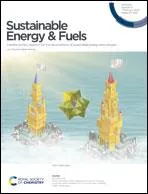
The use of supercritical water for the catalyst-free oxidation of coarse aluminum for hydrogen production
文献信息
发布日期
2020-08-27
DOI
10.1039/D0SE00996B
影响因子
6.367
作者
Keena A. Trowell, Sam Goroshin, David L. Frost, Jeffrey M. Bergthorson
查看原文
摘要
Maximizing the use of renewable resources requires clean, sustainable and recyclable energy carriers for energy trade and long-term storage. Aluminum is energy dense, plentiful, and recyclable and, when reacted with water, the stored energy is released as hydrogen and heat. In this study, we investigated the use of high-temperature liquid water and supercritical water as oxidizers for coarse aluminum. We performed experiments using a variety of aluminum morphologies, including coarse aluminum pieces measuring up to 3 mm in diameter, and water ranging in temperature from 475 K to 650 K (and the corresponding saturated vapour pressures). Previous studies of aluminum–water reactions have focused on low temperature experiments using catalysts, specialized alloys, or nano-powders to increase reaction efficiency. These low-temperature approaches have been shown to be effective but add complexity and expense and waste the thermal energy of the reaction. Our results show that, without special measures, 100% hydrogen yield is possible from coarse aluminum particles and scrap aluminum, when the reaction temperature and pressure are increased. A change in reaction efficiency was observed at 550 K. Up to this temperature, the 55 μm and 120 μm powders had yields below 30%, the aluminum slugs and 2 mm plate had yields close to zero. At temperatures between 550 K and the supercritical temperature, there was a marked increase in hydrogen yield. At temperatures above 647 K and pressures above 220 bar, the critical point of water, 100% of the theoretical hydrogen yield was achieved across all samples tested. These findings open the door to using aluminum as a recyclable energy carrier for renewable energy.
相关文献
Methylene blue loaded K0.3Bi0.7F2.4:Yb,Er upconversion nanoparticles for near-infrared activated photodynamic therapy
Manisha Bungla, Priyanka Sharma, Asifkhan Shanavas
2023-12-27
Paper
DOI: 10.1039/D3NJ04869A
Integrated metabolomics revealed the photothermal therapy of melanoma by Mo2C nanosheets: toward rehabilitated homeostasis in metabolome combined lipidome
Ming Wang, Ge Liang, Wen Zheng, Luolan Gui, Xin Li, Lu Zhang, Wenjuan Zeng, Yin Yang, Yu Zeng, Zhe Huang, Junwen Guan, Tao Li, Ligang Chen, Jie Zhou
2023-12-04
Paper
DOI: 10.1039/D3TB02123H
Hydrothermal conversion of cerium oxalate to CeO2: a parade of oxalate and water coordination modes
Navid Assi, Christophe Lahoud, Petr Brázda, Dominika Zákutná, Daniel N. Rainer, Jakub Hraníček, Jan Rohlíček, Václav Tyrpekl
2023-12-11
Communication
DOI: 10.1039/D3NJ04635D
Ruthenium/HI-catalyzed direct hydromethylation of indoles and quinolines in DME
Pengxiang Gao, Zheng Wang, Ruotong Chang, Wei Li, Ziwei Zhao, Dexin Fu, Qingbin Liu
2023-12-07
Paper
DOI: 10.1039/D3NJ03341D
Porphyrin and doxorubicin mediated nanoarchitectonics of copper clusters: a bimodal theranostics for cancer diagnosis and treatment in vitro
Merin Joseph, Muhammed Shafeeque Rahman Pathiripparambath, Vinoy Thomas, Hanas Tharayil, Ramapurath S Jayasree
2023-12-24
Paper
DOI: 10.1039/D3TB02618C
Thiol ligand-mediated exfoliation of bulk sulfur to nanosheets and nanodots: applications in antibacterial activity
Avijit Mondal, Rashi Salampuriya, Aditya Umesh, Mrinmoy De
2023-12-21
Paper
DOI: 10.1039/D3TB02403B
Porous MnO nanoplate–graphene hybrid as a high-capacity anode material for lithium ion batteries and its safety characteristics
Xiang-Ning Song, Qian Ma, Yuan Yuan, Ke-Feng Wan, Hong-Zhe Zhang, Lang Huang
2023-12-22
Paper
DOI: 10.1039/D3NJ04986H
Localized surface plasmon resonance assisted photoredox catalysis using newly fabricated copper-nanorods: a decarboxylative approach towards carbon–hydrogen bond formation under visible light
Saikat Khamarui, Sirshendu Ghosh
2023-11-28
Communication
DOI: 10.1039/D3NJ04195F
Multifaceted properties of an engineered three-dimensional Zn(ii)–metal–organic coordination polymer: synthesis, crystal structure, efficient photocatalytic degradation of an organic dye and selective luminescent sensing
Rais Ahmad Khan, Amal AlFawaz, Imran Hasan, Nouf A. AlMuryyi, Afnan A. Alhamed, Sameen Laeeq, Sandeep Dey, Anup Paul, Ali Alsalme
2023-12-20
Paper
DOI: 10.1039/D3NJ04709A
Hierarchical chirality transfer of perylene diimide-tethered pillar[5]arenes for configuration and type differentiation of amino acid derivatives
Ting Zhao, Jigao Yi, Chunhong Liu, Lizhi Fang, Long Chen, Yanlin Shen, Xiaotong Liang, Kun Li, Wanhua Wu, Cheng Yang
2023-12-26
Paper
DOI: 10.1039/D3NJ05420A
您可能还喜欢
化合物问答
什么是5-Fluoro-4-iodo-2-methylaniline(CAS号:307306-08-7)?
5-氟-4-碘-2-甲氨基苯属于芳香族化合物,其分子式为C8H7FN2I。该化合物具有一定的反应活性,在有机合成和药物化学领域有一定的应用。
307306-08-75-Fluoro-4-iodo-2-me...
化合物问答
4-氟-3-硝基三氟甲苯(CAS号:367-86-2)通常如何合成?
4-氟-3-硝基三氟甲苯通常通过将三氟甲基苯在酸性条件下催化氧化为三氟甲基硝基苯,然后进行氟化反应得到目标化合物。该过程需要使用催化剂,如三氟乙酸,反应产率较高...
367-86-21-Fluoro-2-nitro-4-(...
化合物问答
6-氯-9-(2,3,5-三苯甲酰氧基-2-C-甲基-beta-D-呋喃核糖基)-9H-嘌呤(CAS号:205171-05-7)的物理化学性质是什么?
该化合物为白色至类白色晶体,分子量约为1046.95。它在水中几乎不溶,在有机溶剂如乙腈和甲醇中具有一定的溶解性。该化合物具有良好的化学稳定性和生物活性。
205171-05-76-Chloro-9-(2-C-meth...
化合物问答
如何储存6-氟喹啉-4-羧酸(CAS号:220844-73-5)?
6-氟喹啉-4-羧酸应储存在阴凉、干燥、通风良好的地方,避免阳光直射。储存在密闭容器中,避免与空气中的水分接触。储存温度应控制在室温以下,避免高温。
220844-73-56-Fluoroquinoline-4-...
化合物问答
(2S,2'S,3S,3'S)-3,3'-di-tert-butyl-4,4'-bis(2,6-dimethoxyphenyl)-2,2',3,3'-tetrahydro-2,2'-bibenzo[d][1,3]oxaphosphole(CAS号:1435940-21-8)通常如何合成?
该化合物通常通过芳香族化合物的亲核取代反应合成,首先将2,6-二甲氧基苯基引入到双环结构中,然后通过特定条件下的还原或氧化反应引入二叔丁基。反应过程中使用了钯作...
1435940-21-8(2S,2'S,3S,3'S)-4,4'...
化合物问答
如何储存KY02111(CAS号:1118807-13-8)?
KY02111应储存于阴凉、干燥、通风良好的地方,避免阳光直射和高温环境。应使用合适的密闭容器储存,并确保容器密封良好,防止水分和潮气进入。在储存期间,应注意检...
1118807-13-8N-(6-chlorobenzo[d]t...
化合物问答
如何储存4-(4-氯苯氧基)丁酸乙酯(CAS号:59227-79-1)?
4-(4-氯苯氧基)丁酸乙酯应储存在阴凉、干燥、通风良好的地方,远离火源和热源。避免阳光直射,防止容器破裂导致泄漏。储存时应保持容器密封,避免与空气中的水蒸气接...
59227-79-1Ethyl 4-(4-chlorophe...
化合物问答
4-庚基苯乙酮(CAS号:37593-03-6)安全吗?
4-庚基苯乙酮相对安全,但在使用和储存时仍需注意。应避免吸入其蒸气,避免皮肤接触,使用时需佩戴防护眼镜和手套。储存时应远离火源和热源,保持容器密封,放置于阴凉、...
37593-03-61-(4-Heptylphenyl)et...
化合物问答
什么是乙基2-氨基-4-(3-溴苯基)噻吩-3-羧酸乙酯(CAS号:438218-48-5)?
乙基2-氨基-4-(3-溴苯基)噻吩-3-羧酸乙酯是一种有机化合物,分子式为C16H12BrN2O2S。它是一种含有噻吩环、氨基、溴苯基和羧酸酯结构的化合物。这...
438218-48-5ethyl 2-amino-4-(3-b...
化合物问答
什么是(9ci)-2-氨基-6-甲基-苯甲酰胺(CAS号:1885-31-0)?
(9ci)-2-氨基-6-甲基-苯甲酰胺是一种化学化合物,其英文名称为2-Amino-6-methylbenzamide,CAS号为1885-31-0。该化合物...
1885-31-02-Amino-6-methylbenz...
来源期刊
推荐化合物
推荐供应商




免责声明
本页面提供的学术期刊信息仅供参考和研究使用。我们与任何期刊出版商均无关联,也不处理投稿事宜。如有投稿相关咨询,请直接联系相关期刊出版商。
如发现页面信息有误,请发送邮件至 support@chemtradehub.com 联系我们。我们将及时核实并处理您的问题。