



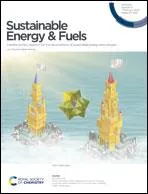
Safe Li-ion batteries enabled by completely inorganic electrode-coated silicalite separators
文献信息
发布日期
2020-09-16
DOI
10.1039/D0SE01058H
影响因子
6.367
作者
Kishen Rafiz, Jerry Y. S. Lin
查看原文
摘要
The recent development of salt-concentrated electrolytes with fire-retarding solvents has paved the route to resolve the safety concerns of electrolytes in Li-ion batteries. However, these salt-concentrated electrolytes have an inherently high viscosity and low wettability on commercially dominant polymeric separators, which inhibits them from filling the pores of separators and electrodes leading to performance issues in the battery. Here we report electrode (cathode)-coated zeolite (silicalite) separators synthesized using a scalable blade-coating process. These separators show a much higher wettability and electrolyte uptake towards these electrolytes due to their higher surface energy and intra-particle micropores, resulting in a uniform Li-ion concentration gradient. The zeolite separator also has a much higher porosity (80%) than the PP (39%) separator resulting in a higher electrolyte loading and hence upgraded electrochemical performance. These coated zeolite separators when used in full cells with salt-concentrated electrolytes demonstrate a 15% higher charge retention in long-term cycling and lower charge transfer and SEI resistance compared to the PP separator, as a result of a more uniform lithium ion concentration profile. Moreover, with 1C-rate cycling, the silicalite separator realizes about 20% higher capacity than the PP separator, while losing about 11% of its capacity as compared to the 25% capacity lost by the PP separator, post 50 cycles. The combination of non-combustible, highly electrolyte wettable and industrially scalable zeolite separators combined with a fire-retarding electrolyte provides an effective approach for developing high performance and safe Li-ion batteries.
相关文献
A silver nanoparticle embedded hydrogel as a substrate for surface contamination analysis by surface-enhanced Raman scattering
Zhengjun Gong, Cong Wang, Changyu Tang, Fansheng Cheng, Meikun Fan, Alexandre G. Brolo
2014-07-29
Paper
DOI: 10.1039/C4AN00968A
Sampling and analysis of metabolomes in biological fluids
Helvécio Costa Menezes, Zenilda de Lourdes Cardeal
2014-06-04
Critical Review
DOI: 10.1039/C4AN00583J
Karhunen–Loève treatment to remove noise and facilitate data analysis in sensing, spectroscopy and other applications
P. J. Snyder, B. H. Davison
2014-09-09
Paper
DOI: 10.1039/C4AN01300J
Haptens, bioconjugates, and antibodies for penthiopyrad immunosensing
Eric Ceballos-Alcantarilla, Antonio Abad-Fuentes, Vincenzo Aloisio, Consuelo Agulló, Antonio Abad-Somovilla, Josep V. Mercader
2014-08-26
Communication
DOI: 10.1039/C4AN00828F
Construction of carbon nanotube based nanoarchitectures for selective impedimetric detection of cancer cells in whole blood
Wangxia Dan, Yu Fu, Shaoqin Liu
2014-07-21
Paper
DOI: 10.1039/C4AN00758A
Prussian blue–Au nanocomposites actuated hemin/G-quadruplexes catalysis for amplified detection of DNA, Hg2+ and adenosine triphosphate
2014-07-29
Paper
DOI: 10.1039/C4AN00897A
Modification of microfluidic paper-based devices with silica nanoparticles
Elizabeth Evans, Tomás E. Benavidez, Wendell Karlos Tomazelli Coltro, Carlos D. Garcia
2014-08-20
Paper
DOI: 10.1039/C4AN01147C
您可能还喜欢
化合物问答
什么是5-Fluoro-4-iodo-2-methylaniline(CAS号:307306-08-7)?
5-氟-4-碘-2-甲氨基苯属于芳香族化合物,其分子式为C8H7FN2I。该化合物具有一定的反应活性,在有机合成和药物化学领域有一定的应用。
307306-08-75-Fluoro-4-iodo-2-me...
化合物问答
4-氟-3-硝基三氟甲苯(CAS号:367-86-2)通常如何合成?
4-氟-3-硝基三氟甲苯通常通过将三氟甲基苯在酸性条件下催化氧化为三氟甲基硝基苯,然后进行氟化反应得到目标化合物。该过程需要使用催化剂,如三氟乙酸,反应产率较高...
367-86-21-Fluoro-2-nitro-4-(...
化合物问答
6-氯-9-(2,3,5-三苯甲酰氧基-2-C-甲基-beta-D-呋喃核糖基)-9H-嘌呤(CAS号:205171-05-7)的物理化学性质是什么?
该化合物为白色至类白色晶体,分子量约为1046.95。它在水中几乎不溶,在有机溶剂如乙腈和甲醇中具有一定的溶解性。该化合物具有良好的化学稳定性和生物活性。
205171-05-76-Chloro-9-(2-C-meth...
化合物问答
如何储存6-氟喹啉-4-羧酸(CAS号:220844-73-5)?
6-氟喹啉-4-羧酸应储存在阴凉、干燥、通风良好的地方,避免阳光直射。储存在密闭容器中,避免与空气中的水分接触。储存温度应控制在室温以下,避免高温。
220844-73-56-Fluoroquinoline-4-...
化合物问答
(2S,2'S,3S,3'S)-3,3'-di-tert-butyl-4,4'-bis(2,6-dimethoxyphenyl)-2,2',3,3'-tetrahydro-2,2'-bibenzo[d][1,3]oxaphosphole(CAS号:1435940-21-8)通常如何合成?
该化合物通常通过芳香族化合物的亲核取代反应合成,首先将2,6-二甲氧基苯基引入到双环结构中,然后通过特定条件下的还原或氧化反应引入二叔丁基。反应过程中使用了钯作...
1435940-21-8(2S,2'S,3S,3'S)-4,4'...
化合物问答
如何储存KY02111(CAS号:1118807-13-8)?
KY02111应储存于阴凉、干燥、通风良好的地方,避免阳光直射和高温环境。应使用合适的密闭容器储存,并确保容器密封良好,防止水分和潮气进入。在储存期间,应注意检...
1118807-13-8N-(6-chlorobenzo[d]t...
化合物问答
如何储存4-(4-氯苯氧基)丁酸乙酯(CAS号:59227-79-1)?
4-(4-氯苯氧基)丁酸乙酯应储存在阴凉、干燥、通风良好的地方,远离火源和热源。避免阳光直射,防止容器破裂导致泄漏。储存时应保持容器密封,避免与空气中的水蒸气接...
59227-79-1Ethyl 4-(4-chlorophe...
化合物问答
4-庚基苯乙酮(CAS号:37593-03-6)安全吗?
4-庚基苯乙酮相对安全,但在使用和储存时仍需注意。应避免吸入其蒸气,避免皮肤接触,使用时需佩戴防护眼镜和手套。储存时应远离火源和热源,保持容器密封,放置于阴凉、...
37593-03-61-(4-Heptylphenyl)et...
化合物问答
什么是乙基2-氨基-4-(3-溴苯基)噻吩-3-羧酸乙酯(CAS号:438218-48-5)?
乙基2-氨基-4-(3-溴苯基)噻吩-3-羧酸乙酯是一种有机化合物,分子式为C16H12BrN2O2S。它是一种含有噻吩环、氨基、溴苯基和羧酸酯结构的化合物。这...
438218-48-5ethyl 2-amino-4-(3-b...
化合物问答
什么是(9ci)-2-氨基-6-甲基-苯甲酰胺(CAS号:1885-31-0)?
(9ci)-2-氨基-6-甲基-苯甲酰胺是一种化学化合物,其英文名称为2-Amino-6-methylbenzamide,CAS号为1885-31-0。该化合物...
1885-31-02-Amino-6-methylbenz...
来源期刊
推荐化合物
![5-Bromoimidazo[1,2-a]pyridine structure](https://cnstatic.chemtradehub.com/structs/692/69214-09-1-d8e2.webp "5-Bromoimidazo[1,2-a]pyridine structure")
![N-[(E)-Phenylmethylene]benzenesulfonamide structure](https://cnstatic.chemtradehub.com/structs/139/13909-34-7-8167.webp "N-[(E)-Phenylmethylene]benzenesulfonamide structure")
推荐供应商






免责声明
本页面提供的学术期刊信息仅供参考和研究使用。我们与任何期刊出版商均无关联,也不处理投稿事宜。如有投稿相关咨询,请直接联系相关期刊出版商。
如发现页面信息有误,请发送邮件至 support@chemtradehub.com 联系我们。我们将及时核实并处理您的问题。