



When amine-based conducting polymers meet Au nanoparticles: suppressing H2 evolution and promoting the selective electroreduction of CO2 to CO at low overpotentials
文献信息
发布日期
2020-12-23
DOI
10.1039/D0SE01848A
影响因子
6.367
作者
Jialei Yu, Han Zhu, Jiace Hao, Huilin Li, Huining Li, Shuanglong Lu, Mingliang Du
查看原文
摘要
The electrochemical reduction of CO2 is a promising method to produce reusable carbon forms from renewable resources. Herein, we propose a facile strategy for improving CO selectivity by designing an amine-based conducting polymer for supporting Au nanoparticles (Au/PANI) that is then used as an electrocatalyst for the electrochemical CO2 reduction reaction. The oxidized quinonoid imine (QI) units and reduced benzenoid amine (BA) units in polyaniline (PANI) offer a possible approach for combining with metal ions. The size and distribution of Au NPs on PANI can be controlled by adjusting the concentration of Au ions. Au/PANI prepared with 1.0 mM Au ions shows a maximum CO faradaic efficiency (FECO) of 90.32% at −0.7 V vs. RHE when compared with Au NPs coupled with PANI-derived N-doped carbon nanofibers (Au/NCNFs) (FECO of 33.85% at −0.7 V vs. RHE); this result suggests that PANI plays a significant role in improving CO selectivity. Moreover, Raman spectroscopy and the temperature programmed desorption of CO2 (CO2-TPD) indicate that the N–H groups of PANI can catch CO2 and suppress H2 evolution.
期刊推荐

Chemical Communications
Saudi Pharmaceutical Journal

Current Opinion in Solid State & Materials Science
Nature Medicine
Russian Journal of Applied Chemistry
Current Opinion in Colloid & Interface Science
Organic Process Research & Development
Russian Chemical Bulletin

Chemistry Education Research and Practice

New Journal of Chemistry
相关文献
Iridium-catalysed asymmetricallylic substitutions
Günter Helmchen, Axel Dahnz, Pierre Dübon, Mathias Schelwies, Robert Weihofen
2006-12-06
Feature Article
DOI: 10.1039/B614169B
Macropolyhedral boron-containing cluster chemistry. Novel intercluster linkages from the reaction of [Pt(cod)Cl2] and [PtMe2(PMe2Ph)2] with 6,6′-(B10H13)2O
Jonathan Bould, John D. Kennedy
2007-10-05
Communication
DOI: 10.1039/B712084B
An unprecedented (6,8)-connected self-penetrating network based on two distinct zinc clusters
Ya-Qian Lan, Xin-Long Wang, Shun-Li Li, Zhong-Min Su, Kui-Zhan Shao, En-Bo Wang
2007-09-19
Communication
DOI: 10.1039/B709835A
Transition metal dinitrogen complexes supported by a versatile monoanionic [N2P2] ligand
Wayne A. Chomitz, John Arnold
2007-09-05
Communication
DOI: 10.1039/B709763H
Sugar sensing based on induced pH changes
Youngmi Kim, Scott A. Hilderbrand, Ralph Weissleder, Ching-Hsuan Tung
2007-03-09
Communication
DOI: 10.1039/B700741H
Facile transformation of hydrophilic cellulose into superhydrophobic cellulose
Shenghai Li, Haibo Xie, Suobo Zhang, Xianhong Wang
2007-09-21
Communication
DOI: 10.1039/B712056G
Samarium(ii) iodide-mediated intramolecular pinacol coupling reactions with cyclopropyl ketones
Sarah L. Foster, Sandeep Handa, Michael Krafft, David Rowling
2007-09-05
Communication
DOI: 10.1039/B712542A
Carboraneradical anions: spectroscopic and electronic properties of a carboraneradical anion with a 2n + 3 skeletal electron count
Mark A. Fox, Carlo Nervi, Antonella Crivello, Paul J. Low
2007-03-09
Communication
DOI: 10.1039/B700110J
A theoretical analysis of a classic example of supramolecular catalysis
Peter Carlqvist
2006-11-21
Communication
DOI: 10.1039/B613434C
您可能还喜欢
化合物问答
奥美沙坦酯杂质4(CAS号:95579-71-8)的主要用途是什么?
奥美沙坦酯杂质4在药物工业中并无特定用途,主要作为生产和质量控制中的监控指标,以确保产品质量和符合相关规范。它具有一定的化学活性,因此在生产过程中需要严格控制其...
95579-71-84-Chloro-4-methyl-5-...
化合物问答
如何储存C3bot (154-182)(CAS号:1246280-79-4)?
C3bot (154-182)应储存在干燥、阴凉、通风良好的环境中,避免阳光直射。具体储存条件需要参考其相关安全数据表(SDS)中的储存信息。建议使用密闭容器存...
1246280-79-4C3bot (154-182)
化合物问答
在合成中是否有4-吡唑甲酸乙酯(CAS号:37622-90-5)的替代品?
在合成过程中,可以考虑使用类似结构的化合物作为替代品,例如4-吡唑甲酸甲酯或其他吡唑类化合物。这些替代品在性质上相似,可以用于相似的合成反应中,但需根据具体应用...
37622-90-5Ethyl 1H-pyrazole-4-...
化合物问答
(2-溴乙基)三甲基硅烷(CAS号:18156-67-7)的主要用途是什么?
(2-溴乙基)三甲基硅烷主要用作有机合成中的溴代试剂,特别是在硅化学领域中,用于制备硅烷衍生物和硅基功能材料。它也用于表面改性、催化剂合成、医药中间体合成以及分...
18156-67-7(2-Bromoethyl)(trime...
化合物问答
如何处理含有2-(4-broMophenyl)-1,1,1-trifluoropropan-2-ol(CAS号:122243-28-1)的废料?
含该化合物的废料需按照危险废物管理规定进行分类和处理。首先,应尽量减少废料的产生,通过改进生产工艺实现废物最小化。对于不可避免的废料,建议采用安全的收集方法,避...
122243-28-12-(4-bromophenyl)-1,...
化合物问答
什么是1,1,1-三氟-6-苯基-5-(e)-己烯-2,4-二酮(CAS号:18931-64-1)?
1,1,1-三氟-6-苯基-5-(e)-己烯-2,4-二酮是一种有机化合物,化学式为C14H8F3O2。它是一种具有特定立体结构的芳香族化合物,属于酮类。
18931-64-1(5E)-1,1,1-Trifluoro...
化合物问答
2-(2-甲基哌啶-1-基)-2-氧代-乙酸(CAS号:77654-61-6)的主要用途是什么?
2-(2-甲基哌啶-1-基)-2-氧代-乙酸主要用于药物合成、有机合成及作为化学试剂。它在医药领域有一定的应用,可用于合成某些药物中间体。此外,它还用于实验室研...
77654-61-6(2-Methyl-1-piperidi...
化合物问答
如何储存(R)-1-(3-Chlorophenyl)-2,2,2-trifluoroethanamine(CAS号:1213627-66-7)?
应将(R)-1-(3-氯苯基)-2,2,2-三氟乙胺储存在阴凉、干燥、通风良好的地方,远离火源和热源。应使用密封的容器储存,并避免光照。储存温度应控制在室温范围...
1213627-66-7(1R)-1-(3-Chlorophen...
化合物问答
N-亚硝基-N,N-二壬基胺(CAS号:84424-96-4)的市场或研究趋势如何?
N-亚硝基-N,N-二壬基胺目前主要应用于有机合成和药物化学领域。市场趋势显示,随着有机合成技术的进步,该化合物在新药研发中的应用将更加广泛。新兴研究领域包括其...
84424-96-4N-Nitroso-N-nonyl-1-...
化合物问答
5-Chloro-2-methoxy-3-(2,2,2-trifluoroethoxy)pyridine(CAS号:1280786-68-6)的市场或研究趋势如何?
该化合物在医药、农药等领域有潜在应用价值,但市场需求较小。目前研究趋势主要集中在探索其在特定领域的应用潜力,如作为药物合成中的中间体。随着研究的深入,预计未来市...
1280786-68-65-Chloro-2-methoxy-3...
来源期刊
推荐化合物
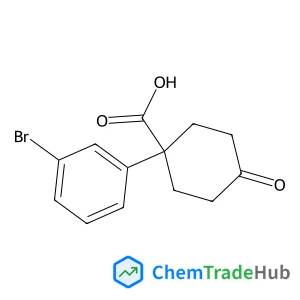
推荐供应商



免责声明
本页面提供的学术期刊信息仅供参考和研究使用。我们与任何期刊出版商均无关联,也不处理投稿事宜。如有投稿相关咨询,请直接联系相关期刊出版商。
如发现页面信息有误,请发送邮件至 support@chemtradehub.com 联系我们。我们将及时核实并处理您的问题。