










![1-[3-(4-Morpholinylsulfonyl)phenyl]methanamine structure](https://cnstatic.chemtradehub.com/structs/933/933989-32-3-51af.webp "1-[3-(4-Morpholinylsulfonyl)phenyl]methanamine structure")
The ferromagnetic and anti-ferromagnetic phases (cubic, tetragonal, orthorhombic) of KMnF3. A quantum mechanical investigation
文献信息
发布日期
2021-11-06
DOI
10.1039/D1CP03816H
影响因子
3.676
作者
Fabien Pascale, Philippe D’Arco, Roberto Dovesi
查看原文
摘要
Many space groups are proposed in the literature for the KMnF3 perovskite (see, for example, Knight et al., J. Alloys Compd., 2020, 842, 155935), ranging from cubic (C) (Pmm) to tetragonal (T) ( or I4/m) down to orthorhombic (O) (Pbnm). The relative stability ΔE of these phases, both ferromagnetic (FM) and antiferromagnetic (AFM), has been investigated quantum mechanically by using both the B3LYP hybrid functional and the Hartree–Fock Hamiltonian, an all-electron Gaussian type basis set and the CRYSTAL code. The O phase is slightly more stable than the T phase which in turn is more stable than the C phase, in agreement with experimental evidence. The C to T to O transition is accompanied by a volume reduction. The mechanism of stabilization of the AFM solution with respect to the FM one is discussed. Spin density maps and profiles, Mulliken charges, magnetic moments and bond population data are used for supporting the proposed mechanism. The IR and Raman spectra of the FM and AFM C, T and O cells are discussed; the only noticeable difference between the C, T and O spectra appears at wavenumbers lower than 150 cm−1. The effect of pressure is also explored in the 0–20 GPa interval. The stability order (O > T > C) at 0 GPa persists also at high pressure, and the differences between the phases increase.
相关文献
Piezoelectric and polarized enhancement by hydrofluorination of penta-graphene
Hui-Min Mu, Jin-Peng Li, Xiao-Chun Wang
2018-10-03
Paper
DOI: 10.1039/C8CP04010A
Enhancement of Y123 dye-sensitized solar cell performance using plasmonic gold nanorods
P. S. Chandrasekhar, Piyush K. Parashar, Sanjay Kumar Swami, Viresh Dutta, Vamsi K. Komarala
2018-03-16
Paper
DOI: 10.1039/C7CP08445E
What kind of neutral halogen bonds can be modulated by solvent effects?
Dan Shen, Peifeng Su, Wei Wu
2018-09-20
Paper
DOI: 10.1039/C8CP05358H
Does Rashba splitting in CH3NH3PbBr3 arise from 2 × 2 surface reconstruction?
Boubacar Traore, Claudine Katan, Mikaël Kepenekian, Jacky Even
2018-03-08
Paper
DOI: 10.1039/C8CP00745D
Design of iron atom modified thiophene-linked metalloporphyrin 2D conjugated microporous polymer as CO2 reduction photocatalyst
Chongyang Chen, Chao Tang, Weiwei Xu, Youyong Li, Lai Xu
2018-03-12
Paper
DOI: 10.1039/C8CP00974K
The influence of manganese concentration on the sensitivity of bandshape and lifetime luminescent thermometers based on Y3Al5O12:Mn3+,Mn4+,Nd3+ nanocrystals
K. Trejgis, L. Marciniak
2018-03-07
Paper
DOI: 10.1039/C8CP00558C
High-frequency pulsed electron–electron double resonance spectroscopy on DNA duplexes using trityl tags and shaped microwave pulses
D. Akhmetzyanov, V. Denysenkov, T. Prisner
2018-10-04
Paper
DOI: 10.1039/C8CP03951H
Correction: Unravelling the impact of hydrocarbon structure on the fumarate addition mechanism – a gas-phase ab initio study
Vivek S. Bharadwaj, Stephanie M. Villano, C. Mark Maupin, Anthony M. Dean
2018-03-22
Correction
DOI: 10.1039/C8CP90064G
Theoretical aspects in structural distortion and the electronic properties of lithium peroxide under high pressure
Komsilp Kotmool, Suttichai Assabumrungrat
2018-02-12
Paper
DOI: 10.1039/C7CP07293G
您可能还喜欢
化合物问答
3 - (二氟甲基)-1 -氟苯(CAS号:26029-52-7)适用哪些法规指南?
3 - (二氟甲基)-1 -氟苯需遵循联合国全球化学品统一分类和标签制度(GHS),包括急性毒性、皮肤腐蚀/刺激、严重眼损伤/眼刺激等分类。同时,该化合物还需符...
26029-52-71-(Difluoromethyl)-3...
化合物问答
3,5-二甲基苯胺(CAS号:108-69-0)通常如何合成?
3,5-二甲基苯胺通常通过乙苯的氨解反应合成。反应中使用硫酸作为催化剂,反应温度为120-130°C。乙苯在硫酸存在下与氨反应,生成3,5-二甲基苯胺和苯胺副产...
108-69-03,5-Dimethylaniline
化合物问答
3-甲基异噻唑-5-胺(CAS号:24340-76-9)安全吗?
3-甲基异噻唑-5-胺在适当使用和储存条件下是相对安全的,但在操作时应注意防护措施。应避免吸入粉尘,避免与皮肤和眼睛直接接触。在操作过程中,应穿戴适当的防护装备...
24340-76-93-Methyl-1,2-thiazol...
化合物问答
3-(1,3-Thiazol-2-yl)-1H-indole(CAS号:135531-86-1)通常如何合成?
3-(1,3-噻唑-2-基)-1H-吲哚通常通过多步合成方法制备。首先,由噻唑-2-基溴化物和吲哚进行偶联反应,得到中间体。然后,通过还原反应将中间体转化为所需...
135531-86-13-(1,3-Thiazol-2-yl)...
化合物问答
4-溴-2-氟苯甲基氯(CAS号:85510-82-3)的主要用途是什么?
4-溴-2-氟苯甲基氯主要用于有机合成中间体,特别是在医药、农药和染料等领域。作为一种具有特定结构的化合物,它在合成复杂有机分子时扮演重要角色。
85510-82-34-Bromo-1-(chloromet...
化合物问答
处理Fmoc-β-(3-噻吩基)-D-Ala-OH(CAS号:220497-90-5)时应注意哪些实验室安全事项?
处理Fmoc-β-(3-噻吩基)-D-Ala-OH时,应佩戴防护手套、护目镜和实验服。操作应在通风橱内进行。如发生泄露,应立即用大量水冲洗,并通知实验室管理人员...
220497-90-5N-[(9H-Fluoren-9-ylm...
化合物问答
氮化硅(CAS号:12033-89-5)通常如何合成?
氮化硅通常通过氮化硅的直接反应合成,即在高温下将四氯化硅与氨气反应。具体步骤是将四氯化硅和氨气混合并加热至1300-1700℃,在该条件下,四氯化硅与氨气反应生...
12033-89-5Trisilicon tetranitr...
化合物问答
Cetirizine EP Impurity B DiHCl(CAS号:1000690-91-4)通常如何合成?
Cetirizine EP Impurity B DiHCl通常通过一锅法合成,首先将4-氯苯基-苯甲基氯甲酸酯与1-哌嗪乙酸反应,生成相应的酸,然后与盐酸反应...
1000690-91-4{4-[(4-Chlorophenyl)...
化合物问答
如何储存1-哌啶-4-基丁-1-酮(CAS号:3509-15-7)?
1-哌啶-4-基丁-1-酮应储存在阴凉、干燥的地方,避免阳光直射。存储容器应密封,并确保通风良好。建议储存温度不超过25℃,湿度保持在相对较低的水平。
3509-15-71-Piperidin-4-ylbuta...
化合物问答
如何处理含有VORUCICLIB(CAS号:1000023-04-0)的废料?
含有VORUCICLIB的废料应进行专业的收集和处理,包括使用适当的容器进行隔离,避免与其他化学品接触。处理方法通常包括化学中和、沉淀反应或吸附过程,随后进行焚...
1000023-04-02-[2-Chloro-4-(trifl...
来源期刊
Physical Chemistry Chemical Physics

CiteScore:
5.5
自引率:
10.3%
年发文量:
3036
Physical Chemistry Chemical Physics (PCCP) is an international journal co-owned by 19 physical chemistry and physics societies from around the world. This journal publishes original, cutting-edge research in physical chemistry, chemical physics and biophysical chemistry. To be suitable for publication in PCCP, articles must include significant innovation and/or insight into physical chemistry; this is the most important criterion that reviewers and Editors will judge against when evaluating submissions. The journal has a broad scope and welcomes contributions spanning experiment, theory, computation and data science. Topical coverage includes spectroscopy, dynamics, kinetics, statistical mechanics, thermodynamics, electrochemistry, catalysis, surface science, quantum mechanics, quantum computing and machine learning. Interdisciplinary research areas such as polymers and soft matter, materials, nanoscience, energy, surfaces/interfaces, and biophysical chemistry are welcomed if they demonstrate significant innovation and/or insight into physical chemistry. Joined experimental/theoretical studies are particularly appreciated when complementary and based on up-to-date approaches.
推荐化合物
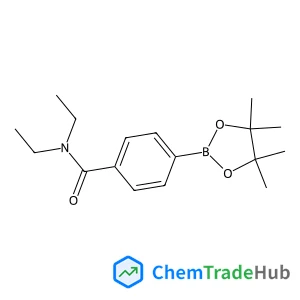
N,N-Diethyl-4-(4,4,5,5-tetramethyl-1,3,2-dioxaborolan-2-yl)benzamide
CAS号:
325142-99-2
分子式:
C17H26BNO3
![tert-Butyl N-[(2-chloropyridin-4-yl)methyl]carbamate structure](https://cnstatic.chemtradehub.com/structs/916/916210-27-0-9f95.webp "tert-Butyl N-[(2-chloropyridin-4-yl)methyl]carbamate structure")
推荐供应商


免责声明
本页面提供的学术期刊信息仅供参考和研究使用。我们与任何期刊出版商均无关联,也不处理投稿事宜。如有投稿相关咨询,请直接联系相关期刊出版商。
如发现页面信息有误,请发送邮件至 support@chemtradehub.com 联系我们。我们将及时核实并处理您的问题。