












![Pyrazolo[1,5-a]pyridine-3-carbothioamide structure](https://cnstatic.chemtradehub.com/structs/885/885275-44-5-aae0.webp "Pyrazolo[1,5-a]pyridine-3-carbothioamide structure")
Computational investigations of Dienes defect- and vacancy-induced changes in the electronic and vibrational properties of carbon fiber structural units‡
文献信息
发布日期
2021-12-03
DOI
10.1039/D1CP03930J
影响因子
3.676
作者
Sara B. Isbill, Ashley E. Shields, Roger J. Kapsimalis, J. L. Niedziela
查看原文
摘要
Carbon fiber (CF) is a promising lightweight alternative to steel and is of significant interest for energy applications. As CF continues to find new uses and is exposed to new external conditions, a noninvasive method of monitoring its structural integrity is critical. Raman spectroscopy is a commonly used method for this monitoring; however, it is highly inferential, and the interpretation of the data is not always straightforward. In this work, we perform density functional theory (DFT) calculations to investigate changes in the vibrational properties of CF structural units (i.e., graphene and graphite) caused by monovacancy and Dienes defects as a foundation for modeling more complex defects that move our model toward that of realistic CF. Using large computational supercells, we can understand how these defects change the electronic structure and vibrational properties of graphene and graphite for interdefect distances near those of the lower experimental limit. The monovacancy opens an electronic bandgap at the K point. Although no such electronic gap is opened by the Dienes defect, both defects introduce flat defect bands near the Fermi energy. The Dienes defect creates long-range deviations of the phonons, leading to substantial broadening of the highest frequency optical modes in the band structure compared to that of the pristine material. In contrast, the phonon changes caused by the monovacancy are short range, and only minor changes in the band structure or phonon density of states were observed. These findings can assist in the interpretation of experimental results by providing atomic-scale insight into key electronic and vibrational features.
相关文献
Connectivity-driven bi-thermoelectricity in heteroatom-substituted molecular junctions
Sara Sangtarash, Hatef Sadeghi, Colin J. Lambert
2018-03-12
Paper
DOI: 10.1039/C8CP00381E
Impact of surface wettability on dynamics of supercooled water confined in nitrogen-doped ordered mesoporous carbon
Clinton G. Wiener, Zhe Qiang, Yanfeng Xia, Bryan D. Vogt
2018-10-23
Paper
DOI: 10.1039/C8CP05670F
Pressure-dependent kinetics of methyl formate reactions with OH at combustion, atmospheric and interstellar temperatures
Junjun Wu, Liuhao Ma
2018-09-24
Paper
DOI: 10.1039/C8CP04114H
Design of iron atom modified thiophene-linked metalloporphyrin 2D conjugated microporous polymer as CO2 reduction photocatalyst
Chongyang Chen, Chao Tang, Weiwei Xu, Youyong Li, Lai Xu
2018-03-12
Paper
DOI: 10.1039/C8CP00974K
Determination of accurate backbone chemical shift tensors in microcrystalline proteins by integrating MAS NMR and QM/MM
Guangjin Hou, Jochem Struppe, David A. Case
2018-03-08
Paper
DOI: 10.1039/C8CP00647D
Density-functional description of alkalides: introducing the alkalide state
Stephen G. Dale, Axel D. Becke, Erin R. Johnson
2018-10-01
Paper
DOI: 10.1039/C8CP04014A
Variable temperature NMR of organogelators: the intensities of a single sample describe the full phase diagram
Elliot Christ, Dominique Collin, Jean-Philippe Lamps
2018-03-27
Paper
DOI: 10.1039/C8CP00009C
Computational strategies to probe CH activation in dioxo-dicopper complexes
Zhenzhuo Lan, Shaama Mallikarjun Sharada
2018-09-27
Paper
DOI: 10.1039/C8CP05096A
Carbonate and carbonate anion radicals in aqueous solutions exist as CO3(H2O)62− and CO3(H2O)6˙− respectively: the crucial role of the inner hydration sphere of anions in explaining their properties
Shmuel Zilberg, Amir Mizrahi, Haya Kornweitz
2018-03-06
Paper
DOI: 10.1039/C7CP08240A
Theoretical study of radiative and nonradiative decay rates for Cu(i) complexes with double heteroleptic ligands
Yuannan Chen, Aimin Ren, Zhongyue Yang, Tengfei He, Xiaoli Ding, Hongxing Zhang, Luyi Zou
2018-03-07
Paper
DOI: 10.1039/C8CP00525G
您可能还喜欢
化合物问答
3 - (二氟甲基)-1 -氟苯(CAS号:26029-52-7)适用哪些法规指南?
3 - (二氟甲基)-1 -氟苯需遵循联合国全球化学品统一分类和标签制度(GHS),包括急性毒性、皮肤腐蚀/刺激、严重眼损伤/眼刺激等分类。同时,该化合物还需符...
26029-52-71-(Difluoromethyl)-3...
化合物问答
3,5-二甲基苯胺(CAS号:108-69-0)通常如何合成?
3,5-二甲基苯胺通常通过乙苯的氨解反应合成。反应中使用硫酸作为催化剂,反应温度为120-130°C。乙苯在硫酸存在下与氨反应,生成3,5-二甲基苯胺和苯胺副产...
108-69-03,5-Dimethylaniline
化合物问答
3-甲基异噻唑-5-胺(CAS号:24340-76-9)安全吗?
3-甲基异噻唑-5-胺在适当使用和储存条件下是相对安全的,但在操作时应注意防护措施。应避免吸入粉尘,避免与皮肤和眼睛直接接触。在操作过程中,应穿戴适当的防护装备...
24340-76-93-Methyl-1,2-thiazol...
化合物问答
3-(1,3-Thiazol-2-yl)-1H-indole(CAS号:135531-86-1)通常如何合成?
3-(1,3-噻唑-2-基)-1H-吲哚通常通过多步合成方法制备。首先,由噻唑-2-基溴化物和吲哚进行偶联反应,得到中间体。然后,通过还原反应将中间体转化为所需...
135531-86-13-(1,3-Thiazol-2-yl)...
化合物问答
4-溴-2-氟苯甲基氯(CAS号:85510-82-3)的主要用途是什么?
4-溴-2-氟苯甲基氯主要用于有机合成中间体,特别是在医药、农药和染料等领域。作为一种具有特定结构的化合物,它在合成复杂有机分子时扮演重要角色。
85510-82-34-Bromo-1-(chloromet...
化合物问答
处理Fmoc-β-(3-噻吩基)-D-Ala-OH(CAS号:220497-90-5)时应注意哪些实验室安全事项?
处理Fmoc-β-(3-噻吩基)-D-Ala-OH时,应佩戴防护手套、护目镜和实验服。操作应在通风橱内进行。如发生泄露,应立即用大量水冲洗,并通知实验室管理人员...
220497-90-5N-[(9H-Fluoren-9-ylm...
化合物问答
氮化硅(CAS号:12033-89-5)通常如何合成?
氮化硅通常通过氮化硅的直接反应合成,即在高温下将四氯化硅与氨气反应。具体步骤是将四氯化硅和氨气混合并加热至1300-1700℃,在该条件下,四氯化硅与氨气反应生...
12033-89-5Trisilicon tetranitr...
化合物问答
Cetirizine EP Impurity B DiHCl(CAS号:1000690-91-4)通常如何合成?
Cetirizine EP Impurity B DiHCl通常通过一锅法合成,首先将4-氯苯基-苯甲基氯甲酸酯与1-哌嗪乙酸反应,生成相应的酸,然后与盐酸反应...
1000690-91-4{4-[(4-Chlorophenyl)...
化合物问答
如何储存1-哌啶-4-基丁-1-酮(CAS号:3509-15-7)?
1-哌啶-4-基丁-1-酮应储存在阴凉、干燥的地方,避免阳光直射。存储容器应密封,并确保通风良好。建议储存温度不超过25℃,湿度保持在相对较低的水平。
3509-15-71-Piperidin-4-ylbuta...
化合物问答
如何处理含有VORUCICLIB(CAS号:1000023-04-0)的废料?
含有VORUCICLIB的废料应进行专业的收集和处理,包括使用适当的容器进行隔离,避免与其他化学品接触。处理方法通常包括化学中和、沉淀反应或吸附过程,随后进行焚...
1000023-04-02-[2-Chloro-4-(trifl...
来源期刊
Physical Chemistry Chemical Physics

CiteScore:
5.5
自引率:
10.3%
年发文量:
3036
Physical Chemistry Chemical Physics (PCCP) is an international journal co-owned by 19 physical chemistry and physics societies from around the world. This journal publishes original, cutting-edge research in physical chemistry, chemical physics and biophysical chemistry. To be suitable for publication in PCCP, articles must include significant innovation and/or insight into physical chemistry; this is the most important criterion that reviewers and Editors will judge against when evaluating submissions. The journal has a broad scope and welcomes contributions spanning experiment, theory, computation and data science. Topical coverage includes spectroscopy, dynamics, kinetics, statistical mechanics, thermodynamics, electrochemistry, catalysis, surface science, quantum mechanics, quantum computing and machine learning. Interdisciplinary research areas such as polymers and soft matter, materials, nanoscience, energy, surfaces/interfaces, and biophysical chemistry are welcomed if they demonstrate significant innovation and/or insight into physical chemistry. Joined experimental/theoretical studies are particularly appreciated when complementary and based on up-to-date approaches.
推荐化合物
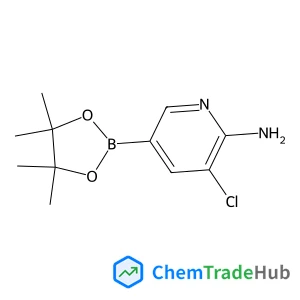
3-Chloro-5-(4,4,5,5-tetramethyl-1,3,2-dioxaborolan-2-yl)-2-pyridinamine
CAS号:
1032758-99-8
分子式:
C11H16BClN2O2
推荐供应商



免责声明
本页面提供的学术期刊信息仅供参考和研究使用。我们与任何期刊出版商均无关联,也不处理投稿事宜。如有投稿相关咨询,请直接联系相关期刊出版商。
如发现页面信息有误,请发送邮件至 support@chemtradehub.com 联系我们。我们将及时核实并处理您的问题。