





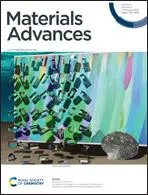
A ruthenium-inserted hydrotalcite (Ru-HT) heterogeneous catalyst: kinetic studies on the selective hydrogenation of carbon dioxide to formic acid
文献信息
发布日期
2021-07-03
DOI
10.1039/D1MA00431J
影响因子
0
作者
查看原文
摘要
Kinetic studies have been carried out for the base-free hydrogenation of CO2 to formic acid using a heterogeneous ruthenium-inserted hydrotalcite (Ru-HT) catalyst. An impressive turnover number (TON = 11 389) was achieved for formic acid under the optimized reaction conditions using a methanol : water mixture as the solvent (5 : 1, v/v) with 60 bar total pressure at 60 °C for 24 hours. The rates were determined directly in terms of the formation of formic acid with time. Kinetics were performed by carrying out experiments concerning the amount of catalyst, the individual partial pressures of CO2 and H2, the total pressure, temperature, agitation speed, reaction volume and v/v ratio of the mixed solvent. The rate of formic acid formation was first order on the amount of catalyst and partial pressures of CO2 and H2. The best reaction conditions achieved from the kinetic parametric optimization were: 100 mg catalyst, 30 bar pCO2, 30 bar pH2, 60 °C temperature, 800 rpm agitation speed and methanol–water (5 : 1, v/v) solvent. The computed activation parameters obtained from the temperature-dependent rate of formic acid formation were Ea = 34.5 ± 2.5 kJ mol−1, ΔH# = 32 ± 2.5 kJ mol−1 and ΔS# = −384 ± 5 J deg−1 mol−1. The presence of water in the mixed solvent effectively enhanced the reaction rate, which is characteristically observed due to its molecular effect. Two mechanistic routes for CO2 hydrogenation to formic acid are proposed and discussed based on the kinetic and experimental observations. The studied parameters were found to be significantly effective to increase the rate of reaction appreciably.
相关文献
Sublimation thermodynamics of nucleobases derived from fast scanning calorimetry
A. V. Buzyurov
2019-12-10
Paper
DOI: 10.1039/C9CP04761A
Prototypical cyclohexane dimers: spectroscopic evidence for σ stacking at low temperatures
N. Ramanathan, Shubhra Sarkar, K. Sundararajan
2019-12-02
Paper
DOI: 10.1039/C9CP05237B
Quantum mechanical molecular dynamics simulations of polaron formation in methylammonium lead iodide perovskite
Hiroki Uratani, Chien-Pin Chou
2019-11-27
Paper
DOI: 10.1039/C9CP04739E
Defining aluminum-zoning during synthesis of ZSM-5 zeolites
Teng Li, Frank Krumeich, Ming Chen, Zhiqiang Ma
2019-12-02
Paper
DOI: 10.1039/C9CP05423E
Quantitative determination of the phosphorus environment in lithium aluminosilicate glasses using solid-state NMR techniques
Monique Comte, Lionel Montagne, Bertrand Doumert, Laurent Cormier
2019-07-31
Paper
DOI: 10.1039/C9CP03181B
Enhanced anisotropic electrical conductivity of perturbed monolayer β12-borophene
Nguyen N. Hieu, Bui Dinh Hoi
2019-11-18
Paper
DOI: 10.1039/C9CP05597E
您可能还喜欢
化合物问答
如何储存8-溴-4-羟基-6-(三氟甲氧基)喹啉-3-羧酸乙酯(CAS号:1072944-81-0)?
8-溴-4-羟基-6-(三氟甲氧基)喹啉-3-羧酸乙酯应储存在阴凉、干燥的地方,避免光照和高温。建议使用密封容器进行储存,以防止水分和空气的影响。
1072944-81-0Ethyl 8-bromo-4-hydr...
化合物问答
2,2-二(2-呋喃基)丙烷(CAS号:17920-88-6)的市场或研究趋势如何?
2,2-二(2-呋喃基)丙烷的研究趋势主要集中在新型材料的开发和应用,如高分子材料、有机光电材料等。市场趋势方面,随着环保要求的提高和新材料的应用,该化合物的需...
17920-88-62,2'-(2,2-Propanediy...
化合物问答
如何处理含有螺[呋喃并[3,4-b]吡啶-5(7H),4'-哌啶]-7-酮盐酸盐(CAS号:475152-31-9)的废料?
对于含有螺[呋喃并[3,4-b]吡啶-5(7H),4'-哌啶]-7-酮盐酸盐的废料,应首先进行分类和分离,以减少危险物质的数量。随后,可以考虑通过化学氧化、生物...
475152-31-97H-Spiro[furo[3,4-b]...
化合物问答
Cinnamyl 3-aminobut-2-enoate(CAS号:113898-97-8)安全吗?
Cinnamyl 3-氨基丁-2-烯酸在接触皮肤和眼睛时可能会引起刺激。应避免吸入其粉尘和烟雾。操作时应穿戴适当的个人防护装备,如手套、护目镜和实验室外套。
113898-97-8Cinnamyl 3-aminobut-...
化合物问答
反式-2-十二碳烯二酸(CAS号:6402-36-4)的市场或研究趋势如何?
反式-2-十二碳烯二酸在医药、材料科学等领域有一定的应用,但其市场相对较小。近年来,由于环保意识的提升,对环境友好型化学品的需求增加,研究倾向于开发更绿色的合成...
6402-36-4Traumatic Acid
化合物问答
什么是(9ci)-1H-苯并咪唑-5-乙酸(CAS号:473895-86-2)?
(9ci)-1H-苯并咪唑-5-乙酸是一种含氮杂环化合物,其化学结构为1H-苯并咪唑-5-乙酸。该化合物具有特定的分子式C8H7NO2,属于有机酸类化合物。
473895-86-21H-Benzimidazol-5-yl...
化合物问答
酞菁蓝(CAS号:147-14-8)的主要用途是什么?
酞菁蓝主要用作颜料和染料,广泛应用于塑料、油墨、涂料、纺织品及橡胶工业中。它也用于光敏材料,如太阳能电池和光刻胶。在医疗领域,酞菁蓝因其光敏特性被用于某些光动力...
147-14-8Copper(2+) phthalocy...
化合物问答
5-甲基-1,2,3,4-四氢异喹啉(CAS号:123593-99-7)安全吗?
5-甲基-1,2,3,4-四氢异喹啉在使用和储存时需要谨慎处理。它具有一定的毒性,应避免吸入其蒸气或直接接触皮肤和眼睛。操作此化合物时,建议佩戴防护眼镜、实验服...
123593-99-75-Methyl-1,2,3,4-tet...
化合物问答
如何处理含有3',4',5'-三甲氧基苯乙酮(CAS号:1136-86-3)的废料?
含有3',4',5'-三甲氧基苯乙酮的废液应首先确保其是否为危险废物,根据当地法规确定处理方法。通常,这类有机废液可以采用中和反应降低其pH值,然后通过蒸馏或萃...
1136-86-31-(3,4,5-Trimethoxyp...
化合物问答
如何储存KI-7(CAS号:1489263-00-4)?
KI-7应储存在通风良好的干燥环境中,避免光照和高温。建议使用密封容器储存,并保持在阴凉处。储存温度应控制在室温范围内,一般建议不超过25°C。避免与氧化剂接触...
1489263-00-42-(1-Benzyl-1H-indol...
来源期刊
推荐化合物
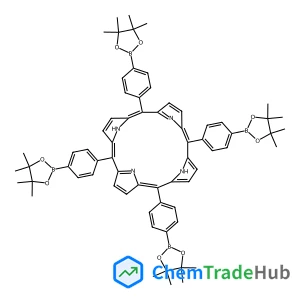
5,10,15,20-tetrakis(4-boronic acid pinacol ester phenyl) porphyrin
CAS号:
1332748-00-1
分子式:
C68H74B4N4O8
![N-{3-[Benzyl(methyl)amino]propyl}-9-chloro-5,6,7,8-tetrahydro-2-acridinecarboxamide structure](https://cnstatic.chemtradehub.com/structs/142/1426944-49-1-1e4c.webp "N-{3-[Benzyl(methyl)amino]propyl}-9-chloro-5,6,7,8-tetrahydro-2-acridinecarboxamide structure")

推荐供应商





免责声明
本页面提供的学术期刊信息仅供参考和研究使用。我们与任何期刊出版商均无关联,也不处理投稿事宜。如有投稿相关咨询,请直接联系相关期刊出版商。
如发现页面信息有误,请发送邮件至 support@chemtradehub.com 联系我们。我们将及时核实并处理您的问题。