




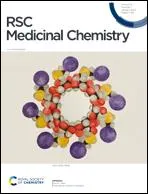
Small molecule-mediated induction of endoplasmic reticulum stress in cancer cells
文献信息
发布日期
2021-07-15
DOI
10.1039/D1MD00095K
影响因子
0
作者
Virender Kumar Sharma, Ankur Biswas, Mayurika Lahiri, Sudipta Basu
查看原文
摘要
The endoplasmic reticulum (ER) is one of the crucial sub-cellular organelles controlling myriads of functions including protein biosynthesis, folding, misfolding and unfolding. As a result, dysregulation of these pathways in the ER is implicated in cancer development and progression. Subsequently, targeting the ER in cancer cells emerged as an interesting unorthodox strategy in next-generation anticancer therapy. However, development of small molecules to selectively target the ER for cancer therapy remained elusive and unexplored. To address this, herein, we have developed a novel small molecule library of sulfonylhydrazide-hydrazones through a short and concise chemical synthetic strategy. We identified a fluorescent small molecule that localized into the endoplasmic reticulum (ER) of HeLa cells, induced ER stress followed by triggering autophagy which was subsequently inhibited by chloroquine (autophagy inhibitor) to initiate apoptosis. This small molecule showed remarkable cancer cell killing efficacy in different cancer cells as mono and combination therapy with chloroquine, thus opening a new direction to illuminate ER-biology towards the development of novel anticancer therapeutics.
相关文献
Alloy-composition-dependent oxygen reduction reaction activity and electrochemical stability of Pt-based bimetallic systems: a model electrocatalyst study of Pt/PtxNi100−x(111)
Naoto Todoroki, Ryutaro Kawamura, Masato Asano, Ren Sasakawa, Shuntaro Takahashi, Toshimasa Wadayama
2018-04-03
Paper
DOI: 10.1039/C8CP01217B
Effects of graphene/BN encapsulation, surface functionalization and molecular adsorption on the electronic properties of layered InSe: a first-principles study
Andrey A. Kistanov, Yongqing Cai, Kun Zhou, Yong-Wei Zhang
2018-04-14
Paper
DOI: 10.1039/C8CP01146J
Dative versus electron-sharing bonding in N-oxides and phosphane oxides R3EO and relative energies of the R2EOR isomers (E = N, P; R = H, F, Cl, Me, Ph). A theoretical study
Tao Yang, Diego M. Andrada
2018-04-06
Paper
DOI: 10.1039/C8CP00951A
Mechanistic insights into the interaction between energetic oxygen ions and nanosized ZnFe2O4: XAS-XMCD investigations
Jitendra Pal Singh, Baljeet Kaur, Aditya Sharma, So Hee Kim, Sanjeev Gautam, Ramesh Chandra Srivastava, Navdeep Goyal, Weol Cheol Lim, H.-J. Lin, J. M. Chen, K. Asokan, D. Kanjilal, Sung Ok Won, Ik-Jae Lee, Keun Hwa Chae
2018-04-03
Paper
DOI: 10.1039/C8CP00368H
How changes in interfacial pH lead to new voltammetric features: the case of the electrochemical oxidation of hydrazine
Antony Cyril Arulrajan, Christophe Renault, Stanley C. S. Lai
2018-04-06
Paper
DOI: 10.1039/C8CP01835A
Phase behaviours of a cationic surfactant in deep eutectic solvents: from micelles to lyotropic liquid crystals
Qintang Li, Jiao Wang, Nana Lei, Minhao Yan, Xiao Chen
2018-04-11
Paper
DOI: 10.1039/C8CP00001H
Direct observation of stepwise intermolecular proton and hydrogen transfer between alcohols and the triplet state of 4-nitro-1-naphthol
Fengjin Zhang, Di Zhang, Yong Du, Peipei Jin, Yanying Zhao, Xuming Zheng, Jiadan Xue
2018-04-17
Paper
DOI: 10.1039/C8CP00484F
QM/MM studies on the excited-state relaxation mechanism of a semisynthetic dTPT3 base
Wei-Wei Guo, Teng-Shuo Zhang, Wei-Hai Fang, Ganglong Cui
2018-01-15
Paper
DOI: 10.1039/C7CP08696B
Phase diagram and oxygen–vacancy ordering in the CeO2–Gd2O3 system: a theoretical study
2018-04-05
Paper
DOI: 10.1039/C8CP01029C
Molecular structure and adsorption of dimethyl sulfoxide at the air/aqueous solution interface probed by non-resonant second harmonic generation
Qianshun Wei, Dexia Zhou, Hongtao Bian
2018-03-27
Paper
DOI: 10.1039/C8CP00099A
您可能还喜欢
化合物问答
3 - (二氟甲基)-1 -氟苯(CAS号:26029-52-7)适用哪些法规指南?
3 - (二氟甲基)-1 -氟苯需遵循联合国全球化学品统一分类和标签制度(GHS),包括急性毒性、皮肤腐蚀/刺激、严重眼损伤/眼刺激等分类。同时,该化合物还需符...
26029-52-71-(Difluoromethyl)-3...
化合物问答
3,5-二甲基苯胺(CAS号:108-69-0)通常如何合成?
3,5-二甲基苯胺通常通过乙苯的氨解反应合成。反应中使用硫酸作为催化剂,反应温度为120-130°C。乙苯在硫酸存在下与氨反应,生成3,5-二甲基苯胺和苯胺副产...
108-69-03,5-Dimethylaniline
化合物问答
3-甲基异噻唑-5-胺(CAS号:24340-76-9)安全吗?
3-甲基异噻唑-5-胺在适当使用和储存条件下是相对安全的,但在操作时应注意防护措施。应避免吸入粉尘,避免与皮肤和眼睛直接接触。在操作过程中,应穿戴适当的防护装备...
24340-76-93-Methyl-1,2-thiazol...
化合物问答
3-(1,3-Thiazol-2-yl)-1H-indole(CAS号:135531-86-1)通常如何合成?
3-(1,3-噻唑-2-基)-1H-吲哚通常通过多步合成方法制备。首先,由噻唑-2-基溴化物和吲哚进行偶联反应,得到中间体。然后,通过还原反应将中间体转化为所需...
135531-86-13-(1,3-Thiazol-2-yl)...
化合物问答
4-溴-2-氟苯甲基氯(CAS号:85510-82-3)的主要用途是什么?
4-溴-2-氟苯甲基氯主要用于有机合成中间体,特别是在医药、农药和染料等领域。作为一种具有特定结构的化合物,它在合成复杂有机分子时扮演重要角色。
85510-82-34-Bromo-1-(chloromet...
化合物问答
处理Fmoc-β-(3-噻吩基)-D-Ala-OH(CAS号:220497-90-5)时应注意哪些实验室安全事项?
处理Fmoc-β-(3-噻吩基)-D-Ala-OH时,应佩戴防护手套、护目镜和实验服。操作应在通风橱内进行。如发生泄露,应立即用大量水冲洗,并通知实验室管理人员...
220497-90-5N-[(9H-Fluoren-9-ylm...
化合物问答
氮化硅(CAS号:12033-89-5)通常如何合成?
氮化硅通常通过氮化硅的直接反应合成,即在高温下将四氯化硅与氨气反应。具体步骤是将四氯化硅和氨气混合并加热至1300-1700℃,在该条件下,四氯化硅与氨气反应生...
12033-89-5Trisilicon tetranitr...
化合物问答
Cetirizine EP Impurity B DiHCl(CAS号:1000690-91-4)通常如何合成?
Cetirizine EP Impurity B DiHCl通常通过一锅法合成,首先将4-氯苯基-苯甲基氯甲酸酯与1-哌嗪乙酸反应,生成相应的酸,然后与盐酸反应...
1000690-91-4{4-[(4-Chlorophenyl)...
化合物问答
如何储存1-哌啶-4-基丁-1-酮(CAS号:3509-15-7)?
1-哌啶-4-基丁-1-酮应储存在阴凉、干燥的地方,避免阳光直射。存储容器应密封,并确保通风良好。建议储存温度不超过25℃,湿度保持在相对较低的水平。
3509-15-71-Piperidin-4-ylbuta...
化合物问答
如何处理含有VORUCICLIB(CAS号:1000023-04-0)的废料?
含有VORUCICLIB的废料应进行专业的收集和处理,包括使用适当的容器进行隔离,避免与其他化学品接触。处理方法通常包括化学中和、沉淀反应或吸附过程,随后进行焚...
1000023-04-02-[2-Chloro-4-(trifl...
来源期刊
推荐化合物
![Methyl 4-({[(2-methyl-2-propanyl)oxy]carbonyl}amino)bicyclo[2.2.2]octane-1-carboxylate structure](https://cnstatic.chemtradehub.com/structs/943/943845-74-7-b7e5.webp "Methyl 4-({[(2-methyl-2-propanyl)oxy]carbonyl}amino)bicyclo[2.2.2]octane-1-carboxylate structure")

推荐供应商





免责声明
本页面提供的学术期刊信息仅供参考和研究使用。我们与任何期刊出版商均无关联,也不处理投稿事宜。如有投稿相关咨询,请直接联系相关期刊出版商。
如发现页面信息有误,请发送邮件至 support@chemtradehub.com 联系我们。我们将及时核实并处理您的问题。