



![2,6-Bis({(2R)-2-[hydroxy(diphenyl)methyl]-1-pyrrolidinyl}methyl)-4-methylphenol structure](https://cnstatic.chemtradehub.com/structs/877/877395-58-9-70bf.webp "2,6-Bis({(2R)-2-[hydroxy(diphenyl)methyl]-1-pyrrolidinyl}methyl)-4-methylphenol structure")
2-Difluoromethylpyridine as a bioisosteric replacement of pyridine-N-oxide: the case of quorum sensing inhibitors
文献信息
发布日期
2021-09-08
DOI
10.1039/D1MD00245G
影响因子
0
作者
Thang Nguyen Quoc
查看原文
摘要
Herein, we demonstrate that 2-difluoromethylpyridine is a bioisosteric replacement of pyridine-N-oxide. Using the quorum sensing inhibitor 4NPO as a model compound, a library of 2-difluoromethylpyridine derivatives was designed, synthesized, and evaluated toward quorum sensing activity, biofilm formation, anti-violacein activity, and protease activity. As a result, compounds 1 (IC50 of 35 ± 1.12 μM), 5 (IC50 of 19 ± 1.01 μM), and 6 (IC50 of 27 ± 0.67 μM) showed a similar or better activity in comparison to 4NPO (IC50 of 33 ± 1.12 μM) in a quorum sensing system of Pseudomonas aeruginosa. In addition, compounds 1, 5, 6, and 4NPO showed good antibiofilm biomass of Pseudomonas aeruginosa and reduced violacein production in Chromobacterium violaceum. In terms of protease activity, compounds 1, 5, and 6 showed significant activity compared to 4NPO. Overall, the replacement of pyridine-N-oxide by 2-difluoromethylpyridine enhances the activity of the model compound, which could open a new path for bioisosteric replacement in drug discovery and development.
期刊推荐

Chemistry of Natural Compounds

Bulletin of the Chemical Society of Japan

Corrosion Science

Journal of the American Chemical Society

Ferroelectrics
Chemical & Pharmaceutical Bulletin
Doklady Chemistry

Advances in Colloid and Interface Science
Journal of the Chinese Chemical Society

Cement and Concrete Research
相关文献
The energetics of carbonated PuO2 surfaces affects nanoparticle morphology: a DFT+U study
Samuel Moxon, Adam R. Symington, Joshua S. Tse, James Dawson, Joseph M. Flitcroft, Stephen C. Parker, David J. Cooke, Robert M. Harker, Marco Molinari
2020-03-11
Paper
DOI: 10.1039/D0CP00021C
Selective host–guest chemistry, self-assembly and conformational preferences of m-xylene macrocycles probed by ion-mobility spectrometry mass spectrometry
Benjamin A. Link, Ammon J. Sindt, Linda S. Shimizu, Thanh D. Do
2020-04-14
Paper
DOI: 10.1039/C9CP06938K
Hierarchical phenomena in multicomponent liquids: simulation methods, analysis, chemistry
Michael J. Servis, Ernesto Martinez-Baez
2020-03-05
Perspective
DOI: 10.1039/D0CP00164C
High-resolution resonance-enhanced multiphoton photoelectron circular dichroism
Alexander Kastner, Greta Koumarianou, Pavle Glodic, Peter C. Samartzis, Nicolas Ladda, Simon T. Ranecky, Tom Ring, Sudheendran Vasudevan, Constantin Witte, Hendrike Braun, Han-Gyeol Lee, Arne Senftleben, Robert Berger, Thomas Baumert
2020-03-16
Paper
DOI: 10.1039/D0CP00470G
Negative magnetization, complex magnetic ordering and applications of Cr-doped Co2TiO4
Q. S. Fu, X. H. Chen, C. Chakrabarti, C. L. Li, J. Zheng, P. J. Wang, H. X. Yin, Y. Qiu, B. Meng, S. L. Yuan
2020-02-28
Paper
DOI: 10.1039/C9CP06444C
Distinct microscopic mechanisms for the accelerated aggregation of pathogenic Tau mutants revealed by kinetic analysis
Liu Hong
2020-03-17
Paper
DOI: 10.1039/C9CP06083A
Aqueous solvation of the chloride ion revisited with density functional theory: impact of correlation and exchange approximations
Mark DelloStritto, Jianhang Xu, Xifan Wu, Michael L. Klein
2020-02-04
Paper
DOI: 10.1039/C9CP06821J
Metal extraction from a deep eutectic solvent, an insight into activities
Peng Cen, Mikhail S. Tyumentsev, Mark R. St. J. Foreman
2020-04-28
Paper
DOI: 10.1039/C9CP05982B
Clarifying the impacts of surface hydroxyls on CO oxidation on CeO2(100) surfaces: a DFT+U study
Hui Zhou, Dong Wang, Xue-Qing Gong
2020-03-09
Paper
DOI: 10.1039/D0CP00204F
Versatile surface-active ionic liquid: construction of microemulsions and their applications in light harvesting
Pratap Bahadur, Debes Ray, V. K. Aswal
2020-03-24
Paper
DOI: 10.1039/C9CP06842B
您可能还喜欢
化合物问答
3 - (二氟甲基)-1 -氟苯(CAS号:26029-52-7)适用哪些法规指南?
3 - (二氟甲基)-1 -氟苯需遵循联合国全球化学品统一分类和标签制度(GHS),包括急性毒性、皮肤腐蚀/刺激、严重眼损伤/眼刺激等分类。同时,该化合物还需符...
26029-52-71-(Difluoromethyl)-3...
化合物问答
3,5-二甲基苯胺(CAS号:108-69-0)通常如何合成?
3,5-二甲基苯胺通常通过乙苯的氨解反应合成。反应中使用硫酸作为催化剂,反应温度为120-130°C。乙苯在硫酸存在下与氨反应,生成3,5-二甲基苯胺和苯胺副产...
108-69-03,5-Dimethylaniline
化合物问答
3-甲基异噻唑-5-胺(CAS号:24340-76-9)安全吗?
3-甲基异噻唑-5-胺在适当使用和储存条件下是相对安全的,但在操作时应注意防护措施。应避免吸入粉尘,避免与皮肤和眼睛直接接触。在操作过程中,应穿戴适当的防护装备...
24340-76-93-Methyl-1,2-thiazol...
化合物问答
3-(1,3-Thiazol-2-yl)-1H-indole(CAS号:135531-86-1)通常如何合成?
3-(1,3-噻唑-2-基)-1H-吲哚通常通过多步合成方法制备。首先,由噻唑-2-基溴化物和吲哚进行偶联反应,得到中间体。然后,通过还原反应将中间体转化为所需...
135531-86-13-(1,3-Thiazol-2-yl)...
化合物问答
4-溴-2-氟苯甲基氯(CAS号:85510-82-3)的主要用途是什么?
4-溴-2-氟苯甲基氯主要用于有机合成中间体,特别是在医药、农药和染料等领域。作为一种具有特定结构的化合物,它在合成复杂有机分子时扮演重要角色。
85510-82-34-Bromo-1-(chloromet...
化合物问答
处理Fmoc-β-(3-噻吩基)-D-Ala-OH(CAS号:220497-90-5)时应注意哪些实验室安全事项?
处理Fmoc-β-(3-噻吩基)-D-Ala-OH时,应佩戴防护手套、护目镜和实验服。操作应在通风橱内进行。如发生泄露,应立即用大量水冲洗,并通知实验室管理人员...
220497-90-5N-[(9H-Fluoren-9-ylm...
化合物问答
氮化硅(CAS号:12033-89-5)通常如何合成?
氮化硅通常通过氮化硅的直接反应合成,即在高温下将四氯化硅与氨气反应。具体步骤是将四氯化硅和氨气混合并加热至1300-1700℃,在该条件下,四氯化硅与氨气反应生...
12033-89-5Trisilicon tetranitr...
化合物问答
Cetirizine EP Impurity B DiHCl(CAS号:1000690-91-4)通常如何合成?
Cetirizine EP Impurity B DiHCl通常通过一锅法合成,首先将4-氯苯基-苯甲基氯甲酸酯与1-哌嗪乙酸反应,生成相应的酸,然后与盐酸反应...
1000690-91-4{4-[(4-Chlorophenyl)...
化合物问答
如何储存1-哌啶-4-基丁-1-酮(CAS号:3509-15-7)?
1-哌啶-4-基丁-1-酮应储存在阴凉、干燥的地方,避免阳光直射。存储容器应密封,并确保通风良好。建议储存温度不超过25℃,湿度保持在相对较低的水平。
3509-15-71-Piperidin-4-ylbuta...
化合物问答
如何处理含有VORUCICLIB(CAS号:1000023-04-0)的废料?
含有VORUCICLIB的废料应进行专业的收集和处理,包括使用适当的容器进行隔离,避免与其他化学品接触。处理方法通常包括化学中和、沉淀反应或吸附过程,随后进行焚...
1000023-04-02-[2-Chloro-4-(trifl...
来源期刊
推荐化合物
![5-Methyl-4,5,6,7-tetrahydropyrazolo[1,5-a]pyrazin-2-amine structure](https://cnstatic.chemtradehub.com/structs/122/1227210-33-4-8d64.webp "5-Methyl-4,5,6,7-tetrahydropyrazolo[1,5-a]pyrazin-2-amine structure")
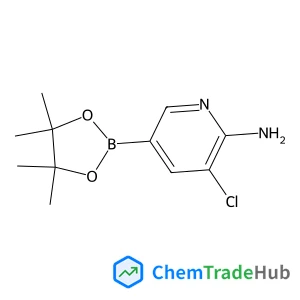
3-Chloro-5-(4,4,5,5-tetramethyl-1,3,2-dioxaborolan-2-yl)-2-pyridinamine
CAS号:
1032758-99-8
分子式:
C11H16BClN2O2
![2,6-Di(thiophen-2-yl)dithieno[3,2-b:2',3'-d]thiophene structure](https://cnstatic.chemtradehub.com/structs/910/910788-24-8-5b70.webp "2,6-Di(thiophen-2-yl)dithieno[3,2-b:2',3'-d]thiophene structure")
![Methyl 4-({[(2-methyl-2-propanyl)oxy]carbonyl}amino)bicyclo[2.2.2]octane-1-carboxylate structure](https://cnstatic.chemtradehub.com/structs/943/943845-74-7-b7e5.webp "Methyl 4-({[(2-methyl-2-propanyl)oxy]carbonyl}amino)bicyclo[2.2.2]octane-1-carboxylate structure")
推荐供应商




免责声明
本页面提供的学术期刊信息仅供参考和研究使用。我们与任何期刊出版商均无关联,也不处理投稿事宜。如有投稿相关咨询,请直接联系相关期刊出版商。
如发现页面信息有误,请发送邮件至 support@chemtradehub.com 联系我们。我们将及时核实并处理您的问题。