


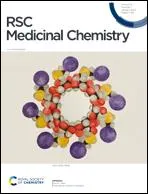
Functionalized resorcinarenes effectively disrupt the aggregation of αA66-80 crystallin peptide related to cataracts
文献信息
发布日期
2021-11-01
DOI
10.1039/D1MD00294E
影响因子
0
作者
Kwaku Twum, Avik Bhattacharjee, Erving T. Laryea, Josephine Esposto, George Omolloh, Shaelyn Mortensen, Maya Jaradi, Naomi L. Stock, Bianca Elias, Elan Pszenica, Theresa M. McCormick, Ngong Kodiah Beyeh
查看原文
摘要
Cataracts, an eye lens clouding disease, are debilitating and while operable, remain without a cure. αA66-80 crystallin peptide abundant in cataracted eye lenses contributes to aggregation of αA-crystallin protein leading to cataracts. Inspired by the versatility of macrocycles and programmable guest selectivity through discrete functionalizations, we report on three water-soluble ionic resorcinarene receptors (A, B, and C) that disrupt the aggregation of αA66-80 crystallin peptide. A and B each possess four anionic sulfonate groups, while C includes four cationic ammonium groups with four flexible extended benzyl groups. Through multiple non-covalent attractions, these receptors successfully disrupt and reverse the aggregation of αA66-80 crystallin peptide, which was studied through spectroscopic, spectrometric, calorimetric, and imaging techniques. The αA66-80·receptor complexes were also explored using molecular dynamics simulation, and binding energies were calculated. Even though each of the three receptors can bind with the peptide, receptor C was characterized by the highest binding energy and affinity for three different domains of the peptide. In effect, the most efficient inhibitor was a cationic receptor Cvia extended aromatic interactions. These results highlight the potential of versatile and tunable functionalized resorcinarenes as potential therapeutics to reverse the aggregation of α-crystallin dominant in eye cataracts.
期刊推荐
Journal of the Chinese Chemical Society

Analyst
Canadian Metallurgical Quarterly
Accounts of Chemical Research
Ferroelectrics
Australian Journal of Chemistry

Chemistry of Heterocyclic Compounds
Anti-Corrosion Methods and Materials
Advances in Colloid and Interface Science
Bulletin of the Chemical Society of Japan
相关文献
CPMD investigation of α-RDX and ε-CL-20: the transition of deflagration to detonation depending on the self-produced radicals
Tiantian Zhang, Longjiu Cheng, Jianguo Zhang, Kun Wang
2020-03-02
Paper
DOI: 10.1039/D0CP00050G
Ab initio investigation of the formation mechanism of nano-interfaces between 3d-late transition-metals and ZrO2 nanoclusters
Larissa Zibordi-Besse, Lucas G. Verga, Vivianne K. Ocampo-Restrepo, Juarez L. F. Da Silva
2020-03-25
Paper
DOI: 10.1039/D0CP00584C
Semiconducting few-layer PdSe2 and Pd2Se3: native point defects and contacts with native metallic Pd17Se15
Xintong Xu, John Robertson, Huanglong Li
2020-03-18
Paper
DOI: 10.1039/C9CP06654C
Quantifying the hydration structure of sodium and potassium ions: taking additional steps on Jacob's Ladder
Gregory K. Schenter, John L. Fulton, Thomas Huthwelker, Mahalingam Balasubramanian, Mirza Galib, Marcel D. Baer, Jürg Hutter, Mauro Del Ben, X. S. Zhao
2019-12-19
Paper
DOI: 10.1039/C9CP06161D
Phosphorus-based metal-free Z-scheme 2D van der Waals heterostructures for visible-light photocatalytic water splitting: a first-principles study
Junyu Lang
2020-03-30
Paper
DOI: 10.1039/D0CP00637H
Enhanced extraction of phenol from model oils using ionic liquids elucidated with neutron diffraction
Emily L. Byrne, Thaise Pereira, John D. Holbrey
2020-04-08
Paper
DOI: 10.1039/D0CP01013H
Including dispersion in density functional theory for adsorption on flat oxide surfaces, in metal–organic frameworks and in acidic zeolites
Florian R. Rehak, GiovanniMaria Piccini, Maristella Alessio, Joachim Sauer
2020-03-30
Paper
DOI: 10.1039/D0CP00394H
The energetics of carbonated PuO2 surfaces affects nanoparticle morphology: a DFT+U study
Samuel Moxon, Adam R. Symington, Joshua S. Tse, James Dawson, Joseph M. Flitcroft, Stephen C. Parker, David J. Cooke, Robert M. Harker, Marco Molinari
2020-03-11
Paper
DOI: 10.1039/D0CP00021C
您可能还喜欢
化合物问答
3 - (二氟甲基)-1 -氟苯(CAS号:26029-52-7)适用哪些法规指南?
3 - (二氟甲基)-1 -氟苯需遵循联合国全球化学品统一分类和标签制度(GHS),包括急性毒性、皮肤腐蚀/刺激、严重眼损伤/眼刺激等分类。同时,该化合物还需符...
26029-52-71-(Difluoromethyl)-3...
化合物问答
3,5-二甲基苯胺(CAS号:108-69-0)通常如何合成?
3,5-二甲基苯胺通常通过乙苯的氨解反应合成。反应中使用硫酸作为催化剂,反应温度为120-130°C。乙苯在硫酸存在下与氨反应,生成3,5-二甲基苯胺和苯胺副产...
108-69-03,5-Dimethylaniline
化合物问答
3-甲基异噻唑-5-胺(CAS号:24340-76-9)安全吗?
3-甲基异噻唑-5-胺在适当使用和储存条件下是相对安全的,但在操作时应注意防护措施。应避免吸入粉尘,避免与皮肤和眼睛直接接触。在操作过程中,应穿戴适当的防护装备...
24340-76-93-Methyl-1,2-thiazol...
化合物问答
3-(1,3-Thiazol-2-yl)-1H-indole(CAS号:135531-86-1)通常如何合成?
3-(1,3-噻唑-2-基)-1H-吲哚通常通过多步合成方法制备。首先,由噻唑-2-基溴化物和吲哚进行偶联反应,得到中间体。然后,通过还原反应将中间体转化为所需...
135531-86-13-(1,3-Thiazol-2-yl)...
化合物问答
4-溴-2-氟苯甲基氯(CAS号:85510-82-3)的主要用途是什么?
4-溴-2-氟苯甲基氯主要用于有机合成中间体,特别是在医药、农药和染料等领域。作为一种具有特定结构的化合物,它在合成复杂有机分子时扮演重要角色。
85510-82-34-Bromo-1-(chloromet...
化合物问答
处理Fmoc-β-(3-噻吩基)-D-Ala-OH(CAS号:220497-90-5)时应注意哪些实验室安全事项?
处理Fmoc-β-(3-噻吩基)-D-Ala-OH时,应佩戴防护手套、护目镜和实验服。操作应在通风橱内进行。如发生泄露,应立即用大量水冲洗,并通知实验室管理人员...
220497-90-5N-[(9H-Fluoren-9-ylm...
化合物问答
氮化硅(CAS号:12033-89-5)通常如何合成?
氮化硅通常通过氮化硅的直接反应合成,即在高温下将四氯化硅与氨气反应。具体步骤是将四氯化硅和氨气混合并加热至1300-1700℃,在该条件下,四氯化硅与氨气反应生...
12033-89-5Trisilicon tetranitr...
化合物问答
Cetirizine EP Impurity B DiHCl(CAS号:1000690-91-4)通常如何合成?
Cetirizine EP Impurity B DiHCl通常通过一锅法合成,首先将4-氯苯基-苯甲基氯甲酸酯与1-哌嗪乙酸反应,生成相应的酸,然后与盐酸反应...
1000690-91-4{4-[(4-Chlorophenyl)...
化合物问答
如何储存1-哌啶-4-基丁-1-酮(CAS号:3509-15-7)?
1-哌啶-4-基丁-1-酮应储存在阴凉、干燥的地方,避免阳光直射。存储容器应密封,并确保通风良好。建议储存温度不超过25℃,湿度保持在相对较低的水平。
3509-15-71-Piperidin-4-ylbuta...
化合物问答
如何处理含有VORUCICLIB(CAS号:1000023-04-0)的废料?
含有VORUCICLIB的废料应进行专业的收集和处理,包括使用适当的容器进行隔离,避免与其他化学品接触。处理方法通常包括化学中和、沉淀反应或吸附过程,随后进行焚...
1000023-04-02-[2-Chloro-4-(trifl...
来源期刊
推荐化合物
![2,6-Bis({(2R)-2-[hydroxy(diphenyl)methyl]-1-pyrrolidinyl}methyl)-4-methylphenol structure](https://cnstatic.chemtradehub.com/structs/877/877395-58-9-70bf.webp "2,6-Bis({(2R)-2-[hydroxy(diphenyl)methyl]-1-pyrrolidinyl}methyl)-4-methylphenol structure")
推荐供应商




免责声明
本页面提供的学术期刊信息仅供参考和研究使用。我们与任何期刊出版商均无关联,也不处理投稿事宜。如有投稿相关咨询,请直接联系相关期刊出版商。
如发现页面信息有误,请发送邮件至 support@chemtradehub.com 联系我们。我们将及时核实并处理您的问题。