






Cross-linked polyurethane with dynamic phenol-carbamate bonds: properties affected by the chemical structure of isocyanate
文献信息
发布日期
2021-03-23
DOI
10.1039/D1PY00157D
影响因子
5.582
作者
Jiaxin Shi, Tianze Zheng, Yao Zhang, Baohua Guo, Jun Xu
查看原文
摘要
Polyurethanes with covalent adaptive network (CAN) have received widespread attention due to their recyclability and self-healing properties. The strategy of regulating the dynamic network rearrangement kinetics through varying the monomer structure is particularly interesting. Herein, based on the phenol–carbamate dynamic bond, we design a strategy to regulate the rearrangement kinetics of the dynamic covalent network by adjusting the chemical structure of aliphatic isocyanates with the same initial cross-linking degree. Temperature-varying FTIR and stress relaxation experiments prove the feasibility of this strategy from the perspective of thermodynamics and kinetics. For the studied isocyanates, greater steric hindrance or attachment of benzyl groups can promote the rearrangement of CAN. The two factors can reduce the relaxation time by one order of magnitude, and the relaxation activation energy can be reduced by over 20 kJ mol−1. Regardless of the network rearrangement kinetics, all polyurethane samples show good self-healing and reprocessing performance. In addition, the mechanical properties and stability in a hot air environment also vary with the chemical structure of the isocyanates, e.g., the isocyanates with alicyclic structure can improve the thermal stability, and the mechanical properties are almost unchanged after 24 h of treatment at 100 °C under air conditions, while the other polyurethanes show obvious softening. The method to regulate the rearrangement kinetics of phenol–carbamate CAN via changing the chemical structure of the monomers would be beneficial for developing self-healing and recyclable cross-linked polyurethanes with variable properties synthesized from industrial chemical feedstocks.
相关文献
Molecular insights into the allosteric coupling mechanism between an agonist and two different transducers for μ-opioid receptors
Fuhui Zhang, Yuan Yuan, Yichi Chen, Jianfang Chen, Yanzhi Guo, Xuemei Pu
2022-01-31
Paper
DOI: 10.1039/D1CP05736G
The effect of PbS quantum dots on molecular dynamics and conductivity of PTB7:PC71BM bulk heterojunction as revealed by dielectric spectroscopy
Mihai Asandulesa, Sergei Kostromin, Alexey Aleksandrov, Alexey Tameev, Sergei Bronnikov
2022-03-30
Paper
DOI: 10.1039/D2CP00770C
Insights from computational analysis: how does the SARS-CoV-2 Delta (B.1.617.2) variant hijack ACE2 more effectively?
Danyang Xiong, Xiaoyu Zhao, Song Luo, Lili Duan
2022-03-21
Paper
DOI: 10.1039/D2CP00843B
Ozone production in electron irradiated CO2:O2 ices
Zuzana Kaňuchová, Sergio Ioppolo, Péter Herczku, Alejandra Traspas Muiña, Béla Sulik, K. K. Rahul, Sándor T. S. Kovács, Perry A. Hailey, Robert W. McCullough, Nigel J. Mason, Zoltán Juhász
2022-07-21
Paper
DOI: 10.1039/D2CP01535H
Spin–orbit coupling and the fine optical structure of chiral helical polymers
Mengzhao Du, Xuan Liu, Shijie Xie
2022-03-30
Paper
DOI: 10.1039/D2CP01092E
Fluoromethylsulfinyl radicals: spectroscopic characterization and photoisomerization via intramolecular hydrogen shift
Bifeng Zhu, Junjie Jiang, Bo Lu, Xiaolong Li, Xiaoqing Zeng
2022-03-17
Paper
DOI: 10.1039/D1CP05556A
Doping effects on the antibonding states and carriers of two-dimensional PC6
Mi Zhong, Wei Zeng, Han Qin, Sheng-Hai Zhu, Xing-Han Li, Fu-Sheng Liu, Bin Tang, Qi-Jun Liu
2022-03-31
Paper
DOI: 10.1039/D2CP00848C
Exploring the permeability of covid-19 drugs within the cellular membrane: a molecular dynamics simulation study
Tahereh Ghaed-Sharaf, Akbar Omidvar
2022-02-08
Paper
DOI: 10.1039/D1CP05550J
The experimental average refractive index of liquid crystals and its prediction from the anisotropic indices
2022-03-10
Paper
DOI: 10.1039/D1CP04065K
您可能还喜欢
化合物问答
什么是2,6-二溴-4,8-双[(2-乙基己基)氧基]苯并[1,2-b:4,5-b']二噻吩(CAS号:1226782-13-3)?
2,6-二溴-4,8-双[(2-乙基己基)氧基]苯并[1,2-b:4,5-b']二噻吩是一种有机化合物,分子式为C23H32Br2O2S2。该化合物具有芳香性和...
1226782-13-32,6-Dibromo-4,8-bis[...
化合物问答
木聚硫钠(CAS号:37319-17-8)的物理化学性质是什么?
木聚硫钠通常为无色或白色结晶性粉末,具有吸湿性。其分子量约为121.11 g/mol。木聚硫钠易溶于水,不溶于醇类和其他非极性溶剂。在酸性或碱性溶液中,木聚硫钠...
37319-17-8Pentosan
化合物问答
2-甲氧基-4-(三氟甲基)苄溴, JRD(CAS号:886500-59-0)适用哪些法规指南?
该化合物在合成、储存和运输过程中需遵循《全球化学品统一分类和标签制度》(GHS)的健康、环境和物理危险分类。在欧洲还需符合《化学品注册、评估、授权和限制》(RE...
886500-59-02-Methoxy-4-(trifluo...
化合物问答
1,4-Diazoniabicyclo[2.2.2]octane-1,4-disulfinate(CAS号:119752-83-9)的主要用途是什么?
1,4-二氮杂双环[2.2.2]辛烷-1,4-二硫酸二酯主要用于有机合成中的保护基团,特别是在保护胺基和硫醇基方面具有广泛应用。此外,它还用于一些特殊化学反应的...
119752-83-91,4-Diazabicyclo[2.2...
化合物问答
如何处理含有4-(Bromomethyl)-2-fluorobenzenesulphonamide(CAS号:1645275-47-3)的废料?
含有4-(Bromomethyl)-2-fluorobenzenesulphonamide的废液应首先进行中和处理,以降低pH值,避免对环境造成腐蚀性影响。随后...
1645275-47-34-(Bromomethyl)-2-fl...
化合物问答
Loureiriol(CAS号:479195-44-3)的物理化学性质是什么?
Loureiriol是一种天然化合物,其分子式为C15H22O4。Loureiriol为无色结晶性粉末,具有较高的熔点和良好的热稳定性。其相对分子质量为262....
479195-44-3Loureiriol
化合物问答
在合成中是否有3-氨基苯甲酰苯胺(CAS号:14315-16-3)的替代品?
在合成过程中,可以考虑使用类似结构的化合物作为3-氨基苯甲酰苯胺的替代品,例如N-苯基-3-氰基苯胺或N-苯基-3-硝基苯胺等,这些化合物具有相似的化学性质,可...
14315-16-33-Amino-N-phenylbenz...
化合物问答
4-异氰酰苯基硼酸频哪醇酯(CAS号:380430-64-8)的市场或研究趋势如何?
4-异氰酰苯基硼酸频哪醇酯主要应用于有机合成、药物化学和材料科学领域。随着绿色化学的发展,该化合物因其高效的官能团转化能力和环境友好性而受到越来越多的关注。近年...
380430-64-82-(4-Isocyanatopheny...
化合物问答
如何储存3β-乙酰氧基-7,25-甘遂二烯-24(R)-醇(CAS号:1352001-09-2)?
3β-乙酰氧基-7,25-甘遂二烯-24(R)-醇应储存在阴凉、干燥、通风良好的地方,避免直接光照。储存容器应密封,防止空气中的水分和氧气影响化合物的稳定性。建...
1352001-09-23β-acetoxy-eupha- 7,...
化合物问答
如何储存4-氟-2-甲基-1H-吲哚(CAS号:1260383-51-4)?
应将4-氟-2-甲基-1H-吲哚存放在阴凉、干燥、通风良好的地方,避免直接暴露在光照下。容器应密封,避免与空气中的水蒸气接触。建议在避光、温度不超过25℃的环境...
1260383-51-44-Fluoro-2-methyl-1H...
来源期刊
Polymer Chemistry

CiteScore:
8.6
自引率:
7.3%
年发文量:
457
Polymer Chemistry welcomes submissions in all areas of polymer science that have a strong focus on macromolecular chemistry. Manuscripts may cover a broad range of fields, yet no direct application focus is required.
推荐化合物
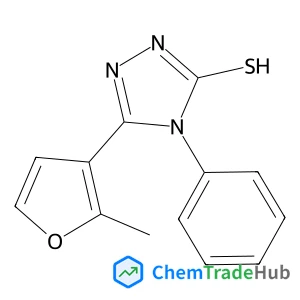
5-(2-Methyl-3-furyl)-4-phenyl-2,4-dihydro-3H-1,2,4-triazole-3-thione
CAS号:
346464-59-3
分子式:
C13H11N3OS
推荐供应商


免责声明
本页面提供的学术期刊信息仅供参考和研究使用。我们与任何期刊出版商均无关联,也不处理投稿事宜。如有投稿相关咨询,请直接联系相关期刊出版商。
如发现页面信息有误,请发送邮件至 support@chemtradehub.com 联系我们。我们将及时核实并处理您的问题。