




Unlocking the potential of furan-based poly(ester amide)s: an investigation of crystallization, molecular dynamics and degradation kinetics of novel poly(ester amide)s based on renewable poly(propylene furanoate)
文献信息
发布日期
2021-09-08
DOI
10.1039/D1PY00713K
影响因子
5.582
作者
Lazaros Papadopoulos, Panagiotis A. Klonos, Marcel Kluge, Alexandra Zamboulis, Zoi Terzopoulou, Dimitra Kourtidou, Andreas Magaziotis, Konstantinos Chrissafis, Apostolos Kyritsis, Dimitrios N. Bikiaris, Tobias Robert
查看原文
摘要
In this work, novel polyester amides (PEAs) based on renewable poly(propylene furanoate) (PPF) were prepared via traditional melt polycondensation utilizing a preformed symmetric amido diol (AD) containing two internal amide bonds. Owing to this innovative synthetic strategy, enhanced crystallization, both in terms of quantity and rate, was observed compared to neat PPF, which is characterized by slow crystallization kinetics. Moreover, the intramolecular hydrogen bonding usually observed in furan dicarboxylic acid (FDCA)-based polyamides, that results in the formation of low-molecular weight materials, was circumvented and copolymers of random structure and higher molecular weight were obtained. Due to the AD unit and the ensuing suppression of intramolecular hydrogen bonds, chain mobility (diffusion) is improved, leading in turn to enhanced crystallization. The crystallinity and crystal structure of PEAs were assessed via the combination of differential scanning calorimetry (DSC), X-ray diffraction (XRD) and polarized optical microscopy (POM). Furthermore, thermal degradation of the furan-based PEAs was thoroughly investigated for the first time, employing thermogravimetric analysis (TGA) kinetic modeling and Pyrolysis-Gas Chromatography–Mass Spectroscopy (Py-GC/MS). Finally, the complex molecular dynamics of PEAs was studied employing broadband dielectric spectroscopy (BDS). This study shows that PEAs have the potential to further enlarge the properties and applications of polyesters derived from FDCA.
相关文献
Three-dimensional AlN microroses and their enhanced photoluminescence properties
Weiwei Lei, Jian Zhang, Dan Liu, Pinwen Zhu, Qiliang Cui, Guangtian Zou
2008-09-12
Communication
DOI: 10.1039/B809380F
One-step fabrication of well-defined hollow CdS nanoboxes
Mee Rahn Kim, Du-Jeon Jang
2008-09-12
Communication
DOI: 10.1039/B809807G
LCST-type liquid–liquid phase separation behaviour of poly(ethylene oxide) derivatives in an ionic liquid
Ryohei Tsuda, Koichi Kodama, Takeshi Ueki, Hisashi Kokubo, Shin-ichiro Imabayashi, Masayoshi Watanabe
2008-08-28
Communication
DOI: 10.1039/B810127B
Changes in the electronic structure and properties of graphene induced by molecular charge-transfer
Rakesh Voggu, Chandra Sekhar Rout
2008-09-25
Communication
DOI: 10.1039/B808955H
Amino-substituted rylene dicarboximides and their quinoidal charge delocalization after deprotonation
Zhihong Liu, Chen Li, Manfred Wagner, Yuri Avlasevich, Andreas Herrmann, Klaus Müllen
2008-09-04
Communication
DOI: 10.1039/B811252E
An improved method for the synthesis of zirconium (CCC-N-heterocyclic carbene) pincer complexes and applications in hydroamination
Joon Cho, T. Keith Hollis, Theodore R. Helgert, Edward J. Valente
2008-09-19
Communication
DOI: 10.1039/B805174G
Activation of hydrocarbons on acidic zeolites: superior selectivity of methylation of ethene with methanol to propene on weakly acidic catalysts
Qingjun Zhu, Junko N. Kondo, Tooru Setoyama, Masashi Yamaguchi, Kazunari Domen, Takashi Tatsumi
2008-09-10
Communication
DOI: 10.1039/B809718F
Heparin–cellulose–charcoal composites for drug detoxification prepared using room temperature ionic liquids
Tae-Joon Park, Sang-Hyun Lee, Trevor J. Simmons, Shaker A. Mousa, Elisaveta A. Snezhkova, Veronika V. Sarnatskaya, Vladimir G. Nikolaev
2008-09-02
Communication
DOI: 10.1039/B809791G
Asymmetric 1,3-dipolar cycloaddition with a P-stereogenic dipolarophile: An efficient approach to novel P-stereogenic 1,2-diphosphine systems
Nikolai Vinokurov, K. Michał Pietrusiewicz, Sławomir Frynas, Michael Wiebcke, Holger Butenschön
2008-09-12
Communication
DOI: 10.1039/B810573A
Photochromic oligothienoacene derivatives with photo-switchable luminescene properties and computational studies
Chi-Chiu Ko, Wai Han Lam, Vivian Wing-Wah Yam
2008-09-12
Communication
DOI: 10.1039/B810585E
您可能还喜欢
化合物问答
3 - (二氟甲基)-1 -氟苯(CAS号:26029-52-7)适用哪些法规指南?
3 - (二氟甲基)-1 -氟苯需遵循联合国全球化学品统一分类和标签制度(GHS),包括急性毒性、皮肤腐蚀/刺激、严重眼损伤/眼刺激等分类。同时,该化合物还需符...
26029-52-71-(Difluoromethyl)-3...
化合物问答
3,5-二甲基苯胺(CAS号:108-69-0)通常如何合成?
3,5-二甲基苯胺通常通过乙苯的氨解反应合成。反应中使用硫酸作为催化剂,反应温度为120-130°C。乙苯在硫酸存在下与氨反应,生成3,5-二甲基苯胺和苯胺副产...
108-69-03,5-Dimethylaniline
化合物问答
3-甲基异噻唑-5-胺(CAS号:24340-76-9)安全吗?
3-甲基异噻唑-5-胺在适当使用和储存条件下是相对安全的,但在操作时应注意防护措施。应避免吸入粉尘,避免与皮肤和眼睛直接接触。在操作过程中,应穿戴适当的防护装备...
24340-76-93-Methyl-1,2-thiazol...
化合物问答
3-(1,3-Thiazol-2-yl)-1H-indole(CAS号:135531-86-1)通常如何合成?
3-(1,3-噻唑-2-基)-1H-吲哚通常通过多步合成方法制备。首先,由噻唑-2-基溴化物和吲哚进行偶联反应,得到中间体。然后,通过还原反应将中间体转化为所需...
135531-86-13-(1,3-Thiazol-2-yl)...
化合物问答
4-溴-2-氟苯甲基氯(CAS号:85510-82-3)的主要用途是什么?
4-溴-2-氟苯甲基氯主要用于有机合成中间体,特别是在医药、农药和染料等领域。作为一种具有特定结构的化合物,它在合成复杂有机分子时扮演重要角色。
85510-82-34-Bromo-1-(chloromet...
化合物问答
处理Fmoc-β-(3-噻吩基)-D-Ala-OH(CAS号:220497-90-5)时应注意哪些实验室安全事项?
处理Fmoc-β-(3-噻吩基)-D-Ala-OH时,应佩戴防护手套、护目镜和实验服。操作应在通风橱内进行。如发生泄露,应立即用大量水冲洗,并通知实验室管理人员...
220497-90-5N-[(9H-Fluoren-9-ylm...
化合物问答
氮化硅(CAS号:12033-89-5)通常如何合成?
氮化硅通常通过氮化硅的直接反应合成,即在高温下将四氯化硅与氨气反应。具体步骤是将四氯化硅和氨气混合并加热至1300-1700℃,在该条件下,四氯化硅与氨气反应生...
12033-89-5Trisilicon tetranitr...
化合物问答
Cetirizine EP Impurity B DiHCl(CAS号:1000690-91-4)通常如何合成?
Cetirizine EP Impurity B DiHCl通常通过一锅法合成,首先将4-氯苯基-苯甲基氯甲酸酯与1-哌嗪乙酸反应,生成相应的酸,然后与盐酸反应...
1000690-91-4{4-[(4-Chlorophenyl)...
化合物问答
如何储存1-哌啶-4-基丁-1-酮(CAS号:3509-15-7)?
1-哌啶-4-基丁-1-酮应储存在阴凉、干燥的地方,避免阳光直射。存储容器应密封,并确保通风良好。建议储存温度不超过25℃,湿度保持在相对较低的水平。
3509-15-71-Piperidin-4-ylbuta...
化合物问答
如何处理含有VORUCICLIB(CAS号:1000023-04-0)的废料?
含有VORUCICLIB的废料应进行专业的收集和处理,包括使用适当的容器进行隔离,避免与其他化学品接触。处理方法通常包括化学中和、沉淀反应或吸附过程,随后进行焚...
1000023-04-02-[2-Chloro-4-(trifl...
来源期刊
Polymer Chemistry

CiteScore:
8.6
自引率:
7.3%
年发文量:
457
Polymer Chemistry welcomes submissions in all areas of polymer science that have a strong focus on macromolecular chemistry. Manuscripts may cover a broad range of fields, yet no direct application focus is required.
推荐化合物
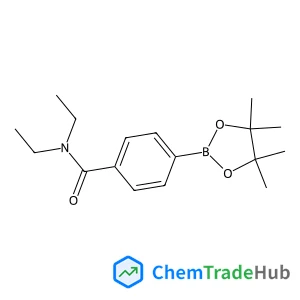
N,N-Diethyl-4-(4,4,5,5-tetramethyl-1,3,2-dioxaborolan-2-yl)benzamide
CAS号:
325142-99-2
分子式:
C17H26BNO3
![2,6-Di(thiophen-2-yl)dithieno[3,2-b:2',3'-d]thiophene structure](https://cnstatic.chemtradehub.com/structs/910/910788-24-8-5b70.webp "2,6-Di(thiophen-2-yl)dithieno[3,2-b:2',3'-d]thiophene structure")
推荐供应商



免责声明
本页面提供的学术期刊信息仅供参考和研究使用。我们与任何期刊出版商均无关联,也不处理投稿事宜。如有投稿相关咨询,请直接联系相关期刊出版商。
如发现页面信息有误,请发送邮件至 support@chemtradehub.com 联系我们。我们将及时核实并处理您的问题。