


Multifunctional P-ligand-controlled “silicon-centered” selectivity in Rh/Cu-catalyzed Si–C bond cleavage of silacyclobutanes
文献信息
发布日期
2021-10-05
DOI
10.1039/D1QO01386F
影响因子
5.281
作者
Xu Wang, Shuai-Shuai Huang, Feng-Jiao Zhang, Jia-Le Xie, Zhao Li, Zheng Xu, Fei Ye
查看原文
摘要
Silicon/carbon switching strategy, known as silasubstitution, plays an important role in drug discovery and material science. However, there is a dearth of efficient and precisely controlled methods for the introduction of a silicon center on complex molecules, which limits advances in the development of silicon-containing drug-like molecules. Here, we disclose an unprecendented process for the synthesis of six-membered functional silacycles based on multifunctional phosphine-promoted bimetallic Rh/Cu-catalyzed Si–C bond activation. The corresponding (4 + 2) annulation reaction chemoselectively and smoothly generates a wide range of monoester-functional silacyclohexenes. And it was found that only our newly developed Ar-BINMOL-Phos bearing a P-center and two hydroxyl groups exhibited perfect chemoselectivity with the aid of the cooperation of rhodium and copper co-catalysts, in which the Rh/Cu co-catalyzed (4 + 2) annulation of silacyclobutanes with arylpropiolate-type internal alkynes led to a facile synthesis of structurally diverse 1-sila-2-cyclohexenes with moderate to good yields. And with a chiral Ar-BINMOL-Phos bearing 3,5-tert-butyl substitutions on the aryl ring as a chiral P-ligand, good enantioselectivity at the “silicon-center” point chirality of the desired silicon-stereogenic silacycles was achieved under the cooperative catalysis of rhodium and copper.
期刊推荐
Electroanalysis

Polycyclic Aromatic Compounds
Journal of the Indian Institute of Science
Herald of the Russian Academy of Sciences

NDT & E International
Critical Reviews in Solid State and Materials Sciences

Topics in Catalysis
Chinese Journal of Chemistry

Atomization and Sprays
Bioorganic & Medicinal Chemistry Letters
相关文献
Reactivity of a N-heterocyclic carbene, 1,3-di-(1-adamantyl) imidazol-2-ylidene, with a pseudo-acid: structural characterization of Claisen condensation adduct
Gabriela A. Grasa, Rohit Singh, Natalie M. Scott, Edwin D. Stevens, Steven P. Nolan
2004-11-04
Communication
DOI: 10.1039/B410986D
Crystallography and magnetism of radicals with hindered hydroxyl groups: 2-(3,5-di-tert-butyl-4-hydroxyphenyl)-4,4,5,5-tetramethyl-4,5-dihydro-1H-imidazole-3-oxide-1-oxyl and 2-(3,5-di-tert-butyl-4-hydroxyphenyl)-4,4,5,5-tetramethyl-4,5-dihydro-1H-imidazole-1-oxyl
Patrick Taylor, Paul M. Lahti
2004-10-27
Communication
DOI: 10.1039/B411574K
Ni(iii) vs. Ni(ii)-thiyl radical: charge-delocalisation in a binuclear Ni(iii)Ni(ii)-dithiolate complex
Neil D. J. Branscombe, Andrew J. Atkins, Armando Marin-Becerra, Eric J. L. McInnes, Frank E. Mabbs, Jonathan McMaster, Martin Schröder
2003-04-02
Communication
DOI: 10.1039/B300245D
Water-soluble supramolecular bowls formed by intra-clipping of resorcin[4]arene-based ligands with Pd(ii) ions
Seong Jin Park, Dong Mok Shin, Shigeru Sakamoto, Kentaro Yamaguchi, Young Keun Chung, Myoung Soo Lah
2003-03-19
Communication
DOI: 10.1039/B212855A
Bioinspired synthesis of new silica structures
Siddharth V. Patwardhan, Niloy Mukherjee, Miriam Steinitz-Kannan, Stephen J. Clarson
2003-04-23
Communication
DOI: 10.1039/B302056H
From atactic to isotactic CO/p-methylstyrenecopolymer by proper modification of Pd(ii) catalysts bearing achiral α-diimines
Barbara Binotti, Carla Carfagna, Cristiano Zuccaccia, Alceo Macchioni
2004-11-29
Communication
DOI: 10.1039/B411214H
Biotinylated poly(p-phenylene ethynylene): unexpected energy transfer results in the detection of biological analytes
Juan Zheng, Timothy M. Swager
2004-11-04
Communication
DOI: 10.1039/B408478K
Synthesis and structure of [{Sn(μ–PCy)}3(Na·PMDETA)2], containing an electron-deficient [{Sn(μ–PCy)}3]2− dianion
Paula Alvarez-Bercedo, Andrew D. Bond, Robert Haigh, Alexander D. Hopkins, Gavin T. Lawson, Mary McPartlin, David Moncrieff, Marta E. Gonzalez Mosquera, Jeremy M. Rawson, Anthony D. Woods, Dominic S. Wright
2003-05-06
Communication
DOI: 10.1039/B300522D
Electrical property and water repellency of a networked monolayer film prepared from Au nanoparticles
Hiroshi Shiigi, Yojiro Yamamoto, Hidetaka Yakabe, Shiho Tokonami, Tsutomu Nagaoka
2003-04-02
Communication
DOI: 10.1039/B212226J
In situ magnetic resonance imaging of electrically-induced water diffusion in a Nafion ionic polymer film
Richard T. Baker, Leila Naji, Karen Lochhead, John A. Chudek
2003-03-18
Communication
DOI: 10.1039/B301039B
您可能还喜欢
化合物问答
如何处理含有8-氯咪唑并[1,2-A]吡嗪(CAS号:69214-33-1)的废料?
处理含有8-氯咪唑并[1,2-A]吡嗪的废料时,应首先将其收集并进行化学回收或降解。如果无法回收,需采用安全的化学处理方法,如中和、氧化还原或沉淀。处理过程中需...
69214-33-18-chloroimidazo[1,2-...
化合物问答
Calhex 231 hydrochloride(CAS号:2387505-78-2)适用哪些法规指南?
Calhex 231 hydrochloride 需要遵循《全球化学品统一分类和标签制度》(GHS)的分类和标签要求,以及欧盟的《化学品注册、评估、授权和限制条...
2387505-78-24-Chloro-N-[(1S,2S)-...
化合物问答
11-Beta,17-alpha,21-三羟基-5-beta-孕烯-3,20-二酮(CAS号:1482-50-4)的物理化学性质是什么?
11-Beta,17-alpha,21-三羟基-5-beta-孕烯-3,20-二酮是一种无色结晶性粉末,分子量为372.45 g/mol。该化合物在水中的溶解度...
1482-50-45β-Dihydrocortisol
化合物问答
处理5-异丙基-1,3,4-恶二唑-2-羧酸(CAS号:944907-13-5)时应注意哪些实验室安全事项?
处理5-异丙基-1,3,4-恶二唑-2-羧酸时应注意以下安全事项:穿戴适当的个人防护装备,包括实验室外套、手套和护目镜;操作应在通风橱中进行,以减少吸入或接触有...
944907-13-55-Isopropyl-1,3,4-ox...
化合物问答
benzyl 3-bromopropanoate(CAS号:90841-55-7)安全吗?
Benzyl 3-bromopropanoate属于有毒物质,吸入、摄入或皮肤接触均可能对人体造成伤害。操作时应佩戴防护眼镜、口罩和手套,避免吸入蒸汽和直接接触...
90841-55-7Benzyl 3-bromopropan...
化合物问答
什么是(R)-N-苄氧羰基-3,4-二氢-1H-异喹啉羧酸(CAS号:151004-88-5)?
(R)-N-苄氧羰基-3,4-二氢-1H-异喹啉羧酸是一种含有苄氧羰基和异喹啉环结构的化合物,分子式为C17H15NO3。它是一种有机化合物,具有一定的生物活性...
151004-88-5(1R)-2-[(Benzyloxy)c...
化合物问答
在合成中是否有1-苄基吡啶嗡-3-羧酸盐(CAS号:15990-43-9)的替代品?
可以考虑使用1-苄基吡啶-3-羧酸盐作为1-苄基吡啶嗡-3-羧酸盐的替代品。此外,还可以探索其他类似物,如1-苄基吡啶-3-氨基甲酸酯等。具体的替代品选择需根据...
15990-43-91-Benzyl-3-pyridiniu...
化合物问答
(2,6-二甲基吡啶-3-基)甲醇(CAS号:582303-10-4)安全吗?
(2,6-二甲基吡啶-3-基)甲醇在使用时需注意安全,应避免吸入其蒸汽,接触皮肤和眼睛。操作应在通风良好的环境中进行,佩戴适当的个人防护装备。
582303-10-4(2,6-Dimethyl-3-pyri...
化合物问答
5-溴-2-乙烯基吡啶(CAS号:226883-52-9)的物理化学性质是什么?
5-溴-2-乙烯基吡啶是一种有机化合物,外观为白色固体,具有良好的结晶性。分子量约为190.03 g/mol。它的溶解性在水中较差,但在有机溶剂如二氯甲烷、甲醇...
226883-52-95-Bromo-2-vinylpyrid...
化合物问答
2-羟基-3-硝基-5-甲基吡啶(CAS号:7464-14-4)应用于哪些行业?
2-羟基-3-硝基-5-甲基吡啶主要应用于医药、聚合物和半导体行业。在医药领域,它可以用作合成其他药物的中间体。在聚合物领域,它可以作为功能性单体参与聚合反应,...
7464-14-45-Methyl-3-nitro-2(1...
来源期刊
Organic Chemistry Frontiers

CiteScore:
7.8
自引率:
8.7%
年发文量:
724
Organic Chemistry Frontiers publishes high-quality research from across organic chemistry. Emphases are placed on studies that make significant contributions to the field of organic chemistry by reporting either new or significantly improved protocols or methodologies. Topics include, but are not limited to the following: Organic synthesis Development of synthetic methodologies Catalysis Natural products Functional organic materials Supramolecular and macromolecular chemistry Physical and computational organic chemistry
推荐化合物
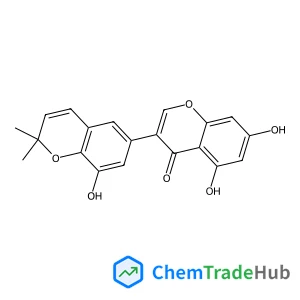
![N-[(5,6-Dichloro-1H-benzimidazol-2-yl)methyl]-9-(1-methyl-1H-pyrazol-4-yl)-2-(4-morpholinyl)-9H-purin-6-amine structure](https://cnstatic.chemtradehub.com/structs/238/2387704-62-1-25f4.webp "N-[(5,6-Dichloro-1H-benzimidazol-2-yl)methyl]-9-(1-methyl-1H-pyrazol-4-yl)-2-(4-morpholinyl)-9H-purin-6-amine structure")

推荐供应商


免责声明
本页面提供的学术期刊信息仅供参考和研究使用。我们与任何期刊出版商均无关联,也不处理投稿事宜。如有投稿相关咨询,请直接联系相关期刊出版商。
如发现页面信息有误,请发送邮件至 support@chemtradehub.com 联系我们。我们将及时核实并处理您的问题。