











Xanthene, cyanine, oxazine and BODIPY: the four pillars of the fluorophore empire for super-resolution bioimaging
文献信息
发布日期
2023-09-25
DOI
10.1039/D2CS00905F
影响因子
54.564
作者
Soham Samanta, Kaitao Lai, Feihu Wu, Yingchao Liu, Songtao Cai, Xusan Yang, Junle Qu, Zhigang Yang
查看原文
摘要
In the realm of biological research, the invention of super-resolution microscopy (SRM) has enabled the visualization of ultrafine sub-cellular structures and their functions in live cells at the nano-scale level, beyond the diffraction limit, which has opened up a new window for advanced biomedical studies to unravel the complex unknown details of physiological disorders at the sub-cellular level with unprecedented resolution and clarity. However, most of the SRM techniques are highly reliant on the personalized special photophysical features of the fluorophores. In recent times, there has been an unprecedented surge in the development of robust new fluorophore systems with personalized features for various super-resolution imaging techniques. To date, xanthene, cyanine, oxazine and BODIPY cores have been authoritatively utilized as the basic fluorophore units in most of the small-molecule-based organic fluorescent probe designing strategies for SRM owing to their excellent photophysical characteristics and easy synthetic acquiescence. Since the future of next-generation SRM studies will be decided by the availability of advanced fluorescent probes and these four fluorescent building blocks will play an important role in progressive new fluorophore design, there is an urgent need to review the recent advancements in designing fluorophores for different SRM methods based on these fluorescent dye cores. This review article not only includes a comprehensive discussion about the recent developments in designing fluorescent probes for various SRM techniques based on these four important fluorophore building blocks with special emphasis on their effective integration into live cell super-resolution bio-imaging applications but also critically evaluates the background of each of the fluorescent dye cores to highlight their merits and demerits towards developing newer fluorescent probes for SRM.
相关文献
A mechanistic study of the manganese porphyrin-catalyzed C–H isocyanation reaction
Ning Liu, Xiahe Chen, Liyuan Jin, Yun-Fang Yang, Yuan-Bin She
2021-02-18
Research Article
DOI: 10.1039/D0QO01442G
α-C–H difluoroalkylation of alkyl sulfoxides via intermolecular Pummerer reaction
Xin Huang, Weizhao Zhao, Yuchen Liang, Minghui Wang, Yaling Zhan, Yage Zhang, Lichun Kong, Zhi-Xiang Wang, Bo Peng
2021-01-22
Research Article
DOI: 10.1039/D0QO01513J
The decomposition of diazo-compounds induced by nucleophiles. The decomposition of 9-diazofluorene in the presence of hydroxide or alkoxide ions
Linda J. McDowell, M. Mehdi Khodaei, Donald Bethell
2003-02-25
Paper
DOI: 10.1039/B211139J
Recent advances in visible-light photocatalytic deuteration reactions
Rong Zhou, Lishuang Ma, Xiaona Yang, Jilei Cao
2020-11-20
Review Article
DOI: 10.1039/D0QO01299H
3,6-Diamino-7,8-dihydroisoquinoline-4-carbonitrile derivatives: unexpected facile synthesis, full-color-tunable solid-state emissions and mechanofluorochromic activities
Xinyu Zhang, Dan Wang, Hao Shen, Shuxian Wang, Yunbing Zhou, Yunxiang Lei, Wenxia Gao, Miaochang Liu, Xiaobo Huang, Huayue Wu
2021-01-11
Research Article
DOI: 10.1039/D0QO01527J
Metal-free visible-light-induced photoredox-catalyzed intermolecular pyridylation/phosphinoylation of alkenes
Jiaxuan Shen, Yipin Zhang, Yanjiang Yu, Manman Wang
2020-12-22
Research Article
DOI: 10.1039/D0QO01218A
The chemical synthesis of β-(1→4)-linked D-mannobiose and D-mannotriose
Gavin W. J. Twaddle, Dmitry V. Yashunsky, Andrei V. Nikolaev
2003-01-30
Paper
DOI: 10.1039/B210661M
Synthesis and bioactivity of labelled germination stimulants for the isolation and identification of the strigolactone receptor
Anat Reizelman, Suzanne C. M. Wigchert, Cinzia del-Bianco, Binne Zwanenburg
2003-02-24
Paper
DOI: 10.1039/B210678G
Pyrimethamine analogs as strong inhibitors of double and quadruple mutants of dihydrofolate reductase in human malaria parasites
Alireza Sardarian, Kenneth T. Douglas, Martin Read, Paul F. G. Sims, John E. Hyde, Penchit Chitnumsub, Rachada Sirawaraporn, Worachart Sirawaraporn
2003-02-25
Paper
DOI: 10.1039/B211636G
您可能还喜欢
化合物问答
4-[4-三氟甲基苯基]恶唑(CAS号:1126636-40-5)通常如何合成?
4-[4-三氟甲基苯基]恶唑通常通过将4-三氟甲基苯酚与异硫氰酸苯酯在有机溶剂中进行酯化反应合成。该反应可在无水条件下,使用适当的催化剂,如四丁基氢氧化铵,以提...
1126636-40-54-(4-(Trifluoromethy...
59729-32-71-[3-(Dimethylamino)...
化合物问答
RockPhos Pd G3(CAS号:2009020-38-4)通常如何合成?
RockPhos Pd G3 通常通过钯催化偶联反应合成,使用配体 (2'-Amino-2-biphenylyl)(methanesulfonato-kappa...
2009020-38-4(2'-Amino-2-biphenyl...
化合物问答
1-哌啶甲酰胺(CAS号:2158-03-4)的市场或研究趋势如何?
1-哌啶甲酰胺作为有机合成中的重要中间体,其市场需求主要受医药、农药、染料等行业推动。近年来,随着新药开发和绿色化学的发展,该化合物的研究趋势集中在开发更高效、...
2158-03-41-Piperidinecarboxam...
化合物问答
2-(二苯基膦基)乙胺(CAS号:4848-43-5)适用哪些法规指南?
2-(二苯基膦基)乙胺适用于多种法规指南,包括但不限于《全球化学品统一分类和标签制度》(GHS),欧盟《化学品注册、评估、授权和限制》法规(REACH),以及美...
4848-43-52-(Diphenylphosphino...
化合物问答
如何储存间苯二甲酸二烯丙酯(CAS号:1087-21-4)?
间苯二甲酸二烯丙酯应储存在阴凉、干燥、通风良好的地方,远离火源和热源。储存容器应密封,避免光照和高温。储存温度应控制在25℃以下,相对湿度应低于80%。避免与其...
1087-21-4Diallyl isophthalate
化合物问答
什么是间甲苯异硫代异氰酸酯(CAS号:621-30-7)?
间甲苯异硫代异氰酸酯是一种有机化合物,分子式为C7H7NO2S,具有刺激性气味。它是一种重要的有机合成中间体,在合成其他化合物时广泛应用。
621-30-71-Isothiocyanato-3-m...
化合物问答
在合成中是否有N-Boc-D-苯丙氨醇(CAS号:106454-69-7)的替代品?
在合成中,可以考虑使用N-Cbz-D-苯丙氨醇或N-Fmoc-D-苯丙氨醇作为替代品。这些化合物同样具有保护氨基的功能,且在合成过程中表现出良好的反应性能。
106454-69-72-Methyl-2-propanyl ...
化合物问答
3-羟甲基-2-氧异丙基吡啶(CAS号:954240-50-7)的主要用途是什么?
3-羟甲基-2-氧异丙基吡啶主要用于有机合成领域,可以作为合成其他药物、农药或精细化学品的中间体。此外,它还可能在实验室研究中作为特定反应的前体或溶剂。
954240-50-7(2-Isopropoxy-3-pyri...
化合物问答
6-氨基-9-甲基嘌呤(CAS号:700-00-5)应用于哪些行业?
6-氨基-9-甲基嘌呤目前主要应用于医药行业,作为某些药物的中间体。此外,它还可能用于聚合物、传感器和半导体的某些领域,作为功能性单体或掺杂剂。
700-00-59-Methyl-9H-purin-6-...
来源期刊
Chemical Society Reviews

CiteScore:
80.8
自引率:
1.2%
年发文量:
250
Chem Soc Rev publishes review articles covering important topics at the forefront of the chemical sciences. Reviews should be of the very highest quality and international impact. We particularly encourage international and multidisciplinary collaborations among our authors. Our scope covers the breadth of the chemical sciences, including interdisciplinary topics where the article has a basis in chemistry. Topics include: Analytical chemistry Biomaterials chemistry Bioorganic/medicinal chemistry Catalysis Chemical Biology Coordination Chemistry Crystal Engineering Energy Sustainable chemistry Green chemistry Inorganic chemistry Inorganic materials Main group chemistry Nanoscience Organic chemistry Organic materials Organometallics Physical chemistry Supramolecular chemistry Synthetic methodology Theoretical and computational chemistry
推荐化合物
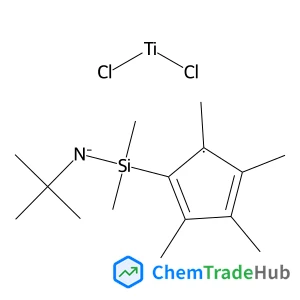
2,3,4,5-TETRAMETHYLCYCLOPENTADIENEDIMETHYLSILYL-TERT-BUTYLAMIDO TITANIUM DICHLORIDE
CAS号:
135072-61-6
分子式:
C15H27Cl2NSiTi-
推荐供应商







免责声明
本页面提供的学术期刊信息仅供参考和研究使用。我们与任何期刊出版商均无关联,也不处理投稿事宜。如有投稿相关咨询,请直接联系相关期刊出版商。
如发现页面信息有误,请发送邮件至 support@chemtradehub.com 联系我们。我们将及时核实并处理您的问题。