








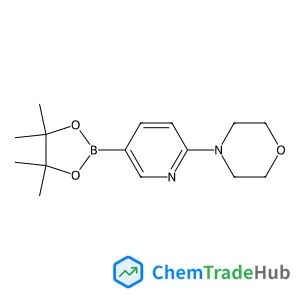
4-(5-(4,4,5,5-tetramethyl-1,3,2-dioxaborolan-2-yl)pyridin-2-yl)morpholine
CAS号:
485799-04-0
分子式:
C15H23BN2O3
Danim Yun, Zhongyao Zhang, David W. Flaherty
Oxidative cleavage of alkenes and unsaturated fatty acids with hydrogen peroxide gives an efficient and sustainable process to obtain mono- and di-acids for polymers and lubricants with fewer safety risks and less environmental impact than processes that utilize ozone or other inorganic oxidizers (e.g., permanganate, dichromate, etc.). Guided by insight into the mechanisms for competing reaction pathways (i.e., epoxidation of alkene on W–(η2-O2) complexes vs. H2O2 decomposition) and the apparent kinetics derived from kinetic experiments, here, we postulate that W-based heterogeneous catalysts can provide high performance and stable operations at low H2O2 concentrations. Semi-batch reactors with continuous introduction of H2O2 solutions offer the means to maintain low H2O2 concentrations while providing sufficient quantities of H2O2 to satisfy the reaction stoichiometry. We derived simple kinetic model equations for the epoxidation, ring-opening, oxidative cleavage, and oxidation steps and fit theses equations to batch experimental data to obtain kinetic parameters. This kinetic model describes the concentration profiles of reactant, oxidant, and products well as shown by agreement with experimental data. Further predictions of the optimal H2O2 feed rate for semi-batch operation utilized by the proposed rate expressions and the reactor design equations suggest that low H2O2 feed rate increases selectivity towards oxidative cleavage products and selective use of H2O2 for oxidative cleavage pathway. Comparisons of oxidative cleavage of 4-octene in batch and semi-batch reactors show that semibatch reactors with optimized molar feed rates of H2O2 increased oxidative cleavage product selectivities (76% to 99%; with an increase in butyric acid selectivity from 1% to 55%) and H2O2 selectivity (3% to 30%). In addition, semibatch reaction conditions used avoid H2O2-mediated dissolution of W-atoms from the catalyst. Analysis of these findings suggest that solid oxide catalysts will be effective for continuous oxidative cleavage reactions if deployed within fixed-bed reactors that allow for distributed introduction of reactants and therefore low in situ concentrations of H2O2.
DOI: 10.1039/C9CP05583E
Natalia Bushlanova, Yurii Uspenskii
DOI: 10.1039/D0CP05139J
Weiwei Ju, Shuai Zhang, Caijuan Xia
DOI: 10.1039/C9CP05185F
Huiwen Wang, Linlu Song, Ting Zhou, Chen Zeng, Ya Jia, Yunjie Zhao
DOI: 10.1039/D0CP03662E
E. M. Gavilán-Arriazu, Rodrigo E. Giménez, O. A. Pinto
DOI: 10.1039/D0CP03348K
Xiaoxiao Lu, Bina Fu, Dong H. Zhang
DOI: 10.1039/D0CP04611F
Chongshan Yin, Chunqing He, Qicheng Liu, Bangyun Xiong, Xiaowei Zhang, Libing Qian, Jingjing Li, Yawei Zhou
DOI: 10.1039/C9CP04832D
Stuart J. Brown, Calum J. Drummond, Jessica Marchand, Kieran P. Stockton, Tamar L. Greaves
DOI: 10.1039/D0CP03994B
Tae-Hyeon Park, Dong-Won Jeong, Du-Jeon Jang
DOI: 10.1039/D0CP03734F
处理含有该化合物的废料时,应先收集并分类,然后根据其危险特性选择合适的处理方法。推荐采用焚烧或由专业机构进行安全处理,以确保符合环保法规的要求。处理过程中应佩戴...
4-氨基-2-溴-3-碘吡啶主要应用于药物合成和研究领域,尤其是在抗病毒和抗癌药物的研发中。随着新型药物的需求增加,该化合物的研究趋势较好。市场方面,由于其特殊...
当前,4-乙酰基氨基-2-氨基-苯甲酸(CAS号:43134-76-5)在医药和化工领域有一定的应用。随着药物研发的进展,该化合物在新型药物设计中的应用可能增加...
该化合物目前主要用于特定的工业应用,如氟聚合物的合成。市场趋势显示,由于其独特的结构和性能,未来可能在新型氟材料和特种化学品领域有更多的应用。研究趋势方面,主要...
可以考虑使用1,3-丁二烯-1-炔-3-基-聚乙二醇-13-溴化物作为Propargyl-PEG13-bromide的替代品,因为两者在结构上相似,均可用于合成...
2-氨基-6-甲氧基嘌呤在正常使用条件下相对安全,但在操作时仍需注意防护措施,如佩戴手套和护目镜,避免吸入或接触皮肤和眼睛。
该化合物根据其化学性质和潜在危害,可能适用于GHS(全球化学品统一分类和标签制度)的分类标准。具体分类需依据其毒性和燃烧危险性进行评估。此外,欧洲化学品管理局(...
4,4-二甲基吡咯烷-3-羧酸盐酸盐在医药、聚合物和传感器领域有应用。在医药领域,它可以作为某些药物的中间体;在聚合物领域,它可用作某些聚合物的稳定剂;在传感器...
处理该化合物时应注意使用个人防护装备(如手套、护目镜和实验服),在通风橱中操作。避免直接接触皮肤和吸入,泄漏时应立即清理并使用适当的吸收材料。参考安全数据表(S...
该化合物在医药研究中具有潜在应用价值,特别是在抗癌药物研发方面。随着研究的深入,对其合成方法的优化和生物活性的进一步探索将成为研究热点。
Reaction Chemistry & Engineering is an interdisciplinary journal reporting cutting-edge research focused on enhancing the understanding and efficiency of reactions. Reaction engineering leverages the interface where fundamental molecular chemistry meets chemical engineering and technology. Challenges in chemistry can be overcome by the application of new technologies, while engineers may find improved solutions for process development from the latest developments in reaction chemistry. Reaction Chemistry & Engineering is a unique forum for researchers whose interests span the broad areas of chemical engineering and chemical sciences to come together in solving problems of importance to wider society. All papers should be written to be approachable by readers across the engineering and chemical sciences. Papers that consider multiple scales, from the laboratory up to and including plant scale, are particularly encouraged.
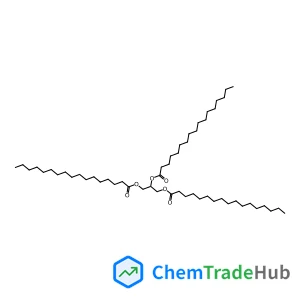
![N-[(9H-Fluoren-9-ylmethoxy)carbonyl]-beta-phenyl-L-phenylalanine structure](https://cnstatic.chemtradehub.com/structs/201/201484-50-6-c2fc.webp "N-[(9H-Fluoren-9-ylmethoxy)carbonyl]-beta-phenyl-L-phenylalanine structure")
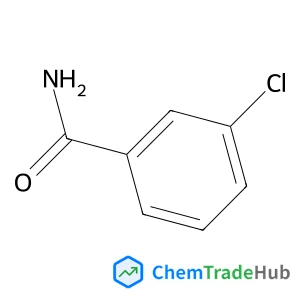
![Ethyl 3-((6-(4,5-dihydro-1H-benzo[d]azepin-3(2H)-yl)-2-(pyridin-2-yl)pyrimidin-4-yl)amino)propanoate structure](https://cnstatic.chemtradehub.com/structs/137/1373423-53-0-496a.webp "Ethyl 3-((6-(4,5-dihydro-1H-benzo[d]azepin-3(2H)-yl)-2-(pyridin-2-yl)pyrimidin-4-yl)amino)propanoate structure")



