








phosphoryl}methyl 4-methylbenzenesulfonate structure](https://cnstatic.chemtradehub.com/structs/864/864068-45-1-ba7c.webp "{[3-(Hexadecyloxy)propoxy](hydroxy)phosphoryl}methyl 4-methylbenzenesulfonate structure")
Efficient large-scale screening of viral pathogens by fragment length identification of pooled nucleic acid samples (FLIPNAS)
文献信息
发布日期
2023-03-09
DOI
10.1039/D3AN00058C
影响因子
4.616
作者
Xianzhen Feng, Xinyu Zhuang, Grace Lui, I-Ming Hsing
查看原文
摘要
The necessity for the large-scale screening of viral pathogens has been amply demonstrated during the COVID-19 pandemic. During this time, SARS-CoV-2 nucleic acid pooled testing, such as Dorfman-based group testing, was widely adopted in response to the sudden increased demand for detection. However, the current approach still necessitates the individual retesting of positive pools. Here, we established an efficient method termed the fragment-length identification of pooled nucleic acid samples (FLIPNAS), where all subsamples (n = 8) can be uniquely labelled and tested in a single-time detection among pools of samples. We used a novel and simple design of unique primers (UPs) to generate amplicons of unique lengths after reverse transcription and polymerase chain reaction to reach this aim. As a result, the unique lengths of the amplicons can be recognized and traced back to the corresponding UPs and specific samples. Our results demonstrated that FLIPNAS could recognize one to eight positive subsamples in a single test without retesting positive pools. The system also showed sufficient sensitivity for the mass monitoring of SARS-CoV-2 and no cross-reactivity against three common respiratory diseases. Moreover, the FLIPNAS results of 40 samples with a positive ratio of 7.8% were in 100% agreement with their individual detection results using the gold standard. Collectively, this study shows that the efficiency of nucleic acid pooling detection can be further improved by FLIPNAS, which can speed up testing and mitigate the urgent demand for resources.
相关文献
Dependence of negative-mode electrospray ionization response factors on mobile phase composition and molecular structure for newly-authenticated neutral acylsucrose metabolites
Banibrata Ghosh
2015-08-27
Paper
DOI: 10.1039/C4AN02124J
Ion-neutral collisional cross sections of carbohydrate isomers as divalent cation adducts and their electron transfer products
Yuting Huang, Eric D. Dodds
2015-07-22
Paper
DOI: 10.1039/C5AN01093D
Sub-cellular spectrochemical imaging of isolated human corneal cells employing synchrotron radiation-based Fourier-transform infrared microspectroscopy
Imran I. Patel, Júlio Trevisan, Takahiro Nakamura, Carol J. Hirschmugl, Nigel J. Fullwood, Francis L. Martin
2012-11-01
Paper
DOI: 10.1039/C2AN36197C
Mercury-induced fragmentation of n-decane and n-undecane in positive mode ion mobility spectrometry
2015-07-22
Paper
DOI: 10.1039/C5AN00876J
Fluorescent polymer-based post-translational differentiation and subtyping of breast cancer cells
Michael D. Scott, Rinku Dutta, Manas K. Haldar, Anil Wagh, Thomas R. Gustad, Benedict Law, Daniel L. Friesner, Sanku Mallik
2012-10-04
Communication
DOI: 10.1039/C2AN35877H
Strand displacement activated peroxidase activity of hemin for fluorescent DNA sensing
Quanbo Wang, Nan Xu, Zhen Gui, Jianping Lei, Huangxian Ju, Feng Yan
2015-08-07
Paper
DOI: 10.1039/C5AN01206F
Development of a method for detecting trace metals in aqueous solutions based on the coordination chemistry of hexahydrotriazines
Rudy J. Wojtecki, Alexander Y. Yuen, Thomas G. Zimmerman, Gavin O. Jones, Hans W. Horn, Dylan J. Boday, James L. Hedrick, Jeannette M. García
2015-06-02
Paper
DOI: 10.1039/C5AN00099H
MALDI mass spectrometric imaging meets “omics”: recent advances in the fruitful marriage
2015-06-29
Minireview
DOI: 10.1039/C5AN00990A
Multimodal chemical imaging of molecular messengers in emerging Pseudomonas aeruginosa bacterial communities
Nameera F. Baig, Sage J. B. Dunham, Jonathan V. Sweedler, Paul W. Bohn
2015-08-24
Paper
DOI: 10.1039/C5AN01149C
Graphene oxide modified light addressable potentiometric sensor and its application for ssDNA monitoring
Yunfang Jia, Xue-Bo Yin, Jia Zhang, Shuang Zhou, Meng Song, Ke-Li Xing
2012-10-02
Paper
DOI: 10.1039/C2AN36087J
您可能还喜欢
化合物问答
如何储存1,2-环己二酮环乙缩醛(CAS号:4746-96-7)?
1,2-环己二酮环乙缩醛应储存在阴凉、干燥、通风良好的地方,避免阳光直射。建议使用密封容器保存,并保持环境温度在室温范围内,远离火源和热源。
4746-96-71,4-Dioxaspiro[4.5]d...
化合物问答
Ecopladib(CAS号:381683-92-7)的市场或研究趋势如何?
Ecopladib作为一种新型的药物,主要应用于治疗高胆固醇等疾病。目前,市场和研究趋势显示,Ecopladib因其独特的药理作用而受到关注。随着对心血管疾病治...
381683-92-7Ecopladib
化合物问答
2,3-Dimethyl-3H-imidazo[4,5-c]pyridine(CAS号:52538-09-7)通常如何合成?
2,3-二甲基-3H-咪唑[4,5-c]吡啶通常通过咪唑和2,3-二甲基吡啶的缩合反应合成。具体来说,将咪唑和2,3-二甲基吡啶在适当的溶剂中进行加热或加压反应...
52538-09-72,3-Dimethyl-3H-imid...
化合物问答
2,3,4,5-tetrahydro-1H-3-苯并氮杂环;盐酸盐(CAS号:17379-01-0)的市场或研究趋势如何?
该化合物在药物化学和有机合成中有一定的应用。近年来,随着对新型药物化合物的需求增加,该化合物的研究趋势主要集中在探索其生物活性,尤其是其在神经系统疾病治疗中的潜...
17379-01-02,3,4,5-Tetrahydro-1...
68-90-6(2-Ethyl-1-benzofura...
化合物问答
如何储存盐酸甘氨酸丁酯(CAS号:13048-99-2)?
盐酸甘氨酸丁酯应储存在阴凉、干燥、通风良好的地方,避免阳光直射和高温环境,温度应控制在25℃以下。储存容器应密封,避免与空气中的水分和酸性物质接触,以防发生水解...
13048-99-2Butyl glycinate hydr...
化合物问答
什么是2-Iodo-N,N-dimethylbenzamide(CAS号:54616-46-5)?
2-碘-N,N-二甲基苯胺是一种有机化合物,化学名为2-Iodo-N,N-dimethylbenzamide。其分子式为C<sub>9</sub>H<sub>1...
54616-46-52-Iodo-N,N-dimethylb...
16817-90-6N-Cyclohexylglycinam...
化合物问答
5-溴-2-(4H-1,2,4-三唑-4-基)吡啶(CAS号:959240-99-4)的市场或研究趋势如何?
随着医药、农药和新材料领域的发展,该化合物作为关键中间体的应用日益增多。特别是在药物合成中,由于其独特的化学性质,可以用于合成多种药物分子。未来的研究趋势可能集...
959240-99-45-Bromo-2-(4H-1,2,4-...
化合物问答
2,4-二溴-6-三氟甲基嘧啶(CAS号:785778-00-9)通常如何合成?
2,4-二溴-6-三氟甲基嘧啶通常通过溴化反应合成。首先,将6-三氟甲基嘧啶与溴化剂(如液溴)在适当的溶剂(如二氯甲烷、四氢呋喃)中反应,加入适当的催化剂(如四...
785778-00-92,4-Dibromo-6-(trifl...
来源期刊
Analyst

CiteScore:
7.8
自引率:
5.6%
年发文量:
653
Analyst publishes analytical and bioanalytical research that reports premier fundamental discoveries and inventions, and the applications of those discoveries, unconfined by traditional discipline barriers.
推荐化合物

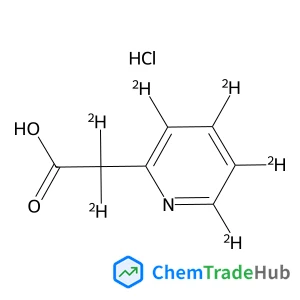
2,2-dideuterio-2-(3,4,5,6-tetradeuterio-2-pyridyl)acetic acid;hydrochloride
CAS号:
1329799-67-8
分子式:
C7H2ClD6NO2


推荐供应商



免责声明
本页面提供的学术期刊信息仅供参考和研究使用。我们与任何期刊出版商均无关联,也不处理投稿事宜。如有投稿相关咨询,请直接联系相关期刊出版商。
如发现页面信息有误,请发送邮件至 support@chemtradehub.com 联系我们。我们将及时核实并处理您的问题。