


An interrupted Heyns rearrangement approach for the regioselective synthesis of acylindoles
文献信息
发布日期
2023-10-24
DOI
10.1039/D3CC04144A
影响因子
6.222
作者
Minakshi Altia, Pazhamalai Anbarasan
查看原文
摘要
An efficient and general method for the synthesis of 2- and 3-acylindoles has been achieved with high regioselectivity from o-acylanilines and α-hydroxycarbonyl or its equivalent. The strategy involves the intramolecular trapping of an in situ generated aminoenol intermediate and an interrupted Heyns rearrangement pathway, followed by aromatization or rearrangement/aromatization. Important features include excellent regiocontrol, good functional group tolerance, operational simplicity and application to gram-scale synthesis and the synthesis of an anti-tumor agent.
相关文献
Charge ordering and scattering pre-peaks in ionic liquids and alcohols
2016-12-06
Paper
DOI: 10.1039/C6CP07834F
Luminophores of tunable colors from ternary Ag–In–S and quaternary Ag–In–Zn–S nanocrystals covering the visible to near-infrared spectral range
Grzegorz Gabka, Piotr Bujak, Kamil Kotwica, Andrzej Ostrowski, Wojciech Lisowski, Janusz W. Sobczak, Adam Pron
2016-12-02
Paper
DOI: 10.1039/C6CP07008F
Ferromagnetism in nitrogen-doped BaO: a self-interaction corrected DFT study
Elisa Albanese, Gianfranco Pacchioni
2016-12-22
Paper
DOI: 10.1039/C6CP07535E
Internal dynamics in helical molecules studied by X-ray diffraction, NMR spectroscopy and DFT calculations
Martin Dračínský, Jan Storch, Vladimír Církva, Ivana Císařová, Jan Sýkora
2017-01-03
Paper
DOI: 10.1039/C6CP07552E
Oxidation, defunctionalization and catalyst life cycle of carbon nanotubes: a Raman spectroscopy view
Anton S. Ivanov, Konstantin I. Maslakov, Alexander V. Egorov, Zexiang Shen
2016-12-12
Paper
DOI: 10.1039/C6CP04657F
Hot electron-driven photocatalytic water splitting
Bingya Hou, Lang Shen, Haotian Shi, Rehan Kapadia
2017-01-05
Paper
DOI: 10.1039/C6CP07542H
Distant ultrafast energy transfer in a trimetallic {Ru–Ru–Cr} complex facilitated by hole delocalization
Alejandro Cadranel, Jaired E. Tate, Paola S. Oviedo, Shiori Yamazaki, José H. Hodak, Luis M. Baraldo, Valeria D. Kleiman
2016-12-20
Paper
DOI: 10.1039/C6CP06562G
Polarization loss in the organic ferroelectric trialkylbenzene-1,3,5-tricarboxamide (BTA)
A. V. Gorbunov, X. Meng, I. Urbanaviciute, T. Putzeys, M. Wübbenhorst, R. P. Sijbesma
2016-12-23
Paper
DOI: 10.1039/C6CP08015D
New insight into the roles of oxygen vacancies in hematite for solar water splitting
Xin Zhao, Jianyong Feng, Shi Chen, Yizhong Huang, Tze Chien Sum, Zhong Chen
2016-10-27
Paper
DOI: 10.1039/C6CP06410H
The intrinsic stabilities and structures of alkali metal cationized guanine quadruplexes
M. Azargun, Y. Jami-Alahmadi, T. D. Fridgen
2016-11-25
Paper
DOI: 10.1039/C6CP07301H
您可能还喜欢
化合物问答
什么是3-表南美楝属二醇(CAS号:19942-04-2)?
3-表南美楝属二醇是一种具有特定立体化学结构的化合物,其分子式为C31H52O2,属于甾醇类化合物。它具有光学活性,是一种复杂的有机分子,主要存在于一些植物中。
19942-04-2(3S,5R,8R,9R,10R,13R...
化合物问答
3-羧基-5-碘苯甲酸甲酯(CAS号:50765-22-5)应用于哪些行业?
3-羧基-5-碘苯甲酸甲酯主要应用于医药行业,作为合成某些药物中间体的重要原料。此外,它还可能用于聚合物的改性、传感器的制备以及半导体材料的制备等领域。
50765-22-5Methyl 3-hydroxy-5-i...
化合物问答
什么是3-Bromoindolin-2-one(CAS号:22942-87-6)?
3-Bromoindolin-2-one是一种含有溴代基团的吲哚酮衍生物,分子式为C9H7BrNO。它是一种无色固体,具有一定的挥发性,熔点为158-159°C...
22942-87-63-Bromoindolin-2-one
化合物问答
如何处理含有L-Lysyl-L-phenylalanyl-L-isoleucylglycyl-L-leucyl-L-methioninamide(CAS号:2990-43-4)的废料?
对于含有该化合物的废液,应先进行中和处理,然后根据其毒性和活性选择合适的处置方法。可以考虑焚烧处理或由专业的化学品废物处理公司进行无害化处理。处理过程中需注意环...
2990-43-4L-Lysyl-L-phenylalan...
化合物问答
ANGIOTENSIN 1/2 + A (2 - 8)(CAS号:51833-76-2)的物理化学性质是什么?
ANGIOTENSIN 1/2 + A (2 - 8)是一种蛋白质类化合物,具有典型的蛋白质性质。它的分子量约为5900 Da。该化合物在水中具有一定的溶解性,...
51833-76-2ANGIOTENSIN 1/2 + A ...
化合物问答
如何储存2-甲基硫代嘧啶-5-硼酸频那酯(CAS号:940284-18-4)?
应将该化合物存放在阴凉干燥、通风良好的地方,避免阳光直射。建议将化合物密封保存在避光的、干燥的容器中,远离火源和高温环境。
940284-18-42-(Methylthio)-5-(4,...
化合物问答
什么是苏丹红IV氘代物 标准品(CAS号:1014689-18-9)?
苏丹红IV氘代物 标准品是一种含有氘代标记的苏丹红IV化合物,是一种用于化合物分析、结构确证以及代谢研究的标准物质。
1014689-18-91-[(E)-{2-Methyl-4-[...
化合物问答
(+)-2-Amino-6-propionamido-d3-tetrahydrobenzothiazole(CAS号:1217680-69-7)适用哪些法规指南?
该化合物需要遵循《全球化学品统一分类和标签制度》(GHS)中的分类和标签要求,具体分类需依据其毒性和物理化学性质。此外,还需要符合《欧盟化学品注册、评估、授权和...
1217680-69-7(+)-2-Amino-6-propio...
化合物问答
如何储存2-氨基-2-(2-吡啶)乙酸乙酯(CAS号:55243-15-7)?
2-氨基-2-(2-吡啶)乙酸乙酯应储存于阴凉、干燥、通风良好的环境中,避免高温和光照。应使用密封容器储存,并远离易燃物、氧化剂和其他危险化学品。
55243-15-7Ethyl 2-amino-2-(pyr...
化合物问答
3-羟基-4-甲氧基吡啶-2-羧酸(CAS号:210300-09-7)的主要用途是什么?
3-羟基-4-甲氧基吡啶-2-羧酸主要用于合成其他有机化合物,如药物合成、农药合成和染料合成等。此外,它还可用作中间体和试剂,在化学研究领域也有一定的应用。
210300-09-73-Hydroxy-4-methoxy-...
来源期刊
Chemical Communications

CiteScore:
8.6
自引率:
4.7%
年发文量:
2458
ChemComm publishes urgent research which is of outstanding significance and interest to experts in the field, while also appealing to the journal’s broad chemistry readership. Our communication format is ideally suited to short, urgent studies that are of such importance that they require accelerated publication. Our scope covers all topics in chemistry, and research at the interface of chemistry and other disciplines (such as materials science, nanoscience, physics, engineering and biology) where there is a significant novelty in the chemistry aspects. Major topic areas covered include: Analytical Chemistry Catalysis Chemical Biology and medicinal chemistry Computational Chemistry and Machine Learning Energy and sustainable chemistry Environmental Chemistry Green Chemistry Inorganic Chemistry Materials Chemistry Nanoscience Organic Chemistry Physical Chemistry Polymer Chemistry Supramolecular Chemistry
推荐化合物
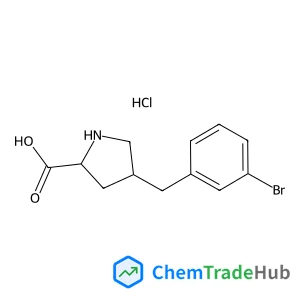
(2S,4R)-4-(3-Bromobenzyl)pyrrolidine-2-carboxylic acid hydrochloride
CAS号:
1049734-10-2
分子式:
C12H15BrClNO2
![Heptadecanoic Acid 3-[2-[4-(6-Fluoro-1,2-benzisoxazol-3-yl)-1-piperidinyl]ethyl]-6,7,8,9-tetrahydro-2-methyl-4-oxo-4H-pyrido[1,2-a]pyrimidin-9-yl Ester structure](https://cnstatic.chemtradehub.com/structs/140/1404053-62-8-9da4.webp "Heptadecanoic Acid 3-[2-[4-(6-Fluoro-1,2-benzisoxazol-3-yl)-1-piperidinyl]ethyl]-6,7,8,9-tetrahydro-2-methyl-4-oxo-4H-pyrido[1,2-a]pyrimidin-9-yl Ester structure")
推荐供应商




免责声明
本页面提供的学术期刊信息仅供参考和研究使用。我们与任何期刊出版商均无关联,也不处理投稿事宜。如有投稿相关咨询,请直接联系相关期刊出版商。
如发现页面信息有误,请发送邮件至 support@chemtradehub.com 联系我们。我们将及时核实并处理您的问题。