



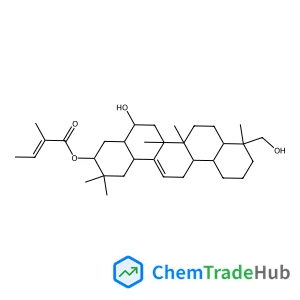
Impact of noise on inverse design: the case of NMR spectra matching
文献信息
发布日期
2023-10-17
DOI
10.1039/D3DD00132F
影响因子
0
作者
查看原文
摘要
Despite its fundamental importance and widespread use for assessing reaction success in organic chemistry, deducing chemical structures from nuclear magnetic resonance (NMR) measurements has remained largely manual and time consuming. To keep up with the accelerated pace of automated synthesis in self driving laboratory settings, robust computational algorithms are needed to rapidly perform structure elucidations. We analyse the effectiveness of solving the NMR spectra matching task encountered in this inverse structure elucidation problem by systematically constraining the chemical search space, and correspondingly reducing the ambiguity of the matching task. Numerical evidence collected for the twenty most common stoichiometries in the QM9-NMR database indicate systematic trends of more permissible machine learning prediction errors in constrained search spaces. Results suggest that compounds with multiple heteroatoms are harder to characterize than others. Extending QM9 by ∼10 times more constitutional isomers with 3D structures generated by Surge, ETKDG and CREST, we used ML models of chemical shifts trained on the QM9-NMR data to test the spectra matching algorithms. Combining both 13C and 1H shifts in the matching process suggests twice as permissible machine learning prediction errors than for matching based on 13C shifts alone. Performance curves demonstrate that reducing ambiguity and search space can decrease machine learning training data needs by orders of magnitude.
期刊推荐

Journal of Asian Natural Products Research

Polycyclic Aromatic Compounds
Bioorganic & Medicinal Chemistry

Journal of the Indian Institute of Science

Medicinal Chemistry Research
Bioorganic & Medicinal Chemistry Letters

Critical Reviews in Solid State and Materials Sciences

Topics in Catalysis
Cellulose

Main Group Chemistry
相关文献
DNA microarraying on compact disc surfaces. Application to the analysis of single nucleotide polymorphisms in Plum pox virus
Sergi Morais, Raquel Marco-Molés, Rosa Puchades, Ángel Maquieira
2006-05-02
Communication
DOI: 10.1039/B600049E
Evidence for C–C bond cleavage by H2O2 in a mesoporous CMK-5 type carbon at room temperature
An-Hui Lu, Wen-Cui Li, Nelli Muratova, Bernd Spliethoff, Ferdi Schüth
2005-09-20
Communication
DOI: 10.1039/B509300G
Monitoring the formation of TTF dimers by Na+ complexation
Marc Sallé, Jean-Yves Balandier, Franck Le Derf, Eric Levillain, Magali Allain, Pascal Viel, Serge Palacin
2006-03-30
Communication
DOI: 10.1039/B518275A
A novel mediatorless microbial fuel cell based on direct biocatalysis of Escherichia coli
Tian Zhang, Changzheng Cui, Shengli Chen, Xinping Ai, Hanxi Yang, Ping Shen, Zhenrong Peng
2006-04-25
Communication
DOI: 10.1039/B600876C
Biomimetic approaches to diazonamide A. Direct synthesis of the indole bis-oxazole fragment by oxidation of a TyrValTrpTrp tetrapeptide
Jonathan Sperry
2006-05-09
Communication
DOI: 10.1039/B604294E
Selective functionalization of imidazolesvia an iodine–copper exchange reaction
Xiaoyin Yang, Paul Knochel
2006-04-20
Communication
DOI: 10.1039/B603419E
Platinum–acetylide polymer based solar cells: involvement of the triplet state for energy conversion
Fengqi Guo, Young-Gi Kim, John R. Reynolds, Kirk S. Schanze
2006-03-21
Communication
DOI: 10.1039/B516086C
Highly stable cyclic dimers based on non-covalent interactions
Valérie G. H. Lafitte, Abil E. Aliev, Peter N. Horton, Michael B. Hursthouse, Helen C. Hailes
2006-04-20
Communication
DOI: 10.1039/B600459H
Assembled bright green fluorescent zinc coordination polymer
Ruibiao Fu, Shengchang Xiang, Shengmin Hu, Longsheng Wang, Yaming Li, Xihe Huang, Xintao Wu
2005-09-22
Communication
DOI: 10.1039/B509695B
您可能还喜欢
化合物问答
硅烷偶联剂ZQ-172(CAS号:1067-53-4)的主要用途是什么?
硅烷偶联剂ZQ-172主要用于增强无机填料与有机高分子材料之间的相容性,常见于橡胶、塑料、涂料和胶黏剂等复合体系中。其硅氧烷基团可与玻璃纤维、二氧化硅等无机物表...
1067-53-46-(2-Methoxyethoxy)-...
化合物问答
如何处理含有6-(2,4-二甲氧基苯基)-2-吡啶甲醇(CAS号:887981-31-9)的废料?
对于含有该化合物的废料,首先应收集并分类存放,避免与其它化学品混合。在处理前,需进行必要的检测,确定其含量和性质。随后,可以采用化学氧化、生物降解或物理吸附等方...
887981-31-9[6-(2,4-Dimethoxyphe...
化合物问答
甲砜霉素甘氨酸酯盐酸盐(CAS号:2611-61-2)的物理化学性质是什么?
该化合物为白色或类白色结晶性粉末,不溶于水,溶于乙醇和氯仿。分子量为403.03 g/mol。它具有手性,含有三个手性中心,分别为2S,3R构型。该化合物在酸性...
2611-61-2(2S,3R)-2-[(Dichloro...
化合物问答
如何储存反式-环丙烷-1,2-二胺双盐酸盐(CAS号:3187-76-6)?
反式-环丙烷-1,2-二胺双盐酸盐应存放在阴凉、干燥且通风良好的地方,避免阳光直射。储存容器应密封,以防挥发和受潮。同时,应远离火源和热源,确保储存环境温度不超...
3187-76-6trans-1,2-Diaminocyc...
化合物问答
什么是吩嗪硫酸甲酯(CAS号:299-11-6)?
吩嗪硫酸甲酯是一种有机化合物,化学结构由吩嗪环与甲酯基团构成,分子式为C10H9N2SO4。其为吩嗪类衍生物,具有典型的芳香环结构和酯基官能团,常作为氧化剂或染...
299-11-65-Methylphenazin-5-i...
化合物问答
N1-异丙基二乙烯三胺(CAS号:207399-20-0)的市场或研究趋势如何?
随着绿色化学和环保意识的提高,N1-异丙基二乙烯三胺的研究趋势正向低毒、环保的方向发展。市场趋势方面,由于其在功能性材料、药物合成等领域的需求,预计其市场需求将...
207399-20-0N-(2-Aminoethyl)-N'-...
化合物问答
4,4-Dimethyl-5,6-dihydro-4H-cyclopenta[d][1,3]thiazol-2-amine(CAS号:1182284-47-4)应用于哪些行业?
该化合物在医药、聚合物、传感器和半导体领域有潜在的应用。在医药领域,作为一种新型的噻唑类化合物,它可能具有抗炎、抗病毒等生物活性。在聚合物领域,该化合物可用作增...
1182284-47-44,4-Dimethyl-5,6-dih...
化合物问答
处理5-(PYRIDIN-4-YL)-OXAZOL-2-YLAMINE(CAS号:1014629-83-4)时应注意哪些实验室安全事项?
在处理5-(吡啶-4-基)-2-氧代-1-氧杂环己烷-3-胺时,应佩戴防护眼镜、手套和防护服。实验应在通风橱中进行,以避免吸入有害气体。如果发生泄露,应立即用大...
1014629-83-45-(4-Pyridinyl)-1,3-...
化合物问答
什么是伊托必利N-氧化物(CAS号:141996-98-7)?
伊托必利N-氧化物是一种化学化合物,其分子结构是伊托必利的N位进行氧化处理后的产物。它具有一定的生物活性,主要用于药物研究和开发。
141996-98-7Itopride N-Oxide
化合物问答
氟氯烟酸(CAS号:82671-06-5)安全吗?
氟氯烟酸属于有机氯化物,具有一定的毒性,需谨慎处理。在操作过程中,应佩戴防护手套、护目镜和实验服,避免吸入其粉尘或蒸汽。接触皮肤或眼睛可能导致刺激,应采取适当的...
82671-06-52,6-Dichloro-5-fluor...
来源期刊
推荐化合物


推荐供应商




免责声明
本页面提供的学术期刊信息仅供参考和研究使用。我们与任何期刊出版商均无关联,也不处理投稿事宜。如有投稿相关咨询,请直接联系相关期刊出版商。
如发现页面信息有误,请发送邮件至 support@chemtradehub.com 联系我们。我们将及时核实并处理您的问题。