



Wide-temperature-range sodium-metal batteries: from fundamentals and obstacles to optimization
文献信息
发布日期
2023-08-25
DOI
10.1039/D3EE02082G
影响因子
38.532
作者
Yu Sun, Jing-Chang Li, Haoshen Zhou
查看原文
摘要
Sodium metal with a high theoretical specific capacity (∼1166 mA h g−1) and low redox potential (−2.71 V) shows tremendous application prospects in sodium-metal batteries (SMBs). However, studies of SMBs in extreme environments, especially at low temperature (LT) and high temperature (HT), have not received enough emphasis, and few reviews have summarize them. More seriously, some mechanistic issues, such as nucleation and deposition behavior, dendrite growth, interfacial chemistry and an unstable solid electrolyte interface (SEI), are perplexing. Herein, we start with the operation fundamentals of SMBs, simultaneously point out the obstacles faced by SMBs in different environments and propose various targeted optimization strategies, including construction of a three-dimensional (3D) framework, design of an artificial SEI and optimization of the liquid (solid-state) electrolyte/metal anode interface. Each strategy starts with carefully selected cases and then moves to illustrate the nucleation and deposition behavior of Na+ in the structure. Finally, we point out challenges, strategies and outlooks for the future practical applications of wide-temperature-range SMBs. Overall, this review provides a design guide for SMBs with high energy density, long lifespan, low-cost and high security, and could inspire more researchers to focus on the mechanism of batteries in extreme environments.
相关文献
Potential energy surface for cyclotrimethylene trinitramine dimer from symmetry-adapted perturbation theory‡
Robert Bukowski, Betsy M. Rice
2007-08-23
Paper
DOI: 10.1039/B709192C
The colloid structural forces as a tool for particle characterization and control of dispersion stability
Elka S. Basheva, Peter A. Kralchevsky, Krassimir D. Danov, Kavssery P. Ananthapadmanabhan, Alex Lips
2007-07-05
Perspective
DOI: 10.1039/B705758J
Probing the evaporation of ternary ethanol–methanol–water droplets by cavity enhanced Raman scattering
Chris R. Howle, Chris J. Homer, Rebecca J. Hopkins, Jonathan P. Reid
2007-08-06
Paper
DOI: 10.1039/B706211G
The canonical and other mechanisms of elementary chemical reactions
Jesús Aldegunde, F. Javier Aoiz, Vicente Sáez-Rábanos, Brian K. Kendrick, Marcelo P. de Miranda
2007-09-13
Paper
DOI: 10.1039/B707190F
How realistic is the pore size distribution calculated from adsorption isotherms if activated carbon is composed of fullerene-like fragments?
Artur P. Terzyk, Sylwester Furmaniak, Peter J. F. Harris, Piotr A. Gauden, Jerzy Włoch, Piotr Kowalczyk, Gerhard Rychlicki
2007-10-02
Paper
DOI: 10.1039/B710552E
您可能还喜欢
化合物问答
4-[4-三氟甲基苯基]恶唑(CAS号:1126636-40-5)通常如何合成?
4-[4-三氟甲基苯基]恶唑通常通过将4-三氟甲基苯酚与异硫氰酸苯酯在有机溶剂中进行酯化反应合成。该反应可在无水条件下,使用适当的催化剂,如四丁基氢氧化铵,以提...
1126636-40-54-(4-(Trifluoromethy...
59729-32-71-[3-(Dimethylamino)...
化合物问答
RockPhos Pd G3(CAS号:2009020-38-4)通常如何合成?
RockPhos Pd G3 通常通过钯催化偶联反应合成,使用配体 (2'-Amino-2-biphenylyl)(methanesulfonato-kappa...
2009020-38-4(2'-Amino-2-biphenyl...
化合物问答
1-哌啶甲酰胺(CAS号:2158-03-4)的市场或研究趋势如何?
1-哌啶甲酰胺作为有机合成中的重要中间体,其市场需求主要受医药、农药、染料等行业推动。近年来,随着新药开发和绿色化学的发展,该化合物的研究趋势集中在开发更高效、...
2158-03-41-Piperidinecarboxam...
化合物问答
2-(二苯基膦基)乙胺(CAS号:4848-43-5)适用哪些法规指南?
2-(二苯基膦基)乙胺适用于多种法规指南,包括但不限于《全球化学品统一分类和标签制度》(GHS),欧盟《化学品注册、评估、授权和限制》法规(REACH),以及美...
4848-43-52-(Diphenylphosphino...
化合物问答
如何储存间苯二甲酸二烯丙酯(CAS号:1087-21-4)?
间苯二甲酸二烯丙酯应储存在阴凉、干燥、通风良好的地方,远离火源和热源。储存容器应密封,避免光照和高温。储存温度应控制在25℃以下,相对湿度应低于80%。避免与其...
1087-21-4Diallyl isophthalate
化合物问答
什么是间甲苯异硫代异氰酸酯(CAS号:621-30-7)?
间甲苯异硫代异氰酸酯是一种有机化合物,分子式为C7H7NO2S,具有刺激性气味。它是一种重要的有机合成中间体,在合成其他化合物时广泛应用。
621-30-71-Isothiocyanato-3-m...
化合物问答
在合成中是否有N-Boc-D-苯丙氨醇(CAS号:106454-69-7)的替代品?
在合成中,可以考虑使用N-Cbz-D-苯丙氨醇或N-Fmoc-D-苯丙氨醇作为替代品。这些化合物同样具有保护氨基的功能,且在合成过程中表现出良好的反应性能。
106454-69-72-Methyl-2-propanyl ...
化合物问答
3-羟甲基-2-氧异丙基吡啶(CAS号:954240-50-7)的主要用途是什么?
3-羟甲基-2-氧异丙基吡啶主要用于有机合成领域,可以作为合成其他药物、农药或精细化学品的中间体。此外,它还可能在实验室研究中作为特定反应的前体或溶剂。
954240-50-7(2-Isopropoxy-3-pyri...
化合物问答
6-氨基-9-甲基嘌呤(CAS号:700-00-5)应用于哪些行业?
6-氨基-9-甲基嘌呤目前主要应用于医药行业,作为某些药物的中间体。此外,它还可能用于聚合物、传感器和半导体的某些领域,作为功能性单体或掺杂剂。
700-00-59-Methyl-9H-purin-6-...
来源期刊
Energy & Environmental Science
CiteScore:
32.34
自引率:
3.4%
年发文量:
481
Energy & Environmental Science is an international journal dedicated to publishing exceptionally important and high quality, agenda-setting research tackling the key global and societal challenges of ensuring the provision of energy and protecting our environment for the future. The scope is intentionally broad and the journal recognises the complexity of issues and challenges relating to energy conversion and storage, alternative fuel technologies and environmental science. For work to be published it must be linked to the energy-environment nexus and be of significant general interest to our community-spanning readership. All scales of studies and analysis, from impactful fundamental advances, to interdisciplinary research across the (bio)chemical, (bio/geo)physical sciences and chemical engineering disciplines are welcomed. Topics include, but are not limited to, the following: Solar energy conversion and photovoltaics Solar fuels and artificial photosynthesis Fuel cells Hydrogen storage and (bio) hydrogen production Materials for energy systems Capture, storage and fate of CO2, including chemicals and fuels from CO2 Catalysis for a variety of feedstocks (for example, oil, gas, coal, biomass and synthesis gas) Biofuels and biorefineries Materials in extreme environments Environmental impacts of energy technologies Global atmospheric chemistry and climate change as related to energy systems Water-energy nexus Energy systems and networks Globally applicable principles of energy policy and techno-economics
推荐化合物
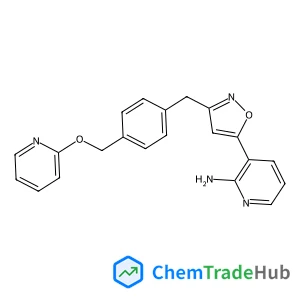
3-(3-(4-((Pyridin-2-yloxy)methyl)benzyl)isoxazol-5-yl)pyridin-2-amine
CAS号:
936339-60-5
分子式:
C21H18N4O2
推荐供应商


免责声明
本页面提供的学术期刊信息仅供参考和研究使用。我们与任何期刊出版商均无关联,也不处理投稿事宜。如有投稿相关咨询,请直接联系相关期刊出版商。
如发现页面信息有误,请发送邮件至 support@chemtradehub.com 联系我们。我们将及时核实并处理您的问题。