


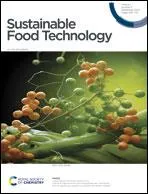
Evaluation of the bioprotective potential of gastrointestinal digest fractions of Arthrospira sp. and Nannochloropsis sp. suspensions treated with high pressure homogenisation
文献信息
发布日期
2024-01-03
DOI
10.1039/D3FB00193H
影响因子
0
作者
Biniam Kebede
查看原文
摘要
Microalgae are promising plant-like food sources rich in proteins and bioactive compounds with nutraceutical potential. This research investigated the health-promoting effects of high pressure homogenisation (HPH)-treated microalgal suspensions (8% w/v) of Arthrospira and Nannochloropsis species. These microalgal suspensions were treated using HPH at 300 bar, 600 bar, and 900 bar for a single pass. To gain valuable information on the bioavailability of potentially bioactive compounds, gastrointestinal digests obtained after in vitro simulated human gastrointestinal digestion of HPH-treated microalgal suspensions were examined for total phenolics, pigments, and antioxidant activity. Furthermore, their bioprotective potential was evaluated on an oxidatively stressed (induced by hydrogen peroxide) Caco-2 cell culture model system. Results showed that increasing the homogenisation pressure resulted in increased chlorophyll a and carotenoids release for both Arthrospira and Nannochloropsis species. Nannochloropsis sp. experienced an improved phenolics yield with HPH but a similar positive impact of HPH was not observed for Arthrospira sp. probably because of its inherent high phenolic content. Similarly, only Nannochloropsis sp. suspensions showed higher antioxidant activity by FRAP assay at 900 bar treatment. HPH-treated gastrointestinal digests of Arthrospira sp. treated at 600 bar and 900 bar demonstrated cell recovery and viability on stressed Caco-2 cells. However, there was an insignificant bioprotective effect from the HPH-treated Nannochloropsis digests. In general, it appears that the ideal homogenizing pressures for Arthrospira and Nannochloropsis suspensions are 300 and 900 bar, respectively. Overall, this study shows the potential of HPH as an efficient tool to produce functional foods and ingredients, particularly from Arthrospira sp. suspensions.
期刊推荐

Journal of the Indian Institute of Science
Polycyclic Aromatic Compounds

Topics in Catalysis
Bioorganic & Medicinal Chemistry Letters
Journal of Asian Natural Products Research

Herald of the Russian Academy of Sciences

Main Group Chemistry
Cellulose

Biocatalysis and Biotransformation
Journal of Chemical Sciences
相关文献
Bioinspired synthesis of new silica structures
Siddharth V. Patwardhan, Niloy Mukherjee, Miriam Steinitz-Kannan, Stephen J. Clarson
2003-04-23
Communication
DOI: 10.1039/B302056H
Electrical property and water repellency of a networked monolayer film prepared from Au nanoparticles
Hiroshi Shiigi, Yojiro Yamamoto, Hidetaka Yakabe, Shiho Tokonami, Tsutomu Nagaoka
2003-04-02
Communication
DOI: 10.1039/B212226J
Direction control in DNA binding of chiral d-lysine-based peptide nucleic acid (PNA) probed by electrospray mass spectrometry
Stefano Sforza, Tullia Tedeschi, Roberto Corradini, Arnaldo Dossena, Rosangela Marchelli
2003-04-02
Communication
DOI: 10.1039/B212718K
Palladium catalysed cyclisation–carbonylation of enynes to give cyclic γ,δ-unsaturated acids
Varinder K. Aggarwal, Mike Butters, Paul W. Davies
2003-04-02
Communication
DOI: 10.1039/B300719G
Fabrication of nanowires with polymer shells using treated carbon nanotube bundles as macro-initiators
Yuyang Liu, Jing Tang, J. H. Xin
2004-10-26
Communication
DOI: 10.1039/B412282H
Excimer formation by interstrand stacked pyrenes
Simon M. Langenegger, Robert Häner
2004-11-09
Communication
DOI: 10.1039/B412831A
Photoactive dimesogen having different pathways of light driven phase transitions at different temperatures
V. Ajay Mallia, Nobuyuki Tamaoki
2004-10-01
Communication
DOI: 10.1039/B410902C
Crystalline oligopyrene nanowires with multicolored emission
Liangti Qu, Gaoquan Shi
2004-11-03
Communication
DOI: 10.1039/B412638F
A sequential highly stereoselective hydroboration and Suzuki–Miyaura cross-coupling reaction of fluoroalkylated internal acetylenes: a practical one-pot synthesis of fluoroalkylated trisubstituted alkenes
Tsutomu Konno, Jungha Chae, Tomoo Tanaka, Takashi Ishihara, Hiroki Yamanaka
2004-02-12
Communication
DOI: 10.1039/B316065C
您可能还喜欢
化合物问答
如何处理含有8-氯咪唑并[1,2-A]吡嗪(CAS号:69214-33-1)的废料?
处理含有8-氯咪唑并[1,2-A]吡嗪的废料时,应首先将其收集并进行化学回收或降解。如果无法回收,需采用安全的化学处理方法,如中和、氧化还原或沉淀。处理过程中需...
69214-33-18-chloroimidazo[1,2-...
化合物问答
Calhex 231 hydrochloride(CAS号:2387505-78-2)适用哪些法规指南?
Calhex 231 hydrochloride 需要遵循《全球化学品统一分类和标签制度》(GHS)的分类和标签要求,以及欧盟的《化学品注册、评估、授权和限制条...
2387505-78-24-Chloro-N-[(1S,2S)-...
化合物问答
11-Beta,17-alpha,21-三羟基-5-beta-孕烯-3,20-二酮(CAS号:1482-50-4)的物理化学性质是什么?
11-Beta,17-alpha,21-三羟基-5-beta-孕烯-3,20-二酮是一种无色结晶性粉末,分子量为372.45 g/mol。该化合物在水中的溶解度...
1482-50-45β-Dihydrocortisol
化合物问答
处理5-异丙基-1,3,4-恶二唑-2-羧酸(CAS号:944907-13-5)时应注意哪些实验室安全事项?
处理5-异丙基-1,3,4-恶二唑-2-羧酸时应注意以下安全事项:穿戴适当的个人防护装备,包括实验室外套、手套和护目镜;操作应在通风橱中进行,以减少吸入或接触有...
944907-13-55-Isopropyl-1,3,4-ox...
化合物问答
benzyl 3-bromopropanoate(CAS号:90841-55-7)安全吗?
Benzyl 3-bromopropanoate属于有毒物质,吸入、摄入或皮肤接触均可能对人体造成伤害。操作时应佩戴防护眼镜、口罩和手套,避免吸入蒸汽和直接接触...
90841-55-7Benzyl 3-bromopropan...
化合物问答
什么是(R)-N-苄氧羰基-3,4-二氢-1H-异喹啉羧酸(CAS号:151004-88-5)?
(R)-N-苄氧羰基-3,4-二氢-1H-异喹啉羧酸是一种含有苄氧羰基和异喹啉环结构的化合物,分子式为C17H15NO3。它是一种有机化合物,具有一定的生物活性...
151004-88-5(1R)-2-[(Benzyloxy)c...
化合物问答
在合成中是否有1-苄基吡啶嗡-3-羧酸盐(CAS号:15990-43-9)的替代品?
可以考虑使用1-苄基吡啶-3-羧酸盐作为1-苄基吡啶嗡-3-羧酸盐的替代品。此外,还可以探索其他类似物,如1-苄基吡啶-3-氨基甲酸酯等。具体的替代品选择需根据...
15990-43-91-Benzyl-3-pyridiniu...
化合物问答
(2,6-二甲基吡啶-3-基)甲醇(CAS号:582303-10-4)安全吗?
(2,6-二甲基吡啶-3-基)甲醇在使用时需注意安全,应避免吸入其蒸汽,接触皮肤和眼睛。操作应在通风良好的环境中进行,佩戴适当的个人防护装备。
582303-10-4(2,6-Dimethyl-3-pyri...
化合物问答
5-溴-2-乙烯基吡啶(CAS号:226883-52-9)的物理化学性质是什么?
5-溴-2-乙烯基吡啶是一种有机化合物,外观为白色固体,具有良好的结晶性。分子量约为190.03 g/mol。它的溶解性在水中较差,但在有机溶剂如二氯甲烷、甲醇...
226883-52-95-Bromo-2-vinylpyrid...
化合物问答
2-羟基-3-硝基-5-甲基吡啶(CAS号:7464-14-4)应用于哪些行业?
2-羟基-3-硝基-5-甲基吡啶主要应用于医药、聚合物和半导体行业。在医药领域,它可以用作合成其他药物的中间体。在聚合物领域,它可以作为功能性单体参与聚合反应,...
7464-14-45-Methyl-3-nitro-2(1...
来源期刊
推荐化合物
推荐供应商







免责声明
本页面提供的学术期刊信息仅供参考和研究使用。我们与任何期刊出版商均无关联,也不处理投稿事宜。如有投稿相关咨询,请直接联系相关期刊出版商。
如发现页面信息有误,请发送邮件至 support@chemtradehub.com 联系我们。我们将及时核实并处理您的问题。