



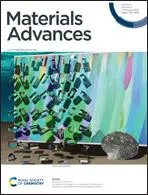
From waste to energy: luminescent solar concentrators based on carbon dots derived from surgical facemasks
文献信息
发布日期
2023-09-20
DOI
10.1039/D3MA00507K
影响因子
0
作者
Antonino Arrigo, Ambra M. Cancelliere, Maurilio Galletta, Antonio Burtone, Giovanni Lanteri, Francesco Nastasi, Fausto Puntoriero
查看原文
摘要
The enormous increase in the consumption of personal protection equipment, such as facemasks, mainly related to the COVID-19 pandemic, has shone light on the metric tons of plastic waste that are released into the oceans, with dramatic environmental concerns. Here, we report on the preparation of carbon dots (C-dots) following an environmentally friendly synthetic strategy using surgical facemasks as the starting material. Such C-dots are highly photostable and luminescent and were used to prepare luminescent solar concentrators exhibiting – once connected to silicon photovoltaic panels – a remarkable solar-to-energy conversion of 6.1%. Our results could suggest a way both to alleviate the serious environmental problem and to produce low-cost materials for solar energy conversion purposes.
相关文献
Multijunction organic photovoltaics with a broad spectral response
Jill A. Macko, Patrick R. Brown, Miles C. Barr, Karen K. Gleason, Vladimir Bulovic
2012-08-29
Paper
DOI: 10.1039/C2CP43000B
Evolution of the structural and electronic properties of beryllium-doped aluminum clusters: comparison with neutral and cationic aluminum clusters
Wei-Ming Sun, Ying Li, Di Wu, Zhi-Ru Li
2012-10-15
Paper
DOI: 10.1039/C2CP42386C
Kinetics and mechanism of the reaction of OH with the trimethylbenzenes – experimental evidence for the formation of adduct isomers
Birger Bohn
2012-08-16
Paper
DOI: 10.1039/C2CP42434G
Water structure and charge transfer phenomena at the liquid–graphene interface
Luisa D'Urso, Cristina Satriano, Giuseppe Forte, Giuseppe Compagnini, Orazio Puglisi
2012-08-17
Paper
DOI: 10.1039/C2CP42249B
A spectroscopic investigation on the interaction of a magnetic ferrofluid with a model plasma protein: effect on the conformation and activity of the protein
Bijan Kumar Paul, Kaustav Bhattacharjee, Subhrangsu Bose, Nikhil Guchhait
2012-09-25
Paper
DOI: 10.1039/C2CP42415K
Layer resolved evolution of the optical properties of α-sexithiophene thin films
Lidong Sun, Stephen Berkebile, Günther Weidlinger, Mariella Denk, Richard Denk, Michael Hohage, Georg Koller, Falko P. Netzer, Michael G. Ramsey, Peter Zeppenfeld
2012-08-20
Paper
DOI: 10.1039/C2CP42270K
Dynamic character of charge transport parameters in disordered organic semiconductor field-effect transistors
Y. Chen, B. Lee, H. T. Yi, S. S. Lee, M. M. Payne, S. Pola, C.-H. Kuo, Y.-L. Loo, J. E. Anthony, Y. T. Tao
2012-07-20
Perspective
DOI: 10.1039/C2CP41823A
Double-chain planar D2h B4H2, C2h B8H2, and C2h B12H2: conjugated aromatic borenes
Yan-Bo Wu, Hai-Gang Lu
2012-05-17
Paper
DOI: 10.1039/C2CP40902J
Catalytic activity of Co–Nx/C electrocatalysts for oxygen reduction reaction: a density functional theory study
Shyam Kattel, Plamen Atanassov, Boris Kiefer
2012-10-19
Paper
DOI: 10.1039/C2CP42609A
The influence of membrane bound proteins on phase separation and coarsening in cell membranes
Thomas Witkowski, Rainer Backofen
2012-06-29
Paper
DOI: 10.1039/C2CP41274H
您可能还喜欢
化合物问答
如何储存8-溴-4-羟基-6-(三氟甲氧基)喹啉-3-羧酸乙酯(CAS号:1072944-81-0)?
8-溴-4-羟基-6-(三氟甲氧基)喹啉-3-羧酸乙酯应储存在阴凉、干燥的地方,避免光照和高温。建议使用密封容器进行储存,以防止水分和空气的影响。
1072944-81-0Ethyl 8-bromo-4-hydr...
化合物问答
2,2-二(2-呋喃基)丙烷(CAS号:17920-88-6)的市场或研究趋势如何?
2,2-二(2-呋喃基)丙烷的研究趋势主要集中在新型材料的开发和应用,如高分子材料、有机光电材料等。市场趋势方面,随着环保要求的提高和新材料的应用,该化合物的需...
17920-88-62,2'-(2,2-Propanediy...
化合物问答
如何处理含有螺[呋喃并[3,4-b]吡啶-5(7H),4'-哌啶]-7-酮盐酸盐(CAS号:475152-31-9)的废料?
对于含有螺[呋喃并[3,4-b]吡啶-5(7H),4'-哌啶]-7-酮盐酸盐的废料,应首先进行分类和分离,以减少危险物质的数量。随后,可以考虑通过化学氧化、生物...
475152-31-97H-Spiro[furo[3,4-b]...
化合物问答
Cinnamyl 3-aminobut-2-enoate(CAS号:113898-97-8)安全吗?
Cinnamyl 3-氨基丁-2-烯酸在接触皮肤和眼睛时可能会引起刺激。应避免吸入其粉尘和烟雾。操作时应穿戴适当的个人防护装备,如手套、护目镜和实验室外套。
113898-97-8Cinnamyl 3-aminobut-...
化合物问答
反式-2-十二碳烯二酸(CAS号:6402-36-4)的市场或研究趋势如何?
反式-2-十二碳烯二酸在医药、材料科学等领域有一定的应用,但其市场相对较小。近年来,由于环保意识的提升,对环境友好型化学品的需求增加,研究倾向于开发更绿色的合成...
6402-36-4Traumatic Acid
化合物问答
什么是(9ci)-1H-苯并咪唑-5-乙酸(CAS号:473895-86-2)?
(9ci)-1H-苯并咪唑-5-乙酸是一种含氮杂环化合物,其化学结构为1H-苯并咪唑-5-乙酸。该化合物具有特定的分子式C8H7NO2,属于有机酸类化合物。
473895-86-21H-Benzimidazol-5-yl...
化合物问答
酞菁蓝(CAS号:147-14-8)的主要用途是什么?
酞菁蓝主要用作颜料和染料,广泛应用于塑料、油墨、涂料、纺织品及橡胶工业中。它也用于光敏材料,如太阳能电池和光刻胶。在医疗领域,酞菁蓝因其光敏特性被用于某些光动力...
147-14-8Copper(2+) phthalocy...
化合物问答
5-甲基-1,2,3,4-四氢异喹啉(CAS号:123593-99-7)安全吗?
5-甲基-1,2,3,4-四氢异喹啉在使用和储存时需要谨慎处理。它具有一定的毒性,应避免吸入其蒸气或直接接触皮肤和眼睛。操作此化合物时,建议佩戴防护眼镜、实验服...
123593-99-75-Methyl-1,2,3,4-tet...
化合物问答
如何处理含有3',4',5'-三甲氧基苯乙酮(CAS号:1136-86-3)的废料?
含有3',4',5'-三甲氧基苯乙酮的废液应首先确保其是否为危险废物,根据当地法规确定处理方法。通常,这类有机废液可以采用中和反应降低其pH值,然后通过蒸馏或萃...
1136-86-31-(3,4,5-Trimethoxyp...
化合物问答
如何储存KI-7(CAS号:1489263-00-4)?
KI-7应储存在通风良好的干燥环境中,避免光照和高温。建议使用密封容器储存,并保持在阴凉处。储存温度应控制在室温范围内,一般建议不超过25°C。避免与氧化剂接触...
1489263-00-42-(1-Benzyl-1H-indol...
来源期刊
推荐化合物
推荐供应商



免责声明
本页面提供的学术期刊信息仅供参考和研究使用。我们与任何期刊出版商均无关联,也不处理投稿事宜。如有投稿相关咨询,请直接联系相关期刊出版商。
如发现页面信息有误,请发送邮件至 support@chemtradehub.com 联系我们。我们将及时核实并处理您的问题。