








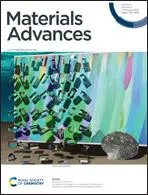
Highly conductive three-dimensional metal organic frameworks from small in situ generated ligands
文献信息
发布日期
2023-10-24
DOI
10.1039/D3MA00562C
影响因子
0
作者
Uddit Narayan Hazarika, Jhorna Borah, Arobinda Kakoti, Rinki Brahma, Kangkan Sarmah, Ankur Kanti Guha, Prithiviraj Khakhlary
查看原文
摘要
Four isostructural formate based electrically conductive metal organic frameworks namely, [H2N(CH3)2][M(HCO2)3] (M = Mn; Mn-F, M = Co; Co-F, M = Ni; Ni-F, and M = Zn; Zn-F), were synthesized with simple and cost effective methods. The in situ generated formate ion was attributed to decomposition of DMF, which was used as the solvent of the reactions, under high pressure and temperature conditions. Single crystal X-ray diffraction analysis reveals that MOFs also contain in-situ generated dimethyl ammonium cations inside their pores to maintain the charge neutrality of the framework. The as-synthesized MOFs exhibit impressive room temperature electrical conductivity compared to the MOFs reported so far. The conductivity is attributed to the charge (in situ generated) flow along the pores of the MOFs and electron flow through the metal–ligand bond owing to the metal d-orbital and ligand p-orbital overlap. All the MOFs are semiconducting in nature and their conductivities increase with temperature. Mn-F exhibits conductivity as high as 47.846 S cm−1 at 50 °C which was the highest among the conductivities of the four reported MOFs. Upon removal of guests from the pores the room temperature electrical conductivity of all the frameworks was improved except for Co-F. The formation of highly mobile hydronium ions upon removal of guests may be one of the reasons for improvement in the conductivity of the aforementioned de-guested MOFs. By the theoretical evaluation of the bonds of the MOFs, through bond conductivity is significantly determined by the number of high spin electrons in the metal d-orbitals.
相关文献
An isoindigo and dithieno[3,2-b:2′,3′-d]silole copolymer for polymer solar cells
Romain Stalder, Caroline Grand, Jegadesan Subbiah, Franky So, John R. Reynolds
2011-10-27
Communication
DOI: 10.1039/C1PY00402F
Aqueous RAFT/MADIX polymerisation of vinylphosphonic acid
Issam Blidi, Roland Geagea, Olivier Coutelier, Stéphane Mazières, Frédéric Violleau, Mathias Destarac
2012-01-11
Communication
DOI: 10.1039/C2PY00541G
From miscible to partially miscible biodegradable double crystalline poly(ethylene succinate)-b-poly(butylene succinate) multiblock copolymers
Jian-Bing Zeng, Qun-Ying Zhu, Xi Lu, Yi-Song He, Yu-Zhong Wang
2011-12-01
Paper
DOI: 10.1039/C1PY00456E
Host–guest driven supramolecular assembly of reversible comb-shaped polymers in aqueous solution
Martina Stenzel
2011-11-29
Paper
DOI: 10.1039/C1PY00478F
Random introduction of degradable linkages into functional vinyl polymers by radical ring-opening polymerization, tailored for soft tissue engineering
Jenny Undin, Teresa Illanes, Anna Finne-Wistrand, Ann-Christine Albertsson
2012-03-19
Paper
DOI: 10.1039/C2PY20034A
Temperature-sensitive nanogels: poly(N-vinylcaprolactam) versus poly(N-isopropylacrylamide)
Jose Ramos, Ainara Imaz, Jacqueline Forcada
2011-12-16
Minireview
DOI: 10.1039/C2PY00485B
High relaxivity MRI imaging reagents from bimodal star polymers
Chinessa T. Adkins, Julia N. Dobish, Clifford S. Brown, Brian Mayrsohn, Sharon K. Hamilton, Felicia Udoji, Kelly Radford, Thomas E. Yankeelov, John C. Gore, Eva Harth
2011-11-29
Paper
DOI: 10.1039/C1PY00474C
Light-emitting poly(N-naphthyl-2,7-carbazole)
Takeshi Mori, Toshinobu Shinnai
2011-10-10
Paper
DOI: 10.1039/C1PY00286D
您可能还喜欢
化合物问答
4-((4-甲基哌嗪-1-基)甲基)苯硼酸(CAS号:763120-62-3)的市场或研究趋势如何?
随着有机硼化学的发展,该化合物在催化、药物合成、材料科学等领域展现出潜在的应用价值。近年来,其在药物前体合成中的应用越来越受到关注。市场趋势显示,随着科研投入的...
763120-62-3{4-[(4-Methyl-1-pipe...
化合物问答
如何储存2,4,5-三甲基-1-硝基苯(CAS号:610-91-3)?
2,4,5-三甲基-1-硝基苯应储存在阴凉、干燥且通风良好的地方,避免阳光直射。储存在密封的金属容器中,远离火源和热源。储存温度应控制在25°C以下,湿度不宜过...
610-91-31,2,4-Trimethyl-5-ni...
化合物问答
处理2,5-二碘噻吩(CAS号:625-88-7)时应注意哪些实验室安全事项?
在处理2,5-二碘噻吩时,应穿戴适当的个人防护装备(PPE),包括实验室外套、手套和防护眼镜。在通风橱中进行操作以避免吸入蒸气。如果发生泄漏,应立即疏散人员并使...
625-88-72,5-Diiodothiophene
化合物问答
在合成中是否有6-bromo-3-chloro-1H-indole(CAS号:57916-08-2)的替代品?
在合成6-溴-3-氯-1H-吲哚(CAS号:57916-08-2)时,可以考虑使用一些类似的化合物作为替代品,如6-氯-3-氯-1H-吲哚或3-氯-1H-吲哚,...
57916-08-26-bromo-3-chloro-1H-...
化合物问答
在合成中是否有(R)-(-)-1-(1-萘基)乙基异氰酸酯(CAS号:42340-98-7)的替代品?
可以考虑使用类似结构的化合物,如1-[(1R)-1-(2-氨基乙基)萘-1-基]乙基异氰酸酯作为替代品。此外,还可以寻找其他类型的异氰酸酯衍生物,如苯基异氰酸酯...
42340-98-71-[(1R)-1-Isocyanato...
化合物问答
3-氨基苯甲酰苯胺(CAS号:14315-16-3)适用哪些法规指南?
3-氨基苯甲酰苯胺适用于多项法规指南,包括但不限于GHS(全球化学品统一分类和标签制度)分类为皮肤腐蚀/刺激类别2,以及潜在的皮肤过敏性类别1。在欧盟地区,它受...
14315-16-33-Amino-N-phenylbenz...
化合物问答
β-环柠檬醛-D5(CAS号:26309-95-5)通常如何合成?
β-环柠檬醛-D5可通过不对称合成方法获得。常见的合成路线包括以环己酮为原料,经过选择性氧化、还原、保护基引入等步骤,最终得到目标化合物。该合成过程中通常使用多...
26309-95-5[(2,2-Dimethylpropan...
34915-68-9Bunitrolol
化合物问答
如何处理含有BIO-1211(CAS号:187735-94-0)的废料?
对于含有BIO-1211(CAS号:187735-94-0)的废料,首先应进行分类收集,确保符合环保要求。然后,可以考虑通过焚烧或其他专业处理方法进行处置。在处...
187735-94-0BIO-1211
化合物问答
如何处理含有4-氯-2-氟-3-甲基苯酚(CAS号:1351668-24-0)的废料?
含有该化合物的废液应收集至专用容器中,避免与其他化学品混合。可采用焚烧或送交专业废弃物处理公司处理。处理过程中需遵守当地环保法规,确保不产生二次污染。处理前应进...
1351668-24-04-Chloro-2-fluoro-3-...
来源期刊
推荐化合物
![7-Amino-5-methyl-5,7-dihydro-6H-dibenzo[b,d]azepin-6-one hydrochloride (1:1) structure](https://cnstatic.chemtradehub.com/structs/209/209984-32-7-9912.webp "7-Amino-5-methyl-5,7-dihydro-6H-dibenzo[b,d]azepin-6-one hydrochloride (1:1) structure")
7-Amino-5-methyl-5,7-dihydro-6H-dibenzo[b,d]azepin-6-one hydrochloride (1:1)
CAS号:
209984-32-7
分子式:
C15H15ClN2O
![4-[2-(3,4-Dihydro-2H-chromen-6-yl)-1,3-oxazol-5-yl]-1-(3-{[(2,5-dioxo-1-pyrrolidinyl)oxy]carbonyl}benzyl)pyridinium bromide structure](https://cnstatic.chemtradehub.com/structs/155/155863-03-9-8183.webp "4-[2-(3,4-Dihydro-2H-chromen-6-yl)-1,3-oxazol-5-yl]-1-(3-{[(2,5-dioxo-1-pyrrolidinyl)oxy]carbonyl}benzyl)pyridinium bromide structure")
![4-[(2-Oxo-1,2,3,4-tetrahydroquinolin-7-yl)oxy]butanoic acid structure](https://cnstatic.chemtradehub.com/structs/588/58899-27-7-1f86.webp "4-[(2-Oxo-1,2,3,4-tetrahydroquinolin-7-yl)oxy]butanoic acid structure")
推荐供应商




免责声明
本页面提供的学术期刊信息仅供参考和研究使用。我们与任何期刊出版商均无关联,也不处理投稿事宜。如有投稿相关咨询,请直接联系相关期刊出版商。
如发现页面信息有误,请发送邮件至 support@chemtradehub.com 联系我们。我们将及时核实并处理您的问题。