






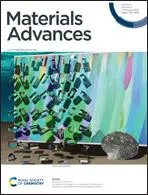
Robust MOF-on-MOF heterostructures as efficient cathode candidates for next-generation supercapacitors
文献信息
发布日期
2023-11-10
DOI
10.1039/D3MA00578J
影响因子
0
作者
Rakesh Deka, Viresh Kumar
查看原文
摘要
Metal–organic frameworks (MOFs) have shown great potential as cathode in supercapacitor applications. However, they can also be used as a platform for designing a new class of materials. Herein, a MOF-on-MOF heterostructure, Ni-BTC@ZIF-67, has been synthesized via a solvothermal method followed by the in situ growth of ZIF-67 on Ni-BTC and was well-characterized through various techniques (PXRD, FT-IR, BET, SEM, TEM, and XPS). From SEM, TEM, and XPS analysis, it is clear that ZIF-67 was successfully deposited over the Ni-BTC surface via N–O bonding interaction. One potential application of Ni-BTC@ZIF-67 is as an electro-active material in the construction of supercapacitors. This material demonstrated an impressive specific capacitance of 1063 F g−1 when subjected to a 4 A g−1 current. The robust nature of both MOFs helped attain a cyclic retention capacity of about ∼98% after 5500 cycles. Moreover, an asymmetric supercapacitor was assembled with activated carbon and Ni-BTC@ZIF-67 in an aqueous system, which delivered an energy density of 22 W h Kg−1 at a power density of 1075 W Kg−1 with a cyclic retention of ∼83% after 1000 cycles. Thus, the MOF-on-MOF architecture can be a new pathway for supercapacitor applications in the future.
相关文献
Synthesis of DNA intercalator–immobilized cyclodextrin and interaction with double-stranded DNA: Utilization of DNA–cyclodextrin conjugated material as an environmental remediation material
Masanori Yamada, Masamitsu Inoue, Tetsuya Yamada
2012-03-23
Paper
DOI: 10.1039/C2PY00007E
Upgrading of bio-oil and subsequent co-processing under FCC conditions for fuel production
Udo Armbruster, Hanan Atia, Ursula Bentrup, Binh Minh Quoc Phan, Reinhard Eckelt, Luong Huu Nguyen, Duc Anh Nguyen, Andreas Martin
2015-12-14
Paper
DOI: 10.1039/C5RE00068H
Boron-containing polymers as versatile building blocks for functional nanostructured materials
Fei Cheng, Frieder Jäkle
2011-05-18
Review Article
DOI: 10.1039/C1PY00123J
From miscible to partially miscible biodegradable double crystalline poly(ethylene succinate)-b-poly(butylene succinate) multiblock copolymers
Jian-Bing Zeng, Qun-Ying Zhu, Xi Lu, Yi-Song He, Yu-Zhong Wang
2011-12-01
Paper
DOI: 10.1039/C1PY00456E
An isoindigo and dithieno[3,2-b:2′,3′-d]silole copolymer for polymer solar cells
Romain Stalder, Caroline Grand, Jegadesan Subbiah, Franky So, John R. Reynolds
2011-10-27
Communication
DOI: 10.1039/C1PY00402F
Copolymers of 2-hydroxyethylacrylate and 2-methoxyethyl acrylate by nitroxide mediated polymerization: kinetics, SEC-ESI-MS analysis and thermoresponsive properties
Anna-Marie Zorn, Helmut Keul, Christopher Barner-Kowollik, Martin Moeller
2011-09-27
Paper
DOI: 10.1039/C1PY00344E
Light-emitting poly(N-naphthyl-2,7-carbazole)
Takeshi Mori, Toshinobu Shinnai
2011-10-10
Paper
DOI: 10.1039/C1PY00286D
A facile and fast method for the functionalization of polymersomes by photoinduced cycloaddition chemistry
Hans-Peter M. de Hoog, Bo Liedberg
2011-12-08
Communication
DOI: 10.1039/C1PY00413A
您可能还喜欢
化合物问答
4-((4-甲基哌嗪-1-基)甲基)苯硼酸(CAS号:763120-62-3)的市场或研究趋势如何?
随着有机硼化学的发展,该化合物在催化、药物合成、材料科学等领域展现出潜在的应用价值。近年来,其在药物前体合成中的应用越来越受到关注。市场趋势显示,随着科研投入的...
763120-62-3{4-[(4-Methyl-1-pipe...
化合物问答
如何储存2,4,5-三甲基-1-硝基苯(CAS号:610-91-3)?
2,4,5-三甲基-1-硝基苯应储存在阴凉、干燥且通风良好的地方,避免阳光直射。储存在密封的金属容器中,远离火源和热源。储存温度应控制在25°C以下,湿度不宜过...
610-91-31,2,4-Trimethyl-5-ni...
化合物问答
处理2,5-二碘噻吩(CAS号:625-88-7)时应注意哪些实验室安全事项?
在处理2,5-二碘噻吩时,应穿戴适当的个人防护装备(PPE),包括实验室外套、手套和防护眼镜。在通风橱中进行操作以避免吸入蒸气。如果发生泄漏,应立即疏散人员并使...
625-88-72,5-Diiodothiophene
化合物问答
在合成中是否有6-bromo-3-chloro-1H-indole(CAS号:57916-08-2)的替代品?
在合成6-溴-3-氯-1H-吲哚(CAS号:57916-08-2)时,可以考虑使用一些类似的化合物作为替代品,如6-氯-3-氯-1H-吲哚或3-氯-1H-吲哚,...
57916-08-26-bromo-3-chloro-1H-...
化合物问答
在合成中是否有(R)-(-)-1-(1-萘基)乙基异氰酸酯(CAS号:42340-98-7)的替代品?
可以考虑使用类似结构的化合物,如1-[(1R)-1-(2-氨基乙基)萘-1-基]乙基异氰酸酯作为替代品。此外,还可以寻找其他类型的异氰酸酯衍生物,如苯基异氰酸酯...
42340-98-71-[(1R)-1-Isocyanato...
化合物问答
3-氨基苯甲酰苯胺(CAS号:14315-16-3)适用哪些法规指南?
3-氨基苯甲酰苯胺适用于多项法规指南,包括但不限于GHS(全球化学品统一分类和标签制度)分类为皮肤腐蚀/刺激类别2,以及潜在的皮肤过敏性类别1。在欧盟地区,它受...
14315-16-33-Amino-N-phenylbenz...
化合物问答
β-环柠檬醛-D5(CAS号:26309-95-5)通常如何合成?
β-环柠檬醛-D5可通过不对称合成方法获得。常见的合成路线包括以环己酮为原料,经过选择性氧化、还原、保护基引入等步骤,最终得到目标化合物。该合成过程中通常使用多...
26309-95-5[(2,2-Dimethylpropan...
34915-68-9Bunitrolol
化合物问答
如何处理含有BIO-1211(CAS号:187735-94-0)的废料?
对于含有BIO-1211(CAS号:187735-94-0)的废料,首先应进行分类收集,确保符合环保要求。然后,可以考虑通过焚烧或其他专业处理方法进行处置。在处...
187735-94-0BIO-1211
化合物问答
如何处理含有4-氯-2-氟-3-甲基苯酚(CAS号:1351668-24-0)的废料?
含有该化合物的废液应收集至专用容器中,避免与其他化学品混合。可采用焚烧或送交专业废弃物处理公司处理。处理过程中需遵守当地环保法规,确保不产生二次污染。处理前应进...
1351668-24-04-Chloro-2-fluoro-3-...
来源期刊
推荐化合物
![N-[2-Bromo-4-(trifluoromethoxy)phenyl]formamide structure](https://cnstatic.chemtradehub.com/structs/941/941294-53-7-f783.webp "N-[2-Bromo-4-(trifluoromethoxy)phenyl]formamide structure")
推荐供应商





免责声明
本页面提供的学术期刊信息仅供参考和研究使用。我们与任何期刊出版商均无关联,也不处理投稿事宜。如有投稿相关咨询,请直接联系相关期刊出版商。
如发现页面信息有误,请发送邮件至 support@chemtradehub.com 联系我们。我们将及时核实并处理您的问题。