



Twisted organic TADF triads based on a diindolocarbazole donor for efficient photoisomerization of stilbene and photo-arylation of heteroarenes
文献信息
发布日期
2023-10-24
DOI
10.1039/D3QO01542D
影响因子
5.281
作者
Sushil Sharma, Sanchita Sengupta
查看原文
摘要
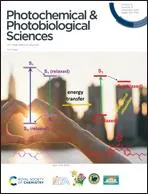
Herein we report the design and synthesis of twisted organic thermally activated delayed fluorescence (TADF) triads DI-PF and DI-PI based on diindolocarbazole (DI) as the donor and dibenzo[a,c]phenazine (PF) and phenanthro[9,10-d]imidazole (PI) as the acceptors. The triads DI-PF and DI-PI showed strong charge transfer bands at 590 nm with a 196 nm Stokes shift and 519 nm with a 126 nm Stokes shift, respectively. For effective TADF properties, theoretical and experimental studies revealed small to relatively modest ΔEST of 0.01 eV and 0.37 eV for DI-PF and DI-PI, respectively. Transient photoluminescence decay profiles of DI-PF and DI-PI indicated shorter prompt components of 40 ns and 13.38 ns, respectively, and longer delayed components of 6.15 μs and 2.05 μs, respectively, confirming the TADF nature for both compounds. The sufficiently long-lived lifetime components render them suitable for participation in organic photocatalysis. Furthermore, both compounds showed tunable and suitable excited state redox potentials for electron transfer photocatalysis. Accordingly, the triads DI-PF and DI-PI have been employed as photocatalysts in E to Z photoisomerization of stilbene based on their suitable triplet energy levels with reasonably good yields of up to 66% for isomerization products and in arylation of various heteroarenes with up to 86% yields for heteroarene photoarylation products.
相关文献
Evolution of nanoscale amorphous, crystalline and phase-segregated PtNiP nanoparticles and their electrocatalytic effect on methanol oxidation reaction
Yanjiao Ma, Rongfang Wang, Hui Wang, Vladimir Linkov, Shan Ji
2013-12-16
Paper
DOI: 10.1039/C3CP54600D
A new approach to determine vapour pressures and hygroscopicities of aqueous aerosols containing semi-volatile organic compounds
D. J. Stewart, T. C. Preston, J. S. Walker, Y.-H. Zhang, J. P. Reid
2014-01-02
Paper
DOI: 10.1039/C3CP54948H
Improving O2 production of WO3 photoanodes with IrO2 in acidic aqueous electrolyte
Joshua M. Spurgeon, Jesus M. Velazquez, Matthew T. McDowell
2014-01-10
Paper
DOI: 10.1039/C3CP55527E
CO2-induced micelle to vesicle transition in zwitterionic–anionic surfactant systems
Wei Li, Yanjuan Yang, Tian Luo, Jianling Zhang, Buxing Han
2013-12-18
Paper
DOI: 10.1039/C3CP54537G
Chemical vs. electrochemical extraction of lithium from the Li-excess Li1.10Mn1.90O4 spinel followed by NMR and DRX techniques
S. Martinez, I. Sobrados, D. Tonti, J. M. Amarilla, J. Sanz
2014-01-13
Paper
DOI: 10.1039/C3CP54386B
Graphene/g-C3N4 bilayer: considerable band gap opening and effective band structure engineering
Xinru Li, Ying Dai, Yandong Ma, Shenghao Han, Baibiao Huang
2014-01-06
Paper
DOI: 10.1039/C3CP54592J
The quantum-chemical approach to calculations of thermodynamic and structural parameters of formation of fatty acid monolayers with hexagonal packing at the air/water interface
Yu. B. Vysotsky, E. A. Belyaeva, E. S. Fomina, D. Vollhardt, V. B. Fainerman, R. Miller
2013-12-19
Paper
DOI: 10.1039/C3CP54124J
Reactions of HOCO radicals through hydrogen-atom hopping utilizing clathrate hydrates as an observational matrix
Motoi Oshima, Atsushi Tani, Takeshi Sugahara, Katsuhisa Kitano, Kazunari Ohgaki
2013-12-18
Paper
DOI: 10.1039/C3CP54680B
In situ IR spectroscopic studies of Ni surface segregation induced by CO adsorption on Cu–Ni/SiO2 bimetallic catalysts
Yunxi Yao, D. Wayne Goodman
2014-01-03
Paper
DOI: 10.1039/C3CP54997F
Experimental and theoretical study on the sensing mechanism of a fluorescence probe for hypochloric acid: a Se⋯N nonbonding interaction modulated twisting process
Songqiu Yang, Peng Li, Panwang Zhou, Keli Han
2013-11-26
Paper
DOI: 10.1039/C3CP54093F
您可能还喜欢
化合物问答
(5-氨基吡唑-3-基)乙酸(CAS号:174891-10-2)的物理化学性质是什么?
(5-氨基吡唑-3-基)乙酸是一种无色至白色固体,分子量为174.15 g/mol。它在水中具有较好的溶解性,在有机溶剂中的溶解度较低。该化合物具有较好的反应活...
174891-10-2(3-Amino-1H-pyrazol-...
化合物问答
3-氟-4,5-二氯苯胺(CAS号:35754-38-2)适用哪些法规指南?
3-氟-4,5-二氯苯胺受到多项法规指南的约束,包括但不限于GHS(全球化学品统一分类和标签制度)的危险分类标准、欧盟的REACH法规(注册、评估、授权和限制)...
35754-38-23,4-Dichloro-5-fluor...
化合物问答
什么是(R)-(+)-2,2',6,6'-四甲氧基-4,4'-联(二(3,5-二甲苯基基)膦基)-3,3'-二联吡啶(CAS号:442905-33-1)?
这是一种有机化合物,化学名为(R)-(+)-2,2',6,6'-四甲氧基-4,4'-联(二(3,5-二甲苯基基)膦基)-3,3'-二联吡啶,CAS号为44290...
442905-33-14,4'-Bis[bis(3,5-dim...
化合物问答
1-氨基-2-氰基萘(CAS号:3100-67-2)应用于哪些行业?
1-氨基-2-氰基萘在医药、聚合物、传感器和半导体等行业中有应用。在医药领域,它可用作中间体合成某些药物。在聚合物行业,它可以用于制备具有特定性能的聚合物。此外...
3100-67-21-Amino-2-naphthonit...
化合物问答
如何处理含有1-溴-4-(异丙氧基甲基)苯(CAS号:98446-84-5)的废料?
处理含1-溴-4-(异丙氧基甲基)苯的废料时,首先应确保废液收集在防渗漏的容器中,避免泄露。然后,可以考虑采用化学降解法或物理吸附法进行处理。在特定条件下,可通...
98446-84-51-Bromo-4-(isopropox...
化合物问答
6-Chloro-8-(trifluoromethyl)chroman-4-one(CAS号:1344889-75-3)的主要用途是什么?
6-氯-8-三氟甲基-2,3-二氢-4H-色喃-4-酮主要用于有机合成中的中间体,也可作为研究试剂使用。
1344889-75-36-Chloro-8-(trifluor...
化合物问答
7-乙氧基-2-萘酚(CAS号:57944-44-2)通常如何合成?
7-乙氧基-2-萘酚通常通过N-乙氧基化反应合成,首先将2-萘酚与乙醇钠在乙醇中反应生成7-乙氧基-2-萘酚钠盐,再通过酸化进一步得到7-乙氧基-2-萘酚。该合...
57944-44-27-Ethoxy-2-naphthol
化合物问答
4-(1,1-二氧硫代吗啉)丁醇(CAS号:59801-41-1)适用哪些法规指南?
该化合物需遵循一系列的法规指南,包括但不限于GHS全球统一分类和标签制度,其分类可能包括易燃液体和可能危害水生环境。在欧洲,还需遵循REACH法规,确保物质和混...
59801-41-14-(4-Hydroxybutyl)th...
化合物问答
4-甲氧基苄基叠氮甲酸酯(CAS号:25474-85-5)的物理化学性质是什么?
4-甲氧基苄基叠氮甲酸酯是一种无色液体,具有一定的挥发性。其分子量为198.16,熔点为-69°C,沸点为105°C。该化合物在水中溶解度较低,在有机溶剂如乙醇...
25474-85-54-Methoxybenzyl carb...
化合物问答
如何处理含有4-氯-2-氟嘧啶(CAS号:51422-00-5)的废料?
含有4-氯-2-氟嘧啶的废料应按照危险废物处理。首先,应收集并分类这些废料,避免与其他废物混合。然后,可以采用焚烧处理或者交由专业机构进行处置。在处理过程中,需...
51422-00-54-Chloro-2-fluoropyr...
来源期刊
Organic Chemistry Frontiers

CiteScore:
7.8
自引率:
8.7%
年发文量:
724
Organic Chemistry Frontiers publishes high-quality research from across organic chemistry. Emphases are placed on studies that make significant contributions to the field of organic chemistry by reporting either new or significantly improved protocols or methodologies. Topics include, but are not limited to the following: Organic synthesis Development of synthetic methodologies Catalysis Natural products Functional organic materials Supramolecular and macromolecular chemistry Physical and computational organic chemistry
推荐化合物
![5'-Fluoro-[2,3'-biindolinylidene]-2',3-dione structure](https://cnstatic.chemtradehub.com/structs/251/251903-00-1-9cb1.webp "5'-Fluoro-[2,3'-biindolinylidene]-2',3-dione structure")
![N-{[(2-Methyl-2-propanyl)oxy]carbonyl}-L-methionylglycine structure](https://cnstatic.chemtradehub.com/structs/234/23446-03-9-e1e5.webp "N-{[(2-Methyl-2-propanyl)oxy]carbonyl}-L-methionylglycine structure")
推荐供应商






免责声明
本页面提供的学术期刊信息仅供参考和研究使用。我们与任何期刊出版商均无关联,也不处理投稿事宜。如有投稿相关咨询,请直接联系相关期刊出版商。
如发现页面信息有误,请发送邮件至 support@chemtradehub.com 联系我们。我们将及时核实并处理您的问题。