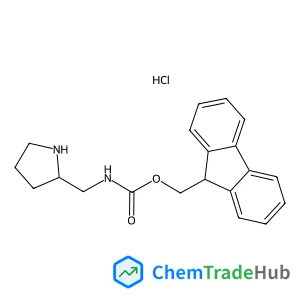
(S)-(9H-Fluoren-9-yl)methyl (pyrrolidin-2-ylmethyl)carbamate hydrochloride
CAS号:
1217813-15-4
分子式:
C20H23ClN2O2
Qing Sun, Jia-Jie Chen, Jia-Yi Liu, Wen-Qing Zhang, Xin Lu, Ren-Jie Song
This cutting-edge research work presents a comprehensive and in-depth theoretical investigation into the mechanism of Au(I)-catalyzed annulations between ynamides and 1,2-benzisoxazoles, as well as the chemoselectivity of the reactions in the presence of different ligands (L = JohnPhos, IPr) and the factors influencing the Z/E-configuration of the resulting 6-membered cyclic products. State-of-the-art density functional theory calculations reveal that (i) the reaction mechanism involves three distinct processes: process 1 corresponds to the transformation of a gold-π-alkyne precursor into a gold–carbene intermediate; process 2 involves the conversion of gold–carbene intermediates into 6-membered/7-membered cyclic intermediates; process 3 involves the conversion of 6-membered/7-membered cyclic intermediates to furnish 6-membered/7-membered cyclic products, respectively. (ii) The distinct chemoselectivity exhibited by the two ligands, JohnPhos and IPr, has been thoroughly explored through distortion/interaction analysis. The distortion energy is responsible for ligand-controlled chemoselectivity. (iii) The Z/E-configuration of 6-membered cyclic products is determined by the N-attack step of 1,2-benzisoxazole on the gold-π-alkyne. These theoretical findings hold significant implications for synthetic chemists, providing valuable insights into the design of novel catalytic systems and the prediction of reaction pathways and selectivity patterns in related organic transformations involving ynamides and isoxazoles.
Russian Journal of Applied Chemistry
Russian Journal of Coordination Chemistry

New Journal of Chemistry
Acta Materialia
Journal of Peptide Science
Journal of Natural Medicines
Russian Chemical Bulletin
Organic Process Research & Development
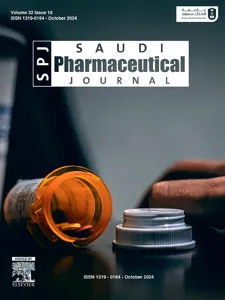
Saudi Pharmaceutical Journal
Current Opinion in Solid State & Materials Science
Andrea Sabatié-Gogova, Eric Renault, Gilles Montavon, Nicolas Galland
DOI: 10.1039/C1CP20512A
ChiYung Yam, Lingyi Meng, GuanHua Chen, Quan Chen, Ngai Wong
DOI: 10.1039/C1CP20766K
Tomoya Uruga, Hajime Tanida, Yasuko Terada, Yasuhiro Iwasawa, Shin-ichi Ohkoshi
DOI: 10.1039/C1CP20895K
Troels Markussen, Robert Stadler, Kristian S. Thygesen
DOI: 10.1039/C1CP20924H
Hary Razafindralambo, Aurore Richel, Bernard Wathelet, Christophe Blecker, Jean-Paul Wathelet, Robert Brasseur, Laurence Lins, Jose Miñones, Jr., Michel Paquot
DOI: 10.1039/C1CP21365B
Juan Pablo Catalán
DOI: 10.1039/C1CP21380F
Yuhui Lu, Craig Lent
DOI: 10.1039/C1CP21332F
Xavier Aparicio-Anglès, Anna Clotet, Josep M. Poblet
DOI: 10.1039/C0CP02602F
N-2,2-丙烯基-2-丙烯酰胺通常通过丙烯酰胺与丙烯基卤化物的缩合反应合成。该反应通常在温和的条件下进行,使用适量的碱如吡啶作为催化剂。反应的选择性良好,产率...
1,2-二碘四氟代乙烷是一种有机化合物,化学式为C2F4I2,CAS号为354-65-4。它是一种无色透明液体,具有特殊的化学性质和物理性质,包括高沸点、低挥发...
根据GHS(全球化学品统一分类和标签制度),3-溴-1H-吡咯[3,2-c]吡啶-4-碳腈被归类为第2类易燃液体。在欧盟,该化合物需要符合REACH法规的要求,...
1-氯甲基萘磺酸在使用时需要谨慎,因为它具有一定的刺激性和腐蚀性。操作时应佩戴适当的防护装备,如防化服、手套、护目镜等,避免直接接触皮肤和吸入其蒸汽。
该化合物主要用于催化剂领域,特别是在有机合成中的催化氧化反应以及作为某些药物合成的中间体。此外,它还被研究用于纳米材料的制备。
3-溴-7-氯噻吩并[3,2-b]吡啶-6-甲腈在处理时需要谨慎,因其含有溴和氯等强卤素,可能具有一定的刺激性和腐蚀性。使用时应佩戴适当的个人防护装备,避免皮肤...
该化合物主要用于有机合成领域,特别是作为催化剂或配体,在有机合成反应中发挥重要作用。此外,它还可能应用于催化加氢反应、偶联反应等。
3-[6-(Diphenylphosphoryl)-2-naphthyl]-1,10-phenanthroline在正常使用条件下相对安全,但在操作时应穿戴适当...
可以考虑使用类似结构的化合物作为替代品,如2-(4-环戊基环己烯基)乙酸酯,这种化合物在结构上相似,可能在某些合成路径中作为替代品。
处理含有3-(3-氨基丙基)丙酮缩甘油的废料时,首先应确保遵守当地的环保法规。对于危险废物,应进行分类收集,然后送至专业的废物处理设施进行焚烧或安全填埋。在处理...
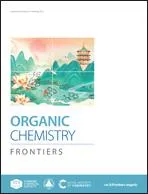
Organic Chemistry Frontiers publishes high-quality research from across organic chemistry. Emphases are placed on studies that make significant contributions to the field of organic chemistry by reporting either new or significantly improved protocols or methodologies. Topics include, but are not limited to the following: Organic synthesis Development of synthetic methodologies Catalysis Natural products Functional organic materials Supramolecular and macromolecular chemistry Physical and computational organic chemistry