



Keeping an “eye” on the experiment: computer vision for real-time monitoring and control
文献信息
发布日期
2023-11-27
DOI
10.1039/D3SC05491H
影响因子
9.825
作者
Rama El-khawaldeh, Mason Guy, Finn Bork, Nina Taherimakhsousi, Kris N. Jones, Joel M. Hawkins, Lu Han, Robert P. Pritchard, Blaine A. Cole, Sebastien Monfette
查看原文
摘要
This work presents a generalizable computer vision (CV) and machine learning model that is used for automated real-time monitoring and control of a diverse array of workup processes. Our system simultaneously monitors multiple physical outputs (e.g., liquid level, homogeneity, turbidity, solid, residue, and color), offering a method for rapid data acquisition and deeper analysis from multiple visual cues. We demonstrate a single platform (consisting of CV, machine learning, real-time monitoring techniques, and flexible hardware) to monitor and control vision-based experimental techniques, including solvent exchange distillation, antisolvent crystallization, evaporative crystallization, cooling crystallization, solid–liquid mixing, and liquid–liquid extraction. Both qualitative (video capturing) and quantitative data (visual outputs measurement) were obtained which provided a method for data cross-validation. Our CV model's ease of use, generalizability, and non-invasiveness make it an appealing complementary option to in situ and real-time analytical monitoring tools and mathematical modeling. Additionally, our platform is integrated with Mettler-Toledo's iControl software, which acts as a centralized system for real-time data collection, visualization, and storage. With consistent data representation and infrastructure, we were able to efficiently transfer the technology and reproduce results between different labs. This ability to easily monitor and respond to the dynamic situational changes of the experiments is pivotal to enabling future flexible automation workflows.
期刊推荐
Russian Journal of General Chemistry
New Journal of Chemistry
Chemical Communications
Journal of Natural Medicines
Russian Journal of Coordination Chemistry
Drug Discovery Today
Saudi Pharmaceutical Journal
Current Opinion in Colloid & Interface Science
Journal of Peptide Science
Chemistry Education Research and Practice
相关文献
A density functional theory study of the hydrogenation and reduction of the thio-spinel Fe3S4{111} surface
Alberto Roldan
2019-01-17
Paper
DOI: 10.1039/C8CP06371K
Computational studies of protein–protein dissociation by statistical potential and coarse-grained simulations: a case study on interactions between colicin E9 endonuclease and immunity proteins
Zhaoqian Su, Yinghao Wu
2019-01-10
Paper
DOI: 10.1039/C8CP05644G
Lithium ions solvated in helium
Monisha Rastogi, Christian Leidlmair, Lukas An der Lan, Josu Ortiz de Zárate, Ricardo Pérez de Tudela, Massimiliano Bartolomei, Marta I. Hernández, José Campos-Martínez, Tomás González-Lezana, Javier Hernández-Rojas, José Bretón, Paul Scheier
2018-08-08
Paper
DOI: 10.1039/C8CP04522D
Direct imaging of a single Ni atom cutting graphene to form a graphene nanomesh
Haixia Zhang, Weiwei Liu, Zhenhua Zhang, Meifen Li, Bingshe Xu, Junjie Guo
2018-08-25
Paper
DOI: 10.1039/C8CP03711F
Control of TiN oxidation upon atomic layer deposition of oxides
E. O. Filatova, S. S. Sakhonenkov, A. S. Konashuk, V. V. Afanas’ev
2018-10-22
Paper
DOI: 10.1039/C8CP06076B
Monte Carlo simulations of the separation of a binary gas mixture (CH4 + CO2) using hydrates
Ioannis G. Economou, Athanassios K. Stubos
2018-10-16
Paper
DOI: 10.1039/C8CP02050G
Influence of microscopic precipitate structures on macroscopic pattern formation in reactive flows in a confined geometry
Edina Balog, Anne De Wit, Gábor Schuszter
2019-01-14
Paper
DOI: 10.1039/C8CP07693F
Twisted scroll wave dynamics: partially pinned waves in excitable chemical media
Porramain Porjai, Malee Sutthiopad, Kritsana Khaothong, Metinee Phantu, Nakorn Kumchaiseemak, Jiraporn Luengviriya, Kenneth Showalter, Chaiya Luengviriya
2019-01-16
Paper
DOI: 10.1039/C8CP06948D
Discovery of conical intersection mediated photochemistry with growing string methods
Cody Aldaz, Joshua A. Kammeraad, Paul M. Zimmerman
2018-10-17
Paper
DOI: 10.1039/C8CP04703K
Theoretical analysis of crystallization by homogeneous nucleation of water droplets
Kyoko K. Tanaka, Yuki Kimura
2019-01-05
Paper
DOI: 10.1039/C8CP06650G
您可能还喜欢
化合物问答
2-(甲基磺酰基)嘧啶-5-胺(CAS号:56621-92-2)适用哪些法规指南?
该化合物适用的法规指南包括GHS(全球化学品统一分类和标签制度)分类为特定目标器官毒性-单次接触类别3;根据欧盟REACH法规,该化合物需要进行注册和评估;在美...
56621-92-22-(Methylsulfonyl)py...
化合物问答
在合成中是否有4-(4-氯苯基)-1H-咪唑(CAS号:35512-29-9)的替代品?
在合成中,可以考虑使用一些类似的化合物作为4-(4-氯苯基)-1H-咪唑的替代品,如4-(4-溴苯基)-1H-咪唑或4-(4-甲氧基苯基)-1H-咪唑。这些化合...
35512-29-94-(4-Chlorophenyl)-1...
化合物问答
什么是N~2~-甲基丙氨酸酰胺(CAS号:32012-16-1)?
N~2~-甲基丙氨酸酰胺是一种有机化合物,其化学名为2-(Methylamino)propanamide。它是一种酰胺类化合物,分子式为C4H10N2O,相对分...
32012-16-12-(Methylamino)propa...
化合物问答
如何处理含有N-苄基-3-氨基氧杂环丁烷草酸盐(CAS号:1956341-96-0)的废料?
处理含有N-苄基-3-氨基氧杂环丁烷草酸盐(CAS号:1956341-96-0)的废料时,应首先确保遵循相关法规要求,如GHS和REACH等。通常,废液应先进行...
1956341-96-0N-Benzyloxetan-3-ami...
化合物问答
4-bromo-2-chloro-6-methylbenzoic acid(CAS号:877149-07-0)的物理化学性质是什么?
4-溴-2-氯-6-甲基苯甲酸是一种固体化合物,具有较高的熔点和较低的沸点。它的分子量为261.03 g/mol。该化合物在水中几乎不溶,在有机溶剂中溶解度适中...
877149-07-04-Bromo-2-chloro-6-m...
化合物问答
2-[(2,5-二氯-4-嘧啶)氨基]-N-甲基苯甲酰胺(CAS号:761440-08-8)通常如何合成?
该化合物通常通过缩合反应合成,典型的方法是将2,5-二氯嘧啶与N-甲基苯甲酰胺在碱性条件下进行偶联反应。常用的碱包括NaH、LDA等强碱。该合成路线具有较高的选...
761440-08-82-[(2,5-dichloropyri...
4752-10-71,4-Dichlorophthalaz...
化合物问答
在合成中是否有3,5-二溴-4-甲基苯胺(CAS号:13194-73-5)的替代品?
3,5-二溴-4-甲基苯胺在某些合成路线中可能没有直接替代品。然而,在某些应用场景下,可以考虑使用其他类似结构的化合物如3,5-二溴-4-硝基苯胺或3,5-二碘...
13194-73-53,5-Dibromo-4-methyl...
化合物问答
2-氯喹啉-4-羧酸甲酯(CAS号:62482-26-2)的主要用途是什么?
2-氯喹啉-4-羧酸甲酯主要用于有机合成和药物合成领域,作为中间体或原料。它在合成某些药物和染料时具有重要作用。此外,该化合物还可能用于某些特定的化学研究中。
62482-26-2Methyl 2-chloro-4-qu...
化合物问答
i>]吡啶(CAS号:474708-88-8)安全吗?
6-溴-8-氯咪唑[1,2-a]吡啶在操作过程中需要谨慎以确保安全。该化合物具有一定的毒性,吸入其蒸气或粉尘可能导致呼吸道刺激。处理时应佩戴适当的防护装备,如手...
474708-88-86-Bromo-8-chloroimid...
来源期刊
Chemical Science
CiteScore:
14.4
自引率:
3.9%
年发文量:
1413
Our journal has a wide-ranging scope which covers the full breadth of the chemical sciences. The research we publish contains the sorts of novel ideas, challenging questions and progressive thinking that bring undiscovered breakthroughs within reach. Your paper could focus on a single area, or cross many. It could be beyond the accepted bounds of the chemical sciences. It might address an immediate challenge, contribute to a future breakthrough or be wholly conceptual. We’re a team from every field of the chemical sciences, and know from experience that breakthroughs that drive the solutions to global challenges can come from anywhere, at any time. You could even start an entirely new area of research. Too bold? Too progressive? No such thing
推荐化合物
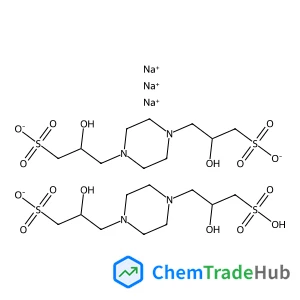
3,3'-(Piperazine-1,4-diyl)bis(2-hydroxypropane-1-sulfonic acid) Sodium Salt
CAS号:
108321-08-0
分子式:
C20H41N4Na3O16S4
推荐供应商



免责声明
本页面提供的学术期刊信息仅供参考和研究使用。我们与任何期刊出版商均无关联,也不处理投稿事宜。如有投稿相关咨询,请直接联系相关期刊出版商。
如发现页面信息有误,请发送邮件至 support@chemtradehub.com 联系我们。我们将及时核实并处理您的问题。