




Solar-driven electrochemical NH3 splitting into H2 and N2 on BiVO4-based photoanodes
文献信息
发布日期
2023-12-13
DOI
10.1039/D3SE01513K
影响因子
6.367
作者
Miwako Teranishi, Shin-ichi Naya, Hiroaki Tada
查看原文
摘要
From the viewpoints of energy and the environment, NH3 splitting into N2 and H2 is an important challenge in chemistry, and we have found that BiVO4 is a highly promising base photoanode material for it. Semiconductor films (TiO2 and BiVO4) were formed on a fluorine-doped tin oxide (FTO) electrode, and three-electrode photoelectrochemical (PEC) cells using them as the photoanodes were fabricated. The photocurrent in the TiO2/FTO photoanode cell is saturated at ∼0.1 mA cm−2 in the range of electrode potential (E) more positive than +0.3 V vs. the standard hydrogen electrode (SHE) in an electrolyte solution containing NH3 (pH 11) under illumination of simulated sunlight (AM 1.5, 100 mW cm−2, one sun). In contrast, the photocurrent in the BiVO4/FTO photoanode cell increases with increasing anodic polarization to reach 1.78 mA cm−2 at E = +1 V vs. SHE. This PEC cell produces H2 from NH3 with a selectivity of 92% under the same irradiation conditions, and the incident photon-to-current conversion efficiency reaches 11.7% at a wavelength of excitation light = 365 nm. Provision of an SnO2 interlayer between the BiVO4 and FTO films effectively suppresses the recombination at the interface to enhance the photocurrent under weak anodic polarization at E < +0.5 V vs. SHE.
期刊推荐

New Journal of Chemistry

Journal of Natural Medicines

Current Opinion in Solid State & Materials Science

Russian Journal of Bioorganic Chemistry

Russian Chemical Bulletin

Organic Process Research & Development

Russian Journal of Applied Chemistry

Journal of Peptide Science

Russian Journal of General Chemistry

Current Opinion in Colloid & Interface Science
相关文献
A novel clean catalytic method for waste-free modification of polysaccharides by oxidation
Svetlana L. Kachkarova-Sorokina, Pierre Gallezot, Alexander B. Sorokin
2004-11-04
Communication
DOI: 10.1039/B411694A
Formation of dimers of inclusion cryptand/paraquat complexes driven by dipole–dipole and face-to-face π-stacking interactions
Feihe Huang, Liang Zhou, Jason W. Jones, Harry W. Gibson, Mehdi Ashraf-Khorassani
2004-10-14
Communication
DOI: 10.1039/B411234B
Chiral Co(iii)(salen)-catalysed hydrolytic kinetic resolution of racemic epoxides in ionic liquids
Dong Joon Choo, Woo Ho Shim, Dong Hoon Lee, Eun Joo Roh, Sang-gi Lee, Choong Eui Song
2003-04-02
Communication
DOI: 10.1039/B301490H
Ring-opening reactions of methylenecyclopropanes with diphenyl diselenide upon heating; formation of 3-phenylselenyl-2,5-dihydrofuran derivatives
Le-Ping Liu, Min Shi
2004-10-25
Communication
DOI: 10.1039/B412823K
Synthesis of novel starburst and dendritic polyhedral oligosilsesquioxanes
Kenji Wada, Naoki Watanabe, Koichi Yamada, Teruyuki Kondo, Take-aki Mitsudo
2004-11-29
Communication
DOI: 10.1039/B413921F
Direction control in DNA binding of chiral d-lysine-based peptide nucleic acid (PNA) probed by electrospray mass spectrometry
Stefano Sforza, Tullia Tedeschi, Roberto Corradini, Arnaldo Dossena, Rosangela Marchelli
2003-04-02
Communication
DOI: 10.1039/B212718K
Biotinylated poly(p-phenylene ethynylene): unexpected energy transfer results in the detection of biological analytes
Juan Zheng, Timothy M. Swager
2004-11-04
Communication
DOI: 10.1039/B408478K
Block copolymer libraries: modular versatility of the macromolecular Lego® system
Bas G. G. Lohmeijer, Daan Wouters, Zhihui Yin, Ulrich S. Schubert
2004-10-25
Communication
DOI: 10.1039/B411777H
Fabrication of a stable inorganic–organic hybrid multilayer film with uniform and dense inorganic nanoparticle deposition
Xurong Xu, Joong Tark Han, Kilwon Cho
2003-03-18
Communication
DOI: 10.1039/B300581J
Bioinspired synthesis of new silica structures
Siddharth V. Patwardhan, Niloy Mukherjee, Miriam Steinitz-Kannan, Stephen J. Clarson
2003-04-23
Communication
DOI: 10.1039/B302056H
您可能还喜欢
化合物问答
如何处理含有8-氯咪唑并[1,2-A]吡嗪(CAS号:69214-33-1)的废料?
处理含有8-氯咪唑并[1,2-A]吡嗪的废料时,应首先将其收集并进行化学回收或降解。如果无法回收,需采用安全的化学处理方法,如中和、氧化还原或沉淀。处理过程中需...
69214-33-18-chloroimidazo[1,2-...
化合物问答
Calhex 231 hydrochloride(CAS号:2387505-78-2)适用哪些法规指南?
Calhex 231 hydrochloride 需要遵循《全球化学品统一分类和标签制度》(GHS)的分类和标签要求,以及欧盟的《化学品注册、评估、授权和限制条...
2387505-78-24-Chloro-N-[(1S,2S)-...
化合物问答
11-Beta,17-alpha,21-三羟基-5-beta-孕烯-3,20-二酮(CAS号:1482-50-4)的物理化学性质是什么?
11-Beta,17-alpha,21-三羟基-5-beta-孕烯-3,20-二酮是一种无色结晶性粉末,分子量为372.45 g/mol。该化合物在水中的溶解度...
1482-50-45β-Dihydrocortisol
化合物问答
处理5-异丙基-1,3,4-恶二唑-2-羧酸(CAS号:944907-13-5)时应注意哪些实验室安全事项?
处理5-异丙基-1,3,4-恶二唑-2-羧酸时应注意以下安全事项:穿戴适当的个人防护装备,包括实验室外套、手套和护目镜;操作应在通风橱中进行,以减少吸入或接触有...
944907-13-55-Isopropyl-1,3,4-ox...
化合物问答
benzyl 3-bromopropanoate(CAS号:90841-55-7)安全吗?
Benzyl 3-bromopropanoate属于有毒物质,吸入、摄入或皮肤接触均可能对人体造成伤害。操作时应佩戴防护眼镜、口罩和手套,避免吸入蒸汽和直接接触...
90841-55-7Benzyl 3-bromopropan...
化合物问答
什么是(R)-N-苄氧羰基-3,4-二氢-1H-异喹啉羧酸(CAS号:151004-88-5)?
(R)-N-苄氧羰基-3,4-二氢-1H-异喹啉羧酸是一种含有苄氧羰基和异喹啉环结构的化合物,分子式为C17H15NO3。它是一种有机化合物,具有一定的生物活性...
151004-88-5(1R)-2-[(Benzyloxy)c...
化合物问答
在合成中是否有1-苄基吡啶嗡-3-羧酸盐(CAS号:15990-43-9)的替代品?
可以考虑使用1-苄基吡啶-3-羧酸盐作为1-苄基吡啶嗡-3-羧酸盐的替代品。此外,还可以探索其他类似物,如1-苄基吡啶-3-氨基甲酸酯等。具体的替代品选择需根据...
15990-43-91-Benzyl-3-pyridiniu...
化合物问答
(2,6-二甲基吡啶-3-基)甲醇(CAS号:582303-10-4)安全吗?
(2,6-二甲基吡啶-3-基)甲醇在使用时需注意安全,应避免吸入其蒸汽,接触皮肤和眼睛。操作应在通风良好的环境中进行,佩戴适当的个人防护装备。
582303-10-4(2,6-Dimethyl-3-pyri...
化合物问答
5-溴-2-乙烯基吡啶(CAS号:226883-52-9)的物理化学性质是什么?
5-溴-2-乙烯基吡啶是一种有机化合物,外观为白色固体,具有良好的结晶性。分子量约为190.03 g/mol。它的溶解性在水中较差,但在有机溶剂如二氯甲烷、甲醇...
226883-52-95-Bromo-2-vinylpyrid...
化合物问答
2-羟基-3-硝基-5-甲基吡啶(CAS号:7464-14-4)应用于哪些行业?
2-羟基-3-硝基-5-甲基吡啶主要应用于医药、聚合物和半导体行业。在医药领域,它可以用作合成其他药物的中间体。在聚合物领域,它可以作为功能性单体参与聚合反应,...
7464-14-45-Methyl-3-nitro-2(1...
来源期刊
推荐化合物
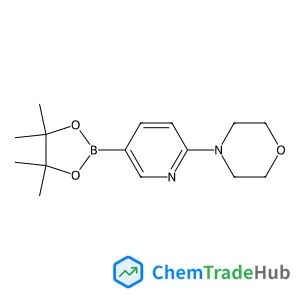
4-(5-(4,4,5,5-tetramethyl-1,3,2-dioxaborolan-2-yl)pyridin-2-yl)morpholine
CAS号:
485799-04-0
分子式:
C15H23BN2O3
推荐供应商





免责声明
本页面提供的学术期刊信息仅供参考和研究使用。我们与任何期刊出版商均无关联,也不处理投稿事宜。如有投稿相关咨询,请直接联系相关期刊出版商。
如发现页面信息有误,请发送邮件至 support@chemtradehub.com 联系我们。我们将及时核实并处理您的问题。