


![2-{3-[4-(3-Chlorophenyl)-1-piperazinyl]propyl}[1,2,4]triazolo[4,3-a]pyridin-3(2H)-one hydrochloride (1:1) structure](https://cnstatic.chemtradehub.com/structs/253/25332-39-2-496e.webp "2-{3-[4-(3-Chlorophenyl)-1-piperazinyl]propyl}[1,2,4]triazolo[4,3-a]pyridin-3(2H)-one hydrochloride (1:1) structure")
Structure and dynamics of chemically active ring polymers: swelling to collapse
文献信息
发布日期
2023-09-12
DOI
10.1039/D3SM00839H
影响因子
3.679
作者
Namita Jain, Snigdha Thakur
查看原文
摘要
The ring structures are common in many synthetic or natural systems and experience both local and long-range forces by chemical sensing. This work is an effort to investigate the structural and dynamical properties of a chemically active ring in an explicit solvent bath utilizing hybrid molecular dynamics (MD) and multiparticle collision dynamics (MPCD) simulation techniques. We show that by tuning the chemical properties of the ring, it can be converted from a chemo-attractant to a chemo-repellent, thereby changing the steady state to be either collapsed or swelled as compared to its passive limit. We quantify these observations by comparing the scaling laws, local structures and the dynamics of active and passive rings. Furthermore, we show the impact of varying numbers of active sites by calculating the contact probability of the collapse state that highlights diverse structures. We also analyze the dynamics of the ring by finding the relaxation time and the mean square displacement of the centre of mass. A faster relaxation with enhanced diffusion is observed for the active rings.
期刊推荐

Environmental Toxicology and Pharmacology
Molecules
Current Pharmaceutical Biotechnology

Photochemical & Photobiological Sciences
Faraday Discussions
Journal of Enzyme inhibition and Medicinal Chemistry

Angewandte Chemie International Edition
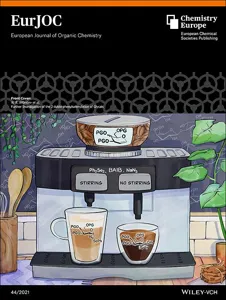
European Journal of Organic Chemistry
Molecular Diversity

Physical Chemistry Chemical Physics
相关文献
Strong temperature-dependent crystallization, phase transition, optical and electrical characteristics of p-type CuAlO2 thin films
2014-11-05
Paper
DOI: 10.1039/C4CP04009K
Tailoring the interface of an immiscible polymer blend by a mutually miscible homopolymer grafted onto graphene oxide: outstanding mechanical properties
Goutam Prasanna Kar, Sourav Biswas, Suryasarathi Bose
2014-11-21
Paper
DOI: 10.1039/C4CP04481A
In situ non-aqueous nucleation and growth of next generation rare-earth-free permanent magnets
Aoran Xu, George E. Sterbinsky, Dario A. Arena, Ziying Wang, Peter W. Stephens
2014-11-21
Paper
DOI: 10.1039/C4CP04451G
Electronic structures at the interface between Au and CH3NH3PbI3
Xiaoliang Liu, Chenggong Wang, Lu Lyu, Congcong Wang, Zhengguo Xiao, Cheng Bi, Jinsong Huang, Yongli Gao
2014-11-07
Paper
DOI: 10.1039/C4CP03842H
Non-universal tracer diffusion in crowded media of non-inert obstacles
Surya K. Ghosh, Andrey G. Cherstvy
2014-11-26
Paper
DOI: 10.1039/C4CP03599B
Revisiting the conundrum of trehalose stabilization
Nidhi Katyal, Shashank Deep
2014-10-28
Paper
DOI: 10.1039/C4CP02914C
A novel two-dimensional MgB6 crystal: metal-layer stabilized boron kagome lattice
Sheng-Yi Xie, Xian-Bin Li, Nian-Ke Chen, Yeliang Wang, Shengbai Zhang, Hong-Bo Sun
2014-11-07
Paper
DOI: 10.1039/C4CP03728F
Structure of palladium nanoparticles under oxidative conditions
Cristina Popa, Tianwei Zhu, Ionut Tranca, Payam Kaghazchi, Emiel J. M. Hensen
2014-12-08
Paper
DOI: 10.1039/C4CP01761G
Energetic contributions of residues to the formation of early amyloid-β oligomers
R. Pouplana, J. M. Campanera
2014-12-05
Paper
DOI: 10.1039/C4CP04544K
Near field plasmonic gradient effects on high vacuum tip-enhanced Raman spectroscopy
Mengtao Sun
2014-11-07
Perspective
DOI: 10.1039/C4CP03871A
您可能还喜欢
化合物问答
4-[4-三氟甲基苯基]恶唑(CAS号:1126636-40-5)通常如何合成?
4-[4-三氟甲基苯基]恶唑通常通过将4-三氟甲基苯酚与异硫氰酸苯酯在有机溶剂中进行酯化反应合成。该反应可在无水条件下,使用适当的催化剂,如四丁基氢氧化铵,以提...
1126636-40-54-(4-(Trifluoromethy...
59729-32-71-[3-(Dimethylamino)...
化合物问答
RockPhos Pd G3(CAS号:2009020-38-4)通常如何合成?
RockPhos Pd G3 通常通过钯催化偶联反应合成,使用配体 (2'-Amino-2-biphenylyl)(methanesulfonato-kappa...
2009020-38-4(2'-Amino-2-biphenyl...
化合物问答
1-哌啶甲酰胺(CAS号:2158-03-4)的市场或研究趋势如何?
1-哌啶甲酰胺作为有机合成中的重要中间体,其市场需求主要受医药、农药、染料等行业推动。近年来,随着新药开发和绿色化学的发展,该化合物的研究趋势集中在开发更高效、...
2158-03-41-Piperidinecarboxam...
化合物问答
2-(二苯基膦基)乙胺(CAS号:4848-43-5)适用哪些法规指南?
2-(二苯基膦基)乙胺适用于多种法规指南,包括但不限于《全球化学品统一分类和标签制度》(GHS),欧盟《化学品注册、评估、授权和限制》法规(REACH),以及美...
4848-43-52-(Diphenylphosphino...
化合物问答
如何储存间苯二甲酸二烯丙酯(CAS号:1087-21-4)?
间苯二甲酸二烯丙酯应储存在阴凉、干燥、通风良好的地方,远离火源和热源。储存容器应密封,避免光照和高温。储存温度应控制在25℃以下,相对湿度应低于80%。避免与其...
1087-21-4Diallyl isophthalate
化合物问答
什么是间甲苯异硫代异氰酸酯(CAS号:621-30-7)?
间甲苯异硫代异氰酸酯是一种有机化合物,分子式为C7H7NO2S,具有刺激性气味。它是一种重要的有机合成中间体,在合成其他化合物时广泛应用。
621-30-71-Isothiocyanato-3-m...
化合物问答
在合成中是否有N-Boc-D-苯丙氨醇(CAS号:106454-69-7)的替代品?
在合成中,可以考虑使用N-Cbz-D-苯丙氨醇或N-Fmoc-D-苯丙氨醇作为替代品。这些化合物同样具有保护氨基的功能,且在合成过程中表现出良好的反应性能。
106454-69-72-Methyl-2-propanyl ...
化合物问答
3-羟甲基-2-氧异丙基吡啶(CAS号:954240-50-7)的主要用途是什么?
3-羟甲基-2-氧异丙基吡啶主要用于有机合成领域,可以作为合成其他药物、农药或精细化学品的中间体。此外,它还可能在实验室研究中作为特定反应的前体或溶剂。
954240-50-7(2-Isopropoxy-3-pyri...
化合物问答
6-氨基-9-甲基嘌呤(CAS号:700-00-5)应用于哪些行业?
6-氨基-9-甲基嘌呤目前主要应用于医药行业,作为某些药物的中间体。此外,它还可能用于聚合物、传感器和半导体的某些领域,作为功能性单体或掺杂剂。
700-00-59-Methyl-9H-purin-6-...
来源期刊
Soft Matter

CiteScore:
6
自引率:
10.3%
年发文量:
856
Soft Matter provides a unique forum for the communication of significant advances in interdisciplinary soft matter research. There is a particular focus on the interface between chemistry, physics, materials science, biology and chemical engineering. Research may report new soft materials or phenomena, encompass their design, synthesis, and use in new applications; or provide fundamental insight and observations on their behaviour. Experimental, theoretical and computational soft matter approaches are encouraged. The scope of Soft Matter covers the following. Soft matter assemblies, including colloids, granular matter, liquid crystals, gels & networks, polymers, hybrid materials, active matter and further examples Soft nanotechnology, soft robotics and devices Synthesis, self-assembly and directed assembly Biological aspects of soft matter including proteins, biopolymers, cells and tissues Surfaces, interfaces and interactions Phase behaviour, coacervation and rheological behaviour Sustainable soft materials including recycling, circular economy and end of life Mechanistic insights and modelling
推荐化合物
![[2',6'-bis(propan-2-yloxy)-[1,1'-biphenyl]-3-yl]dicyclohexylphosphane structure](https://cnstatic.chemtradehub.com/structs/787/787618-22-8-dda2.webp "[2',6'-bis(propan-2-yloxy)-[1,1'-biphenyl]-3-yl]dicyclohexylphosphane structure")
[2',6'-bis(propan-2-yloxy)-[1,1'-biphenyl]-3-yl]dicyclohexylphosphane
CAS号:
787618-22-8
分子式:
C30H43O2P
推荐供应商



免责声明
本页面提供的学术期刊信息仅供参考和研究使用。我们与任何期刊出版商均无关联,也不处理投稿事宜。如有投稿相关咨询,请直接联系相关期刊出版商。
如发现页面信息有误,请发送邮件至 support@chemtradehub.com 联系我们。我们将及时核实并处理您的问题。