







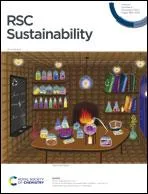
Effective photocatalytic degradation of rhodamine-B over Zn-doped BaO2 and SrO2 composites under UV and sunlight irradiation
文献信息
发布日期
2023-07-17
DOI
10.1039/D3SU00091E
影响因子
0
作者
Daneshwaran Balaji, Nivedita Sudheer, Mittal Bathwar, Manjunath Rangasamy, Ganesh Kumar Dhandabani, Alain R. Puente Santiago, Sumathi Shanmugam, Kien-Voon Kong, Vijayaraghavan R
查看原文
摘要
Environmental pollution due to dye industries is a major concern as it affects both aquatic and human life. Among various processes, photocatalysis involving the advanced oxidation process (AOP) that employs semi-conductor based photocatalysis is popular and this process degrades dyes into CO2 and H2O. The currently used TiO2 based photocatalysis requires ultra-violet (UV) light irradiation for activation. There is always a need for a catalyst that works under natural sunlight so that the dye degradation process is economical. Towards this objective, we have developed Zn doped metal peroxides as efficient photocatalysts towards rhodamine B (RhB) dye degradation. A new family of zinc-doped barium peroxide (Ba1-xZnxO2x = 0, 0.2, 0.4, 0.6, and 0.8) and zinc-doped strontium peroxide (Sr1−xZnxO2x = 0, 0.2, 0.4, 0.6, and 0.8) photocatalysts were prepared by the co-precipitation technique for the photocatalytic degradation of RhB under UV and natural sunlight irradiation. In particular, Ba0.4Zn0.6O2 (x = 0.6) and Sr0.6Zn0.4O2 (x = 0.4) photocatalysts exhibit higher photodegradation efficiency than the pure peroxides both under UV and sunlight irradiation. Ba0.4Zn0.6O2 and Sr0.6Zn0.4O2 photocatalysts show a degradation efficiency of 99.9% and 99.8% within 15 min and 10 min under UV light, respectively. The rate constants of degradation by doped peroxides, in particular Ba0.4Zn0.6O2 and Sr0.6Zn0.4O2, are 100 times higher than those of the parent peroxides.
相关文献
The quasi-unchanged gas-phase molecular structures of the atmospheric aerosol precursor β-pinene and its oxidation product nopinone
E. M. Neeman, J.-R. Avilés-Moreno, T. R. Huet
2017-04-27
Paper
DOI: 10.1039/C7CP01298E
Enhanced planar perovskite solar cells with efficiency exceeding 16% via reducing the oxygen vacancy defect state in titanium oxide electrode
Yangyang Du, Hongkun Cai, Yunhao Wu, Zhixue Xing, Zhenglong Li, Jian Xu, Like Huang, Jian Ni, Juan Li, Jianjun Zhang
2017-04-28
Paper
DOI: 10.1039/C7CP01936J
The behavior of a paramagnetic system in electric and magnetic fields as exemplified by revisiting Li@B10H14‡
Taye B. Demissie, Michael L. McKee, Drahomír Hnyk
2017-04-07
Paper
DOI: 10.1039/C7CP00658F
Oxygen thermomigration in acceptor-doped perovskite
Donghoon Shin, Han-Ill Yoo
2017-04-19
Paper
DOI: 10.1039/C7CP00384F
A kinetic model of water adsorption, clustering and dissociation on the Fe3S4{001} surface
Alberto Roldan
2017-04-06
Paper
DOI: 10.1039/C6CP07371A
Binding site opening by loop C shift and chloride ion-pore interaction in the GABAA receptor model
S. Kraszewski, J. W. Mozrzymas
2017-04-10
Paper
DOI: 10.1039/C7CP00582B
Generation of large spin and valley currents in a quantum pump based on molybdenum disulfide
H. Khani, M. Esmaeilzadeh, F. Kanjouri
2017-04-07
Paper
DOI: 10.1039/C6CP08817A
Hydrophobic hydration and anomalous diffusion of elastin in an ethanolic solution
Nisha Pawar, Priyanka Kaushik, H. B. Bohidar
2017-05-03
Paper
DOI: 10.1039/C7CP01384A
Enhanced oxygen-release/storage properties of Pd-loaded Sr3Fe2O7−δ
Kosuke Beppu, Takuya Shibano, Akito Demizu, Kazuo Kato, Kenji Wada
2017-05-03
Paper
DOI: 10.1039/C7CP01614J
Investigation of surface energies in spin crossover nanomaterials: the role of surface relaxations
William Nicolazzi, Férial Terki, Gábor Molnár, Azzedine Bousseksou
2017-04-20
Paper
DOI: 10.1039/C7CP01364G
您可能还喜欢
化合物问答
N-2,2-丙烯基-2-丙烯酰胺(CAS号:2555-13-7)通常如何合成?
N-2,2-丙烯基-2-丙烯酰胺通常通过丙烯酰胺与丙烯基卤化物的缩合反应合成。该反应通常在温和的条件下进行,使用适量的碱如吡啶作为催化剂。反应的选择性良好,产率...
2555-13-7N-Allylacrylamide
化合物问答
什么是1,2-二碘四氟代乙烷(CAS号:354-65-4)?
1,2-二碘四氟代乙烷是一种有机化合物,化学式为C2F4I2,CAS号为354-65-4。它是一种无色透明液体,具有特殊的化学性质和物理性质,包括高沸点、低挥发...
354-65-41,1,2,2-Tetrafluoro-...
化合物问答
3-溴-1H-吡咯[3,2-c]吡啶-4-碳腈(CAS号:1000341-71-8)适用哪些法规指南?
根据GHS(全球化学品统一分类和标签制度),3-溴-1H-吡咯[3,2-c]吡啶-4-碳腈被归类为第2类易燃液体。在欧盟,该化合物需要符合REACH法规的要求,...
1000341-71-83-Bromo-1H-pyrrolo[3...
化合物问答
1-氯甲基萘磺酸(CAS号:87491-79-0)安全吗?
1-氯甲基萘磺酸在使用时需要谨慎,因为它具有一定的刺激性和腐蚀性。操作时应佩戴适当的防护装备,如防化服、手套、护目镜等,避免直接接触皮肤和吸入其蒸汽。
87491-79-01-((Chloromethyl)sul...
化合物问答
二氯(二环戊二烯)铂(CAS号:12083-92-0)的主要用途是什么?
该化合物主要用于催化剂领域,特别是在有机合成中的催化氧化反应以及作为某些药物合成的中间体。此外,它还被研究用于纳米材料的制备。
12083-92-0(1S,7R)-Tricyclo[5.2...
化合物问答
3-溴-7-氯噻吩并[3,2-b]吡啶-6-甲腈(CAS号:798574-82-0)安全吗?
3-溴-7-氯噻吩并[3,2-b]吡啶-6-甲腈在处理时需要谨慎,因其含有溴和氯等强卤素,可能具有一定的刺激性和腐蚀性。使用时应佩戴适当的个人防护装备,避免皮肤...
798574-82-03-Bromo-7-chlorothie...
化合物问答
(R)-1-((R)-2-(2’-二环己基膦苯基)三戊铁基]乙基(双-3,5-三氟甲基苯基)膦(CAS号:494227-32-6)的主要用途是什么?
该化合物主要用于有机合成领域,特别是作为催化剂或配体,在有机合成反应中发挥重要作用。此外,它还可能应用于催化加氢反应、偶联反应等。
494227-32-6Walphos SL-W008-1
化合物问答
3-[6-(Diphenylphosphoryl)-2-naphthyl]-1,10-phenanthroline(CAS号:1480371-38-7)安全吗?
3-[6-(Diphenylphosphoryl)-2-naphthyl]-1,10-phenanthroline在正常使用条件下相对安全,但在操作时应穿戴适当...
1480371-38-73-[6-(Diphenylphosph...
化合物问答
在合成中是否有ETHYL 2-(4-(4,4,5,5-TETRAMETHYL-1,3,2-DIOXABOROLAN-2-YL)CYCLOHEX-3-ENYL)ACETATE(CAS号:1166829-70-4)的替代品?
可以考虑使用类似结构的化合物作为替代品,如2-(4-环戊基环己烯基)乙酸酯,这种化合物在结构上相似,可能在某些合成路径中作为替代品。
1166829-70-4Ethyl [4-(4,4,5,5-te...
化合物问答
如何处理含有3-(3-氨基丙基)丙酮缩甘油(CAS号:131606-42-3)的废料?
处理含有3-(3-氨基丙基)丙酮缩甘油的废料时,首先应确保遵守当地的环保法规。对于危险废物,应进行分类收集,然后送至专业的废物处理设施进行焚烧或安全填埋。在处理...
131606-42-33-[(2,2-Dimethyl-1,3...
来源期刊
推荐化合物
推荐供应商






免责声明
本页面提供的学术期刊信息仅供参考和研究使用。我们与任何期刊出版商均无关联,也不处理投稿事宜。如有投稿相关咨询,请直接联系相关期刊出版商。
如发现页面信息有误,请发送邮件至 support@chemtradehub.com 联系我们。我们将及时核实并处理您的问题。