


![2-{3-[4-(3-Chlorophenyl)-1-piperazinyl]propyl}[1,2,4]triazolo[4,3-a]pyridin-3(2H)-one hydrochloride (1:1) structure](https://cnstatic.chemtradehub.com/structs/253/25332-39-2-496e.webp "2-{3-[4-(3-Chlorophenyl)-1-piperazinyl]propyl}[1,2,4]triazolo[4,3-a]pyridin-3(2H)-one hydrochloride (1:1) structure")
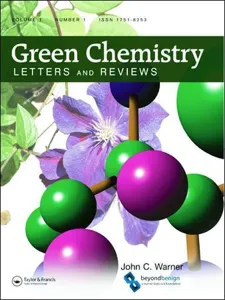
Green Chemistry Letters and Reviews
基本信息
期刊简写:
GREEN CHEM LETT REV
影响因子:
5.8
ISSN:
1751-8253
研究领域:
CHEMICAL
h-index:
27
自引率:
1.7%
年发文量:
50
SCI收录来源:
Science Citation Index Expanded
期刊官网:
https://www.tandfonline.com/journals/tgcl20
期刊介绍:
Green Chemistry Letters and Reviews (GCLR) is an international, cross-disciplinary, fully open access journal focused on the contribution of chemistry to sustainable development. GCLR’s scope aims to build upon the definition of Green Chemistry as first defined by its Founding Editor John Warner, together with Paul Anastas, in Green Chemistry: Theory and Practice, Oxford University Press, Oxford, 1998. GCLR is dedicated to bringing together academic, teaching, and industry professionals, including environmental scientists and law and policy makers, who constitute the green chemistry community. We welcome original research letters and articles, review articles, perspective and feature articles, reports on recent innovations, as well as educational resources from those working in related disciplines across chemistry, chemical engineering, political science, jurisprudence, and economics. GCLR accepts the following article types: Research Article, Research Letter, Review Article, Methods, and Brief Reports. All contributions should clearly demonstrate impact to advancing the field by reference to the 12 Principles of Green Chemistry and the Sustainable Development Goals agreed by the United Nations in 2015. Such topics include, but are not limited to: Green synthesis and catalysis Green manufacturing and engineering Green product design Green chemistry education Critical raw materials and sustainable resources Energy harvest, storage, and savings Circular economy Environmental chemistry and green metrics Ethics, legislation, and economics We encourage authors to deposit their manuscripts as a pre-print to speed up the dissemination of research, which allows for feedback before formal peer review. Deposition of your manuscript in a pre-print server will have no bearing on the peer review process and final decision made on your manuscript. Authors who believe their manuscript would benefit from English editing prior to submission should seek a professional editing service or native English speaker. Details of editing services available from Taylor & Francis are available here. Peer Review Statement Green Chemistry Letters and Reviews is an international, peer-reviewed journal publishing high quality, original research contributions in the pursuit of scientific knowledge. All manuscript submissions are subject to initial appraisal by the Editor, and, if found suitable for further consideration, to single anonymized peer review by independent, anonymous expert referees. Publishing Ethics Statement Green Chemistry Letters and Reviews adheres to the highest standards of publishing ethics, with rigorous processes in place to ensure this is achieved. Taylor & Francis is a member of Committee of Publication Ethics (COPE) and utilizes Similarity Check via CrossRef for all journals. More information on our ethical standards and policies can be found here The Journal has an appeals and complaints policy which can be viewed here
CiteScore
CiteScore
9.1
SJR
1.138
SNIP
1.474
| 学科 | 排名 | 百分位 |
|---|---|---|
ChemistryGeneral Chemistry |
62 / 408 | 84% |
期刊统计
期/年
59 days avg. from submission to first decision
74 days avg. from submission to first post-review decision
13 days avg. from acceptance to online publication
审稿周期
USD1680; GBP1344
论文处理费
投稿信息
投稿网址:
https://rp.tandfonline.com/submission/create?journalCode=TGCL期刊推荐

Biocatalysis and Biotransformation

Acta Metallurgica Sinica-English Letters

Electroanalysis

Chinese Journal of Chemistry

Polycyclic Aromatic Compounds

Bioorganic & Medicinal Chemistry Letters

Heteroatom Chemistry

Journal of Asian Natural Products Research

Herald of the Russian Academy of Sciences

NDT & E International
相关文献
Organic electrosynthesis using toluates as simple and versatile radical precursors
Kevin Lam, István E. Markó
2008-11-17
Communication
DOI: 10.1039/B813545B
Amplified fluorescence determination of microRNAs in homogeneous solution with cationic conjugated polymers
Zhengping Li, Yongqiang Cheng
2008-11-13
Communication
DOI: 10.1039/B816614E
Morphological changes in the self-assembly of a radial oligo-phenylene ethynylene amphiphilic system
Gustavo Fernández, Fátima García, Luis Sánchez
2008-11-12
Communication
DOI: 10.1039/B818378C
Lengthening alkyl spacers to increase SBA-15-anchored Rh–P complex activities in 1-octene hydroformylation
Wei Zhou, Dehua He
2008-10-01
Communication
DOI: 10.1039/B812910J
Preparation of active and robust palladium nanoparticlecatalysts stabilized by diamine-functionalized mesoporous polymers
Rong Xing, Yueming Liu, Haihong Wu, Xiaohong Li, Mingyuan He, Peng Wu
2008-10-27
Communication
DOI: 10.1039/B815186E
One-step synthesis of chiral cages
Vincent Steinmetz, François Couty, Olivier R. P. David
2008-11-26
Communication
DOI: 10.1039/B816628E
Formation of dodecaphenylporphodimethenevia facile protonation of saddle-distorted dodecaphenylporphyrin
Takahiko Kojima, Kakeru Hanabusa, Kei Ohkubo, Motoo Shiro, Shunichi Fukuzumi
2008-11-05
Communication
DOI: 10.1039/B816063E
Tin triflate-mediated total synthesis of circumdatin F, sclerotigenin, asperlicin C, and other quinazolino[3,2-a][1,4]benzodiazepines
Ming-Chung Tseng, Chi-Yu Lai, Yu-Wan Chu, Yen-Ho Chu
2008-11-19
Communication
DOI: 10.1039/B813880J
Tandem conjugate addition–elimination reaction promoted by chiral pyrrolidinyl sulfonamide (CPS)‡
2008-09-24
Communication
DOI: 10.1039/B810905M
Cyclisation of citronellal over heterogeneous inorganic fluorides—highly chemo- and diastereoselective catalysts for (±)-isopulegol
Pratap Patil, Stefan Wuttke, Erhard Kemnitz
2008-12-01
Communication
DOI: 10.1039/B817572A
您可能还喜欢
化合物问答
4-[4-三氟甲基苯基]恶唑(CAS号:1126636-40-5)通常如何合成?
4-[4-三氟甲基苯基]恶唑通常通过将4-三氟甲基苯酚与异硫氰酸苯酯在有机溶剂中进行酯化反应合成。该反应可在无水条件下,使用适当的催化剂,如四丁基氢氧化铵,以提...
1126636-40-54-(4-(Trifluoromethy...
59729-32-71-[3-(Dimethylamino)...
化合物问答
RockPhos Pd G3(CAS号:2009020-38-4)通常如何合成?
RockPhos Pd G3 通常通过钯催化偶联反应合成,使用配体 (2'-Amino-2-biphenylyl)(methanesulfonato-kappa...
2009020-38-4(2'-Amino-2-biphenyl...
化合物问答
1-哌啶甲酰胺(CAS号:2158-03-4)的市场或研究趋势如何?
1-哌啶甲酰胺作为有机合成中的重要中间体,其市场需求主要受医药、农药、染料等行业推动。近年来,随着新药开发和绿色化学的发展,该化合物的研究趋势集中在开发更高效、...
2158-03-41-Piperidinecarboxam...
化合物问答
2-(二苯基膦基)乙胺(CAS号:4848-43-5)适用哪些法规指南?
2-(二苯基膦基)乙胺适用于多种法规指南,包括但不限于《全球化学品统一分类和标签制度》(GHS),欧盟《化学品注册、评估、授权和限制》法规(REACH),以及美...
4848-43-52-(Diphenylphosphino...
化合物问答
如何储存间苯二甲酸二烯丙酯(CAS号:1087-21-4)?
间苯二甲酸二烯丙酯应储存在阴凉、干燥、通风良好的地方,远离火源和热源。储存容器应密封,避免光照和高温。储存温度应控制在25℃以下,相对湿度应低于80%。避免与其...
1087-21-4Diallyl isophthalate
化合物问答
什么是间甲苯异硫代异氰酸酯(CAS号:621-30-7)?
间甲苯异硫代异氰酸酯是一种有机化合物,分子式为C7H7NO2S,具有刺激性气味。它是一种重要的有机合成中间体,在合成其他化合物时广泛应用。
621-30-71-Isothiocyanato-3-m...
化合物问答
在合成中是否有N-Boc-D-苯丙氨醇(CAS号:106454-69-7)的替代品?
在合成中,可以考虑使用N-Cbz-D-苯丙氨醇或N-Fmoc-D-苯丙氨醇作为替代品。这些化合物同样具有保护氨基的功能,且在合成过程中表现出良好的反应性能。
106454-69-72-Methyl-2-propanyl ...
化合物问答
3-羟甲基-2-氧异丙基吡啶(CAS号:954240-50-7)的主要用途是什么?
3-羟甲基-2-氧异丙基吡啶主要用于有机合成领域,可以作为合成其他药物、农药或精细化学品的中间体。此外,它还可能在实验室研究中作为特定反应的前体或溶剂。
954240-50-7(2-Isopropoxy-3-pyri...
化合物问答
6-氨基-9-甲基嘌呤(CAS号:700-00-5)应用于哪些行业?
6-氨基-9-甲基嘌呤目前主要应用于医药行业,作为某些药物的中间体。此外,它还可能用于聚合物、传感器和半导体的某些领域,作为功能性单体或掺杂剂。
700-00-59-Methyl-9H-purin-6-...
推荐化合物
![1-(Hexopyranosyloxy)-4a,5-dihydroxy-7-methyl-1,4a,5,6,7,7a-hexahydrocyclopenta[c]pyran-7-yl 3-phenylacrylate structure](https://cnstatic.chemtradehub.com/structs/192/19210-12-9-ecae.webp "1-(Hexopyranosyloxy)-4a,5-dihydroxy-7-methyl-1,4a,5,6,7,7a-hexahydrocyclopenta[c]pyran-7-yl 3-phenylacrylate structure")
推荐供应商



免责声明
本页面提供的学术期刊信息仅供参考和研究使用。我们与任何期刊出版商均无关联,也不处理投稿事宜。如有投稿相关咨询,请直接联系相关期刊出版商。
如发现页面信息有误,请发送邮件至 support@chemtradehub.com 联系我们。我们将及时核实并处理您的问题。