








![1-(Hexopyranosyloxy)-4a,5-dihydroxy-7-methyl-1,4a,5,6,7,7a-hexahydrocyclopenta[c]pyran-7-yl 3-phenylacrylate structure](https://cnstatic.chemtradehub.com/structs/192/19210-12-9-ecae.webp "1-(Hexopyranosyloxy)-4a,5-dihydroxy-7-methyl-1,4a,5,6,7,7a-hexahydrocyclopenta[c]pyran-7-yl 3-phenylacrylate structure")
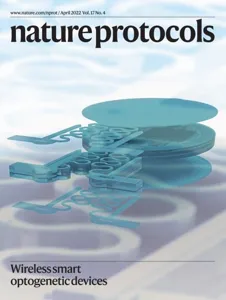
Nature Protocols
基本信息
期刊简写:
NAT PROTOC
影响因子:
13.1
ISSN:
1754-2189
研究领域:
BIOLOGICAL
h-index:
206
自引率:
0.8%
年发文量:
136
SCI收录来源:
Science Citation Index Expanded
期刊官网:
https://www.nature.com/nprot
期刊介绍:
Nature Protocols publishes secondary research articles - predominantly Protocols (including Protocol Updates and Protocol Extensions), but also techniques-related Reviews, Perspectives, Correspondences, Matters Arising, Commentaries, and Consensus Statements - all of which are based on published primary research papers. We cover new techniques and technologies, as well as established methods, used in all fields of the biological, chemical and clinical sciences. Articles are commissioned by the editors. Authors are welcome to submit suggestions for articles as Presubmission Enquiries, which may then be formally commissioned by the editors. Each Protocol contains a full list of reagents and equipment, timing information, and step-by-step procedures (instructions for performing the experiment), as well as information on designing and adapting the technique, its advantages and limitations compared to alternatives, troubleshooting, analysing data, and interpreting results. We also encourage authors to submit videos for steps that are technically challenging. All of our Protocols have been proven to work already (used to generate data in published papers), with further validation provided by peer review of the Protocols themselves. As a supporting primary research paper is a requirement for publication, novelty is not a prerequisite. However, it is important that our Protocols add value to the published literature and expand significantly upon the information available in the supporting papers (for example, with additional detail relating to experimental design, troubleshooting, data analysis, etc.). As we are not a primary research journal, our articles do not include new (previously unpublished) research findings and should only contain minimal new supporting data relating specifically to development of the Protocol (e.g. validation, benchmarking, and troubleshooting data). To ensure we provide the most up-to-date version of a Protocol, the procedure may sometimes deviate slightly from the version used in the supporting paper, but all minor modifications must be clearly discussed. Any major improvements, adaptations, or extensions of a Protocol should be supported by the publication of an additional supporting primary research paper. In addition to Protocols, we also publish other types of techniques-related articles.
CiteScore
CiteScore
29.1
SJR
7.419
SNIP
3.387
| 学科 | 排名 | 百分位 |
|---|---|---|
Biochemistry, Genetics and Molecular BiologyGeneral Biochemistry, Genetics and Molecular Biology |
5 / 221 | 97% |
期刊统计
Quarterly
期/年
Submission to first editorial decision (median days): 14
Submission to acceptance (median days): 197
审稿周期
论文处理费
投稿信息
投稿网址:
https://mts-np.nature.com/收录体裁:
Protocol, Protocol Update, Protocol Extension, Correspondence, Matters Arising, Perspective, Commentary, Review, Analysis
相关文献
Potential energy surface for cyclotrimethylene trinitramine dimer from symmetry-adapted perturbation theory‡
Robert Bukowski, Betsy M. Rice
2007-08-23
Paper
DOI: 10.1039/B709192C
EPR and optical studies of erbium-doped β-PbF2 single-crystals and nanocrystals in transparent glass–ceramics
Géraldine Dantelle, Michel Mortier, Daniel Vivien
2007-08-30
Paper
DOI: 10.1039/B706735F
Kinetic analysis of the ozone processing of an unsaturated organic monolayer as a model of an aerosol surface
Erick González-Labrada, Rolf Schmidt, Christine E. DeWolf
2007-09-20
Paper
DOI: 10.1039/B707890K
The canonical and other mechanisms of elementary chemical reactions
Jesús Aldegunde, F. Javier Aoiz, Vicente Sáez-Rábanos, Brian K. Kendrick, Marcelo P. de Miranda
2007-09-13
Paper
DOI: 10.1039/B707190F
Intracule functional models: I. Angle-corrected correlation kernels
Elise E. Dumont, Deborah L. Crittenden, Peter M. W. Gill
2007-08-13
Paper
DOI: 10.1039/B709513A
On the position of the potential wall in DFT temporary anion calculations
Nick Sablon, Frank De Proft, Paul Geerlings, David J. Tozer
2007-09-24
Paper
DOI: 10.1039/B711428A
Chemorheological analysis and model-free kinetics of acid catalysed furfuryl alcohol polymerization
Nathanael Guigo, Alice Mija, Luc Vincent, Nicolas Sbirrazzuoli
2007-08-08
Paper
DOI: 10.1039/B707950H
Fourth-order coherent Raman spectroscopy in a time domain: applications to buried interfaces
2007-07-05
Perspective
DOI: 10.1039/B704566M
您可能还喜欢
化合物问答
4-[4-三氟甲基苯基]恶唑(CAS号:1126636-40-5)通常如何合成?
4-[4-三氟甲基苯基]恶唑通常通过将4-三氟甲基苯酚与异硫氰酸苯酯在有机溶剂中进行酯化反应合成。该反应可在无水条件下,使用适当的催化剂,如四丁基氢氧化铵,以提...
1126636-40-54-(4-(Trifluoromethy...
59729-32-71-[3-(Dimethylamino)...
化合物问答
RockPhos Pd G3(CAS号:2009020-38-4)通常如何合成?
RockPhos Pd G3 通常通过钯催化偶联反应合成,使用配体 (2'-Amino-2-biphenylyl)(methanesulfonato-kappa...
2009020-38-4(2'-Amino-2-biphenyl...
化合物问答
1-哌啶甲酰胺(CAS号:2158-03-4)的市场或研究趋势如何?
1-哌啶甲酰胺作为有机合成中的重要中间体,其市场需求主要受医药、农药、染料等行业推动。近年来,随着新药开发和绿色化学的发展,该化合物的研究趋势集中在开发更高效、...
2158-03-41-Piperidinecarboxam...
化合物问答
2-(二苯基膦基)乙胺(CAS号:4848-43-5)适用哪些法规指南?
2-(二苯基膦基)乙胺适用于多种法规指南,包括但不限于《全球化学品统一分类和标签制度》(GHS),欧盟《化学品注册、评估、授权和限制》法规(REACH),以及美...
4848-43-52-(Diphenylphosphino...
化合物问答
如何储存间苯二甲酸二烯丙酯(CAS号:1087-21-4)?
间苯二甲酸二烯丙酯应储存在阴凉、干燥、通风良好的地方,远离火源和热源。储存容器应密封,避免光照和高温。储存温度应控制在25℃以下,相对湿度应低于80%。避免与其...
1087-21-4Diallyl isophthalate
化合物问答
什么是间甲苯异硫代异氰酸酯(CAS号:621-30-7)?
间甲苯异硫代异氰酸酯是一种有机化合物,分子式为C7H7NO2S,具有刺激性气味。它是一种重要的有机合成中间体,在合成其他化合物时广泛应用。
621-30-71-Isothiocyanato-3-m...
化合物问答
在合成中是否有N-Boc-D-苯丙氨醇(CAS号:106454-69-7)的替代品?
在合成中,可以考虑使用N-Cbz-D-苯丙氨醇或N-Fmoc-D-苯丙氨醇作为替代品。这些化合物同样具有保护氨基的功能,且在合成过程中表现出良好的反应性能。
106454-69-72-Methyl-2-propanyl ...
化合物问答
3-羟甲基-2-氧异丙基吡啶(CAS号:954240-50-7)的主要用途是什么?
3-羟甲基-2-氧异丙基吡啶主要用于有机合成领域,可以作为合成其他药物、农药或精细化学品的中间体。此外,它还可能在实验室研究中作为特定反应的前体或溶剂。
954240-50-7(2-Isopropoxy-3-pyri...
化合物问答
6-氨基-9-甲基嘌呤(CAS号:700-00-5)应用于哪些行业?
6-氨基-9-甲基嘌呤目前主要应用于医药行业,作为某些药物的中间体。此外,它还可能用于聚合物、传感器和半导体的某些领域,作为功能性单体或掺杂剂。
700-00-59-Methyl-9H-purin-6-...
推荐化合物
![2-Bromodibenzo[b,d]furan structure](https://cnstatic.chemtradehub.com/structs/86-/86-76-0-1814.webp "2-Bromodibenzo[b,d]furan structure")
推荐供应商




免责声明
本页面提供的学术期刊信息仅供参考和研究使用。我们与任何期刊出版商均无关联,也不处理投稿事宜。如有投稿相关咨询,请直接联系相关期刊出版商。
如发现页面信息有误,请发送邮件至 support@chemtradehub.com 联系我们。我们将及时核实并处理您的问题。