










Measurement uncertainty from physical sample preparation: estimation including systematic error
文献信息
发布日期
2003-10-14
DOI
10.1039/B307581H
影响因子
4.616
作者
Jennifer A. Lyn, Michael H. Ramsey, Richard J. Fussell, Roger Wood
查看原文
摘要
A methodology is proposed, which employs duplicated primary sampling and subsequent duplicated physical preparation coupled with duplicated chemical analyses. Sample preparation duplicates should be prepared under conditions that represent normal variability in routine laboratory practice. The proposed methodology requires duplicated chemical analysis on a minimum of two of the sample preparation duplicates. Data produced from the hierarchical design is treated with robust analysis of variance (ANOVA) to generate uncertainty estimates, as standard uncertainties (‘u’ expressed as standard deviation), for primary sampling (ssamp), physical sample preparation (sprep) and chemical analysis (sanal). The ANOVA results allow the contribution of the sample preparation process to the overall uncertainty to be assessed. This methodology has been applied for the first time to a case study of pesticide residues in retail strawberry samples. Duplicated sample preparation was performed under ambient conditions on two consecutive days. Multi-residue analysis (quantification by GC-MS) was undertaken for a range of incurred pesticide residues including those suspected of being susceptible to loss during sample preparation procedures. Sampling and analytical uncertainties dominated at low analyte concentrations. The sample preparation process contributed up to 20% to the total variability and had a relative uncertainty (Uprep%) of up to 66% (for bupirimate at 95% confidence). Estimates of systematic errors during physical sample preparation were also made using spike recovery experiments. Four options for the estimation of measurement uncertainty are discussed, which both include and exclude systematic error arising from sample preparation and chemical analysis. A holistic approach to the combination and subsequent expression of uncertainty is advised.
相关文献
Assessing the stability of alanine-based helices by conformer-selective IR spectroscopy
Mateusz Marianski, Stephan Warnke, Jongcheol Seo, Carsten Baldauf, Gert von Helden
2016-07-05
Paper
DOI: 10.1039/C6CP03827A
Enhancement of encaged electron concentration by Sr2+ doping and improvement of Gd3+ emission through controlling encaged anions in conductive C12A7 phosphors
Meng Zhang, Yuxue Liu, Hancheng Zhu, Duanting Yan, Jian Yang, Xinyang Zhang, Chunguang Liu, Changshan Xu
2016-03-31
Paper
DOI: 10.1039/C6CP02026G
Photolysis study of fluorinated ketones under natural sunlight conditions
Yolanda Díaz-de-Mera, Alfonso Aranda, Alberto Notario, Ana Rodríguez, Diana Rodríguez, Iván Bravo
2015-07-28
Paper
DOI: 10.1039/C5CP03527A
Atomistic modeling of a KRT35/KRT85 keratin dimer: folding in aqueous solution and unfolding under tensile load
Patrick Duchstein, Tim Clark, Dirk Zahn
2015-07-29
Paper
DOI: 10.1039/C5CP02676H
Regiospecific protonation of organic chromophores
Tingting Lin
2016-06-13
Paper
DOI: 10.1039/C6CP02747D
Enhanced fluorescence of [[5′-(4-hydroxyphenyl)[2,2′-bithiophen]-5-yl]methylene]-propanedinitrile (NIAD-4): solvation induced micro-viscosity enhancement
Jiangpu Hu, Huaning Zhu, Yang Li, Xian Wang, Renjun Ma, Qianjin Guo, Andong Xia
2016-06-15
Paper
DOI: 10.1039/C6CP00881J
Probing the energy levels of perovskite solar cells via Kelvin probe and UV ambient pressure photoemission spectroscopy
J. R. Harwell, I. D. Baikie, J. L. Payne, C. Ni, J. T. S. Irvine, G. A. Turnbull, I. D. W. Samuel
2016-07-07
Paper
DOI: 10.1039/C6CP02446G
Spin–orbit effects on the 119Sn magnetic-shielding tensor in solids: a ZORA/DFT investigation
Fahri Alkan, Sean T. Holmes, Robbie J. Iuliucci, Cecil Dybowski
2016-06-23
Paper
DOI: 10.1039/C6CP03807G
Charting the known chemical space for non-aqueous lithium–air battery electrolyte solvents
Tamara Husch, Martin Korth
2015-07-27
Paper
DOI: 10.1039/C5CP02937F
您可能还喜欢
化合物问答
6-氯-2H-1,4-苯并噁嗪-3(4H)-酮(CAS号:7652-29-1)应用于哪些行业?
6-氯-2H-1,4-苯并噁嗪-3(4H)-酮主要应用于医药、农药和聚合物等领域。在医药领域,该化合物可用于合成抗菌药物;在农药领域,可用作杀虫剂的中间体;在聚...
7652-29-16-Chloro-2H-1,4-benz...
化合物问答
活性氧化铝(CAS号:1302-74-5)应用于哪些行业?
活性氧化铝广泛应用于医药、聚合物、传感器、半导体和催化等领域。在医药行业,活性氧化铝用作吸附剂和干燥剂,有助于去除杂质和水分。在聚合物行业,它用作增白剂和抗结块...
1302-74-5aluminum;trihydrate
化合物问答
什么是硅胶(CAS号:112926-00-8)?
硅胶(Silica gel, pptd.,cryst.-free)是一种无定形、多孔的硅酸盐材料,主要成分为二氧化硅(SiO₂)。其结构由硅氧四面体构成,通过酸...
112926-00-8Silica gel, pptd.,cr...
化合物问答
二乙基甲基一氢硅烷(CAS号:760-32-7)的主要用途是什么?
二乙基甲基一氢硅烷主要用于有机合成、表面处理以及作为溶剂。它还被用作合成其他硅烷化合物的原料,以及在涂料、粘合剂和密封剂中的应用。
760-32-7Diethyl(methyl)silan...
化合物问答
在合成中是否有N-花生四烯酰基甘氨酸(CAS号:179113-91-8)的替代品?
在合成过程中,可以考虑使用类似结构的化合物作为替代品,例如N-亚油酰基甘氨酸或N-花生二烯酰基甘氨酸。这些替代品在结构上有类似的双键位置,但可能具有不同的物理化...
179113-91-8Glycine, N-[(5Z,8Z,1...
化合物问答
在合成中是否有1-(4-甲氧基苯基)丙烷-1,2-二酮(CAS号:10557-27-4)的替代品?
在合成过程中,可以考虑使用类似结构的化合物作为替代品,例如1-(3-甲氧基苯基)丙烷-1,2-二酮或1-(4-羟基苯基)丙烷-1,2-二酮。这些替代品具有相似的...
10557-27-41-(4-Methoxyphenyl)p...
化合物问答
N-(4-氨基-1-苄基-3-羟基-5-苯基戊基)-3-甲基-2-(2-氧代四氢嘧啶-1-基)-丁酰胺 5-氧代吡咯烷-2-甲酸(CAS号:192726-06-0)通常如何合成?
该化合物通常通过一系列复杂的有机合成步骤获得。首先,通过芳香族化合物的羟基化反应获得羟基化产物,然后通过酰化反应形成酰胺中间体,最后通过环化反应得到目标产物。常...
192726-06-05-Oxo-L-proline - (2...
化合物问答
(S)-2-氨基-3-喹啉-2-丙酸(CAS号:161513-46-8)的市场或研究趋势如何?
该化合物作为生物活性化合物,尤其是在药物化学领域表现出色。近年来,随着对新型抗炎、抗病毒和抗癌药物的研究增加,其市场和研究趋势持续增长。此外,其在神经科学领域的...
161513-46-8(S)-2-Amino-3-quinol...
化合物问答
核黄素磷酸钠(CAS号:130-40-5)安全吗?
核黄素磷酸钠在常规使用条件下安全,但高剂量可能引起刺激性反应。操作时需佩戴防护手套和护目镜,避免吸入粉尘。若接触皮肤或眼睛,应立即用大量清水冲洗。急救时需根据接...
130-40-5Sodium 1-deoxy-1-(7,...
化合物问答
盐酸丙胺卡因杂质A(EP) 标准品(CAS号:19281-31-3)通常如何合成?
盐酸丙胺卡因杂质A(EP) 标准品可通过重氮化反应和随后的酰胺化反应合成。首先,利用氯化反应将苯环上的氢原子转化为氯原子,然后通过芳香族重氮化反应引入氨基,最后...
19281-31-32-Chloro-N-(2-methyl...
来源期刊
Analyst

CiteScore:
7.8
自引率:
5.6%
年发文量:
653
Analyst publishes analytical and bioanalytical research that reports premier fundamental discoveries and inventions, and the applications of those discoveries, unconfined by traditional discipline barriers.
推荐化合物
![[4-(Heptyloxy)phenyl]boronic acid structure](https://cnstatic.chemtradehub.com/structs/136/136370-19-9-ad33.webp "[4-(Heptyloxy)phenyl]boronic acid structure")

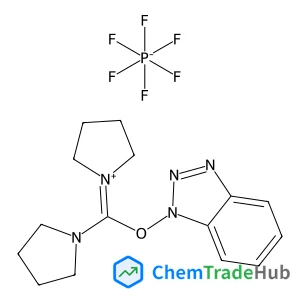
(1H-Benzotriazol-1-yloxy)(di-1-pyrrolidinyl)methylium hexafluorophosphate
CAS号:
105379-24-6
分子式:
C15H21F6N5OP

推荐供应商






免责声明
本页面提供的学术期刊信息仅供参考和研究使用。我们与任何期刊出版商均无关联,也不处理投稿事宜。如有投稿相关咨询,请直接联系相关期刊出版商。
如发现页面信息有误,请发送邮件至 support@chemtradehub.com 联系我们。我们将及时核实并处理您的问题。