










The resurgence of Coulter counting for analyzing nanoscale objects
文献信息
发布日期
2004-05-10
DOI
10.1039/B404251B
影响因子
4.616
作者
Ronald R. Henriquez, Takashi Ito, Li Sun, Richard M. Crooks
查看原文
摘要
This review discusses recent advances in the science and technology of Coulter counting. The Coulter counting principle has been used to determine the size, concentration, and in favorable cases the surface charge, of nanometer-scale colloidal particles, viruses, DNA and other polymers, and metal ions. A resurgence of interest in the field of Coulter counting is occurring because of the advent of new technologies that permit fabrication of membranes containing single, robust, and chemically well-defined channels having smaller and more uniform sizes than could be prepared in the past. These channels are prepared from biological materials, such as self-assembling membrane proteins, and from synthetic materials such as polymers, carbon nanotubes, and silicon-based inorganic materials. In addition to particle characterization, there have been a few recent examples of using Coulter counters to study chemical processes, such as the dehybridization of DNA.
相关文献
Electrochemical and in situ X-ray spectroscopic studies of MnO2/reduced graphene oxide nanocomposites as a supercapacitor
Jeng-Lung Chen, Chi-Liang Chen, Jyh-Fu Lee, Jin-Ming Chen, Yu-Chen Tsai, Ping-Hung Yeh, Wu Ching Chou, Chung-Li Dong
2016-04-12
Paper
DOI: 10.1039/C6CP01192F
Bifurcate localization modes of excess electron in aqueous Ca2+⋯amide solution revealed by ab initio molecular dynamics simulation: towards hydrated electron versus hydrated amide anion
Ru Zhang, Yuxiang Bu
2016-06-14
Paper
DOI: 10.1039/C6CP03552C
PRESTO polarization transfer to quadrupolar nuclei: implications for dynamic nuclear polarization
Frédéric A. Perras, Takeshi Kobayashi
2015-08-04
Paper
DOI: 10.1039/C5CP04145G
Unusual distance dependences of electron transfer rates
Martin Kuss-Petermann, Oliver S. Wenger
2016-06-29
Perspective
DOI: 10.1039/C6CP03124B
Mechanochemistry of lithium nitride under hydrogen gas
J. Zhang, S. Wang, L. Jiang, M. Latroche, J. Du, F. Cuevas
2015-07-28
Paper
DOI: 10.1039/C5CP02812D
Retraction: Atomic-scale simulation to study the dynamical properties and local structure of Cu–Zr and Ni–Zr metallic glass-forming alloys
M. H. Yang, Y. Li, J. H. Li, B. X. Liu
2016-07-12
Retraction
DOI: 10.1039/C6CP90176J
Quantifying non-ergodic dynamics of force-free granular gases
Andrey G. Cherstvy
2015-07-27
Communication
DOI: 10.1039/C5CP02824H
The Raman optical activity of β-d-xylose: where experiment and computation meet
François Zielinski, Shaun T. Mutter, Christian Johannessen, Ewan W. Blanch, Paul L. A. Popelier
2015-06-23
Paper
DOI: 10.1039/C5CP02969D
The ionic transport mechanism and coupling between the ion conduction and segmental relaxation processes of PEO20-LiCF3SO3 based ion conducting polymer clay composites
Tapabrata Dam, Sidhartha S. Jena, Dillip K. Pradhan
2016-06-29
Paper
DOI: 10.1039/C6CP01744D
您可能还喜欢
化合物问答
6-氯-2H-1,4-苯并噁嗪-3(4H)-酮(CAS号:7652-29-1)应用于哪些行业?
6-氯-2H-1,4-苯并噁嗪-3(4H)-酮主要应用于医药、农药和聚合物等领域。在医药领域,该化合物可用于合成抗菌药物;在农药领域,可用作杀虫剂的中间体;在聚...
7652-29-16-Chloro-2H-1,4-benz...
化合物问答
活性氧化铝(CAS号:1302-74-5)应用于哪些行业?
活性氧化铝广泛应用于医药、聚合物、传感器、半导体和催化等领域。在医药行业,活性氧化铝用作吸附剂和干燥剂,有助于去除杂质和水分。在聚合物行业,它用作增白剂和抗结块...
1302-74-5aluminum;trihydrate
化合物问答
什么是硅胶(CAS号:112926-00-8)?
硅胶(Silica gel, pptd.,cryst.-free)是一种无定形、多孔的硅酸盐材料,主要成分为二氧化硅(SiO₂)。其结构由硅氧四面体构成,通过酸...
112926-00-8Silica gel, pptd.,cr...
化合物问答
二乙基甲基一氢硅烷(CAS号:760-32-7)的主要用途是什么?
二乙基甲基一氢硅烷主要用于有机合成、表面处理以及作为溶剂。它还被用作合成其他硅烷化合物的原料,以及在涂料、粘合剂和密封剂中的应用。
760-32-7Diethyl(methyl)silan...
化合物问答
在合成中是否有N-花生四烯酰基甘氨酸(CAS号:179113-91-8)的替代品?
在合成过程中,可以考虑使用类似结构的化合物作为替代品,例如N-亚油酰基甘氨酸或N-花生二烯酰基甘氨酸。这些替代品在结构上有类似的双键位置,但可能具有不同的物理化...
179113-91-8Glycine, N-[(5Z,8Z,1...
化合物问答
在合成中是否有1-(4-甲氧基苯基)丙烷-1,2-二酮(CAS号:10557-27-4)的替代品?
在合成过程中,可以考虑使用类似结构的化合物作为替代品,例如1-(3-甲氧基苯基)丙烷-1,2-二酮或1-(4-羟基苯基)丙烷-1,2-二酮。这些替代品具有相似的...
10557-27-41-(4-Methoxyphenyl)p...
化合物问答
N-(4-氨基-1-苄基-3-羟基-5-苯基戊基)-3-甲基-2-(2-氧代四氢嘧啶-1-基)-丁酰胺 5-氧代吡咯烷-2-甲酸(CAS号:192726-06-0)通常如何合成?
该化合物通常通过一系列复杂的有机合成步骤获得。首先,通过芳香族化合物的羟基化反应获得羟基化产物,然后通过酰化反应形成酰胺中间体,最后通过环化反应得到目标产物。常...
192726-06-05-Oxo-L-proline - (2...
化合物问答
(S)-2-氨基-3-喹啉-2-丙酸(CAS号:161513-46-8)的市场或研究趋势如何?
该化合物作为生物活性化合物,尤其是在药物化学领域表现出色。近年来,随着对新型抗炎、抗病毒和抗癌药物的研究增加,其市场和研究趋势持续增长。此外,其在神经科学领域的...
161513-46-8(S)-2-Amino-3-quinol...
化合物问答
核黄素磷酸钠(CAS号:130-40-5)安全吗?
核黄素磷酸钠在常规使用条件下安全,但高剂量可能引起刺激性反应。操作时需佩戴防护手套和护目镜,避免吸入粉尘。若接触皮肤或眼睛,应立即用大量清水冲洗。急救时需根据接...
130-40-5Sodium 1-deoxy-1-(7,...
化合物问答
盐酸丙胺卡因杂质A(EP) 标准品(CAS号:19281-31-3)通常如何合成?
盐酸丙胺卡因杂质A(EP) 标准品可通过重氮化反应和随后的酰胺化反应合成。首先,利用氯化反应将苯环上的氢原子转化为氯原子,然后通过芳香族重氮化反应引入氨基,最后...
19281-31-32-Chloro-N-(2-methyl...
来源期刊
Analyst

CiteScore:
7.8
自引率:
5.6%
年发文量:
653
Analyst publishes analytical and bioanalytical research that reports premier fundamental discoveries and inventions, and the applications of those discoveries, unconfined by traditional discipline barriers.
推荐化合物
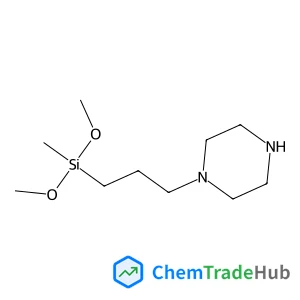
![4-{2-[4-(2-Methyl-2-propanyl)phenyl]ethoxy}quinazoline structure](https://cnstatic.chemtradehub.com/structs/120/120928-09-8-d3db.webp "4-{2-[4-(2-Methyl-2-propanyl)phenyl]ethoxy}quinazoline structure")
推荐供应商





免责声明
本页面提供的学术期刊信息仅供参考和研究使用。我们与任何期刊出版商均无关联,也不处理投稿事宜。如有投稿相关咨询,请直接联系相关期刊出版商。
如发现页面信息有误,请发送邮件至 support@chemtradehub.com 联系我们。我们将及时核实并处理您的问题。