









![(4-{[(2-Methyl-2-propanyl)oxy]methyl}phenyl)boronic acid structure](https://cnstatic.chemtradehub.com/structs/102/1024017-53-5-41c0.webp "(4-{[(2-Methyl-2-propanyl)oxy]methyl}phenyl)boronic acid structure")
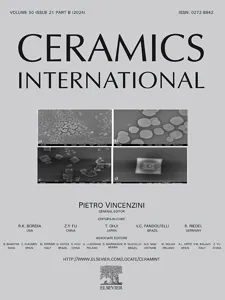
Ceramics International
基本信息
期刊简写:
CERAM INT
影响因子:
5.1
ISSN:
0272-8842
研究领域:
ENGINEERING TECHNOLOGY
h-index:
89
自引率:
13.7%
年发文量:
4206
SCI收录来源:
Science Citation Index Expanded
期刊官网:
https://www.sciencedirect.com/journal/ceramics-international
期刊介绍:
Ceramics International covers the science of advanced ceramic materials. The journal encourages contributions that demonstrate how an understanding of the basic chemical and physical phenomena may direct materials design and stimulate ideas for new or improved processing techniques, in order to obtain materials with desired structural features and properties. Ceramics International covers oxide and non-oxide ceramics, functional glasses, glass ceramics, amorphous inorganic non-metallic materials (and their combinations with metal and organic materials), in the form of particulates, dense or porous bodies, thin/thick films and laminated, graded and composite structures. Process related topics such as ceramic-ceramic joints or joining ceramics with dissimilar materials, as well as surface finishing and conditioning are also covered. Besides traditional processing techniques, manufacturing routes of interest include innovative procedures benefiting from externally applied stresses, electromagnetic fields and energetic beams, as well as top-down and self-assembly nanotechnology approaches. In addition, the journal welcomes submissions on bio-inspired and bio-enabled materials designs, experimentally validated multi scale modelling and simulation for materials design, and the use of the most advanced chemical and physical characterization techniques of structure, properties and behaviour. Technologically relevant low-dimensional systems are a particular focus of Ceramics International. These include 0, 1 and 2-D nanomaterials (also covering CNTs, graphene and related materials, and diamond-like carbons), their nanocomposites, as well as nano-hybrids and hierarchical multifunctional nanostructures that might integrate molecular, biological and electronic components. Ceramics International is particularly keen to attract papers which deal with fundamental scientific aspects that are relevant to the development of the whole range of advanced ceramics including e.g. phase equilibria and transformations, reactivity, transport processes, thermodynamic and electronic properties, as well as quantum effects in low dimensional materials. Priority materials and areas of interest are: Advanced ceramics and composites for civil, military and industrial applications at room and moderate temperatures - High and ultrahigh temperature structural ceramics and composites for use in extreme environments; Electroceramics such as dielectric and microwave ceramics, ferroelectrics, piezoelectrics, pyroelectrics, thermoelectrics, ferroelastics; magnetic, multiferroic, semiconducting and fast ion-conducting ceramics; high Tc superconductors, topological insulators; Optical ceramics including luminescent and chromogenic materials, transparent conducting and semiconducting ceramics, electro-optical, magneto-optical and laser materials, inorganic optical fibers, plasmonic structures and electromagnetic metamaterials; Ceramics for nuclear fission, fusion and nuclear waste management technologies; Bioinert and bioactive ceramics for the full range of medical applications, including functional nanoparticles, composite materials and hybrid hierarchical nanostructures for tissue engineering, delivery systems, bio imaging and neural interfaces.
CiteScore
CiteScore
9.4
SJR
0.938
SNIP
1.18
| 学科 | 排名 | 百分位 |
|---|---|---|
Materials ScienceSurfaces, Coatings and Films |
19 / 132 | 85% |
期刊统计
Bimonthly
期/年
Time to first decision: 1days
Review time: 62days
Submission to acceptance: 67days
Acceptance to publication: 5days
审稿周期
$3440
论文处理费
投稿信息
投稿网址:
https://www.editorialmanager.com/CERI收录体裁:
Original papers; review articles; short communications; letters to the editor
相关文献
One-pot synthesis of PLA-b-PHEA via sequential ROP and RAFT polymerizations
Diana Kalden, Matthias Westerhausen
2017-09-04
Paper
DOI: 10.1039/C7PY01176H
Free radical and RAFT polymerization of vinyl esters in metal–organic-frameworks
Jongkook Hwang, Hui-Chun Lee, Markus Antonietti, Bernhard V. K. J. Schmidt
2017-09-29
Communication
DOI: 10.1039/C7PY01607G
Conductance studies of 1-1 electrolytes in N,N-dimethylformamide at various temperatures
Lubov P. Safonova, Dmitrii V. Sakharov, Ludmila E. Shmukler, Arkadii M. Kolker
2001-02-06
Paper
DOI: 10.1039/B006029L
Functionalized allylamine polyphosphate as a novel multifunctional highly efficient fire retardant for polypropylene
Zhi Li, Uwe Gohs, Udo Wagenknecht
2017-09-21
Paper
DOI: 10.1039/C7PY01315A
The selective population of the vibrational levels of thioformaldehyde
Céline Léonard, Gilberte Chambaud, Pavel Rosmus, Nicholas C. Handy
2001-01-23
Paper
DOI: 10.1039/B008454I
The low temperature crystalline and glassy states of methyl α-hydroxy-isobutyrate
Susana Jarmelo, Teresa M. R. Maria, Maria Luísa P. Leitão, Rui Fausto
2001-01-15
Paper
DOI: 10.1039/B007722O
Photophysics and photochemistry of the EE and ZE isomers of 1-(n-pyridyl)-4-phenyl-1,3-butadiene (n = 2, 3 and 4)
G. Bartocci, G. Galiazzo, U. Mazzucato, A. Spalletti
2001-01-05
Paper
DOI: 10.1039/B009107N
(Co)polymers containing boron difluoride 3-cyanoformazanate complexes: emission enhancement via random copolymerization
Samantha Novoa, Joe B. Gilroy
2017-08-10
Paper
DOI: 10.1039/C7PY01120B
Effects of cell and electrode design on the CO tolerance of polymer electrolyte fuel cells
Lorenz Gubler, Günther G. Scherer, Alexander Wokaun
2001-01-02
Paper
DOI: 10.1039/B007277J
您可能还喜欢
化合物问答
4-[4-三氟甲基苯基]恶唑(CAS号:1126636-40-5)通常如何合成?
4-[4-三氟甲基苯基]恶唑通常通过将4-三氟甲基苯酚与异硫氰酸苯酯在有机溶剂中进行酯化反应合成。该反应可在无水条件下,使用适当的催化剂,如四丁基氢氧化铵,以提...
1126636-40-54-(4-(Trifluoromethy...
59729-32-71-[3-(Dimethylamino)...
化合物问答
RockPhos Pd G3(CAS号:2009020-38-4)通常如何合成?
RockPhos Pd G3 通常通过钯催化偶联反应合成,使用配体 (2'-Amino-2-biphenylyl)(methanesulfonato-kappa...
2009020-38-4(2'-Amino-2-biphenyl...
化合物问答
1-哌啶甲酰胺(CAS号:2158-03-4)的市场或研究趋势如何?
1-哌啶甲酰胺作为有机合成中的重要中间体,其市场需求主要受医药、农药、染料等行业推动。近年来,随着新药开发和绿色化学的发展,该化合物的研究趋势集中在开发更高效、...
2158-03-41-Piperidinecarboxam...
化合物问答
2-(二苯基膦基)乙胺(CAS号:4848-43-5)适用哪些法规指南?
2-(二苯基膦基)乙胺适用于多种法规指南,包括但不限于《全球化学品统一分类和标签制度》(GHS),欧盟《化学品注册、评估、授权和限制》法规(REACH),以及美...
4848-43-52-(Diphenylphosphino...
化合物问答
如何储存间苯二甲酸二烯丙酯(CAS号:1087-21-4)?
间苯二甲酸二烯丙酯应储存在阴凉、干燥、通风良好的地方,远离火源和热源。储存容器应密封,避免光照和高温。储存温度应控制在25℃以下,相对湿度应低于80%。避免与其...
1087-21-4Diallyl isophthalate
化合物问答
什么是间甲苯异硫代异氰酸酯(CAS号:621-30-7)?
间甲苯异硫代异氰酸酯是一种有机化合物,分子式为C7H7NO2S,具有刺激性气味。它是一种重要的有机合成中间体,在合成其他化合物时广泛应用。
621-30-71-Isothiocyanato-3-m...
化合物问答
在合成中是否有N-Boc-D-苯丙氨醇(CAS号:106454-69-7)的替代品?
在合成中,可以考虑使用N-Cbz-D-苯丙氨醇或N-Fmoc-D-苯丙氨醇作为替代品。这些化合物同样具有保护氨基的功能,且在合成过程中表现出良好的反应性能。
106454-69-72-Methyl-2-propanyl ...
化合物问答
3-羟甲基-2-氧异丙基吡啶(CAS号:954240-50-7)的主要用途是什么?
3-羟甲基-2-氧异丙基吡啶主要用于有机合成领域,可以作为合成其他药物、农药或精细化学品的中间体。此外,它还可能在实验室研究中作为特定反应的前体或溶剂。
954240-50-7(2-Isopropoxy-3-pyri...
化合物问答
6-氨基-9-甲基嘌呤(CAS号:700-00-5)应用于哪些行业?
6-氨基-9-甲基嘌呤目前主要应用于医药行业,作为某些药物的中间体。此外,它还可能用于聚合物、传感器和半导体的某些领域,作为功能性单体或掺杂剂。
700-00-59-Methyl-9H-purin-6-...
推荐化合物
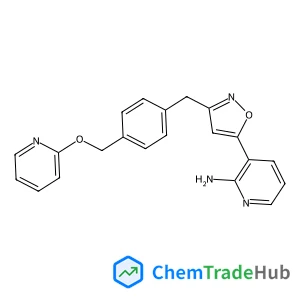
3-(3-(4-((Pyridin-2-yloxy)methyl)benzyl)isoxazol-5-yl)pyridin-2-amine
CAS号:
936339-60-5
分子式:
C21H18N4O2
![Sodium 4-{2-[(E)-2-{(3E)-3-{(2E)-2-[3,3-dimethyl-1-(4-sulfonatobutyl)-1,3-dihydro-2H-indol-2-ylidene]ethylidene}-2-[(4-isothiocyanatophenyl)sulfanyl]-1-cyclohexen-1-yl}vinyl]-3,3-dimethyl-3H-indolium-
1-yl}-1-butanesulfonate structure](https://cnstatic.chemtradehub.com/structs/152/152111-91-6-e5df.webp "Sodium 4-{2-[(E)-2-{(3E)-3-{(2E)-2-[3,3-dimethyl-1-(4-sulfonatobutyl)-1,3-dihydro-2H-indol-2-ylidene]ethylidene}-2-[(4-isothiocyanatophenyl)sulfanyl]-1-cyclohexen-1-yl}vinyl]-3,3-dimethyl-3H-indolium-
1-yl}-1-butanesulfonate structure")
推荐供应商



免责声明
本页面提供的学术期刊信息仅供参考和研究使用。我们与任何期刊出版商均无关联,也不处理投稿事宜。如有投稿相关咨询,请直接联系相关期刊出版商。
如发现页面信息有误,请发送邮件至 support@chemtradehub.com 联系我们。我们将及时核实并处理您的问题。