







Benzyl alcoholoxidation in supercritical carbon dioxide: spectroscopic insight into phase behaviour and reaction mechanism
文献信息
发布日期
2004-12-07
DOI
10.1039/B414755C
影响因子
3.676
作者
Matteo Caravati, Jan-Dierk Grunwaldt, Alfons Baiker
查看原文
摘要
Selective oxidation of benzyl alcohol to benzaldehyde with molecular oxygen over an alumina-supported palladium catalyst was performed with high rate at about 95% selectivity in supercritical carbon dioxide. The experiments in a continuous flow fixed-bed reactor showed that the pressure has a strong influence on the reaction rate. A marked increase of the rate (turnover frequency) from 900 h−1 to 1800 h−1 was observed when increasing the pressure from 140 to 150 bar. Video monitoring of the bulk fluid phase behavior and the simultaneous investigation by transmission and attenuated total reflection (ATR) infrared spectroscopy at two positions of the view cell showed that the sharp increase in activity is correlated to a transition from a biphasic to a monophasic reaction mixture. In the single phase region, both oxygen and benzyl alcohol are dissolved in the supercritical CO2 phase, which leads to a reduction of the mass transport resistances (both in the external fluid film and in the catalyst pores) and thus to the high reaction rate measured in the catalytic experiments. The phase transition could be effectively and easily monitored by transmission and ATR-IR spectroscopy despite the small concentration of the dense liquid like phase. Deposition of the Pd/Al2O3 catalyst on the ATR-crystal at the bottom of the view cell allowed to gain insight into the chemical changes and mass transfer processes occurring in the solid/liquid interface region during reaction. Analyzing the shift of the v2 bending mode of CO2 gave information on the fluid composition in and outside the catalyst pores. Moreover, the catalytic reaction could be investigated in situ in this spectroscopic batch reactor cell by monitoring simultaneously the reaction progress, the phase behaviour and the catalytic interface.
相关文献
The self-assembly of single chain Janus nanoparticles from azobenzene-containing block copolymers and reversible photoinduced morphology transitions
Wei Wen
2021-03-25
Paper
DOI: 10.1039/D1PY00223F
Synthesis of well-defined diblock copolymer nano-objects by RAFT non-aqueous emulsion polymerization of N-(2-acryloyloxy)ethyl pyrrolidone in non-polar media
R. R. Gibson, A. Fernyhough, O. M. Musa, S. P. Armes
2021-06-23
Paper
DOI: 10.1039/D1PY00572C
A pillar[5]arene-based 3D polymer network for efficient iodine capture in aqueous solution
Jiajun Cao, Huangtianzhi Zhu, Liqing Shangguan, Yuezhou Liu, Peiren Liu, Qi Li, Yitao Wu
2021-05-27
Communication
DOI: 10.1039/D1PY00535A
Towards scalable, low dispersity, and dimensionally tunable 2D platelets using living crystallization-driven self-assembly
Charlotte E. Ellis, Tomoya Fukui, Cristina Cordoba, Arthur Blackburn, Ian Manners
2021-05-27
Paper
DOI: 10.1039/D1PY00571E
Polymers and boron neutron capture therapy (BNCT): a potent combination
Anaïs Pitto-Barry
2021-03-23
Review Article
DOI: 10.1039/D0PY01392G
Practical phosphorylation of polymers: an easy access to fully alcohol soluble synthetically and industrially important polymers
Gokhan Sagdic, Ozgun Daglar, Ufuk Saim Gunay, Emrah Cakmakci, Gurkan Hizal, Umit Tunca, Hakan Durmaz
2021-07-05
Paper
DOI: 10.1039/D1PY00726B
您可能还喜欢
化合物问答
6-氯-2H-1,4-苯并噁嗪-3(4H)-酮(CAS号:7652-29-1)应用于哪些行业?
6-氯-2H-1,4-苯并噁嗪-3(4H)-酮主要应用于医药、农药和聚合物等领域。在医药领域,该化合物可用于合成抗菌药物;在农药领域,可用作杀虫剂的中间体;在聚...
7652-29-16-Chloro-2H-1,4-benz...
化合物问答
活性氧化铝(CAS号:1302-74-5)应用于哪些行业?
活性氧化铝广泛应用于医药、聚合物、传感器、半导体和催化等领域。在医药行业,活性氧化铝用作吸附剂和干燥剂,有助于去除杂质和水分。在聚合物行业,它用作增白剂和抗结块...
1302-74-5aluminum;trihydrate
化合物问答
什么是硅胶(CAS号:112926-00-8)?
硅胶(Silica gel, pptd.,cryst.-free)是一种无定形、多孔的硅酸盐材料,主要成分为二氧化硅(SiO₂)。其结构由硅氧四面体构成,通过酸...
112926-00-8Silica gel, pptd.,cr...
化合物问答
二乙基甲基一氢硅烷(CAS号:760-32-7)的主要用途是什么?
二乙基甲基一氢硅烷主要用于有机合成、表面处理以及作为溶剂。它还被用作合成其他硅烷化合物的原料,以及在涂料、粘合剂和密封剂中的应用。
760-32-7Diethyl(methyl)silan...
化合物问答
在合成中是否有N-花生四烯酰基甘氨酸(CAS号:179113-91-8)的替代品?
在合成过程中,可以考虑使用类似结构的化合物作为替代品,例如N-亚油酰基甘氨酸或N-花生二烯酰基甘氨酸。这些替代品在结构上有类似的双键位置,但可能具有不同的物理化...
179113-91-8Glycine, N-[(5Z,8Z,1...
化合物问答
在合成中是否有1-(4-甲氧基苯基)丙烷-1,2-二酮(CAS号:10557-27-4)的替代品?
在合成过程中,可以考虑使用类似结构的化合物作为替代品,例如1-(3-甲氧基苯基)丙烷-1,2-二酮或1-(4-羟基苯基)丙烷-1,2-二酮。这些替代品具有相似的...
10557-27-41-(4-Methoxyphenyl)p...
化合物问答
N-(4-氨基-1-苄基-3-羟基-5-苯基戊基)-3-甲基-2-(2-氧代四氢嘧啶-1-基)-丁酰胺 5-氧代吡咯烷-2-甲酸(CAS号:192726-06-0)通常如何合成?
该化合物通常通过一系列复杂的有机合成步骤获得。首先,通过芳香族化合物的羟基化反应获得羟基化产物,然后通过酰化反应形成酰胺中间体,最后通过环化反应得到目标产物。常...
192726-06-05-Oxo-L-proline - (2...
化合物问答
(S)-2-氨基-3-喹啉-2-丙酸(CAS号:161513-46-8)的市场或研究趋势如何?
该化合物作为生物活性化合物,尤其是在药物化学领域表现出色。近年来,随着对新型抗炎、抗病毒和抗癌药物的研究增加,其市场和研究趋势持续增长。此外,其在神经科学领域的...
161513-46-8(S)-2-Amino-3-quinol...
化合物问答
核黄素磷酸钠(CAS号:130-40-5)安全吗?
核黄素磷酸钠在常规使用条件下安全,但高剂量可能引起刺激性反应。操作时需佩戴防护手套和护目镜,避免吸入粉尘。若接触皮肤或眼睛,应立即用大量清水冲洗。急救时需根据接...
130-40-5Sodium 1-deoxy-1-(7,...
化合物问答
盐酸丙胺卡因杂质A(EP) 标准品(CAS号:19281-31-3)通常如何合成?
盐酸丙胺卡因杂质A(EP) 标准品可通过重氮化反应和随后的酰胺化反应合成。首先,利用氯化反应将苯环上的氢原子转化为氯原子,然后通过芳香族重氮化反应引入氨基,最后...
19281-31-32-Chloro-N-(2-methyl...
来源期刊
Physical Chemistry Chemical Physics

CiteScore:
5.5
自引率:
10.3%
年发文量:
3036
Physical Chemistry Chemical Physics (PCCP) is an international journal co-owned by 19 physical chemistry and physics societies from around the world. This journal publishes original, cutting-edge research in physical chemistry, chemical physics and biophysical chemistry. To be suitable for publication in PCCP, articles must include significant innovation and/or insight into physical chemistry; this is the most important criterion that reviewers and Editors will judge against when evaluating submissions. The journal has a broad scope and welcomes contributions spanning experiment, theory, computation and data science. Topical coverage includes spectroscopy, dynamics, kinetics, statistical mechanics, thermodynamics, electrochemistry, catalysis, surface science, quantum mechanics, quantum computing and machine learning. Interdisciplinary research areas such as polymers and soft matter, materials, nanoscience, energy, surfaces/interfaces, and biophysical chemistry are welcomed if they demonstrate significant innovation and/or insight into physical chemistry. Joined experimental/theoretical studies are particularly appreciated when complementary and based on up-to-date approaches.
推荐化合物
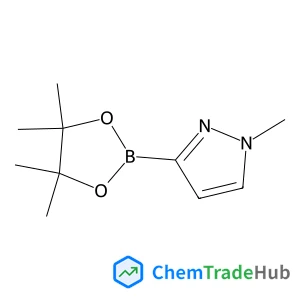
1-Methyl-3-(4,4,5,5-tetramethyl-1,3,2-dioxaborolan-2-yl)-1H-pyrazole
CAS号:
1020174-04-2
分子式:
C10H17BN2O2
推荐供应商




免责声明
本页面提供的学术期刊信息仅供参考和研究使用。我们与任何期刊出版商均无关联,也不处理投稿事宜。如有投稿相关咨询,请直接联系相关期刊出版商。
如发现页面信息有误,请发送邮件至 support@chemtradehub.com 联系我们。我们将及时核实并处理您的问题。