





The self-assembly of single chain Janus nanoparticles from azobenzene-containing block copolymers and reversible photoinduced morphology transitions
文献信息
发布日期
2021-03-25
DOI
10.1039/D1PY00223F
影响因子
5.582
作者
Wei Wen
查看原文
摘要
The self-assembly of amphiphilic single chain Janus nanoparticles (SCJNPs) is a novel and promising approach for fabricating assemblies with diversified morphologies. However, experimental research into the self-assembly behavior of SCJNPs is still limited. Furthermore, it is desirable to broaden the functionality of assemblies of SCJNPs. Herein, we constructed photoresponsive liquid crystalline (LC) SCJNPs through the intrachain photo-cross-linking of azobenzene-containing amphiphilic linear block copolymer precursors of poly(poly(ethylene glycol)methyl ether methacrylate)-b-poly(11-(4-((4-butylphenyl)diazenyl)phenoxy)undecyl methacrylate-co-11-(4-(4-butylstyryl)phenoxy)undecyl methacrylate). The self-assembly behavior of these LC-SCJNPs in solution was investigated via controlling the block copolymer (BCP) composition and initial concentration. Under the effect of the LC driving force, non-spherical assemblies, including lamellae and tubes, were obtained. Additionally, the photoinduced morphological transformations of assemblies with various azobenzene contents were studied via irradiation with alternative UV/vis light irradiation. Owing to the azobenzene moieties tethered within the SCJNP building blocks via intrachain cross-linking, reversible photoinduced morphology transitions of tubes-connected spheres-tubes and spherical vesicles-spheres-spherical vesicles were observed for assemblies with a higher azobenzene content. This work broadens the functionality and self-assembly systems of SCJNPs, providing a novel view of the photoinduced morphological transitions of assemblies from SCJNPs.
相关文献
Capillary bridges between unsaturated nano-mineral particles: a molecular dynamics study
Yubing Ouyang, Shujian Chen, Kwesi Sagoe-Crentsil, Wenhui Duan
2022-03-24
Paper
DOI: 10.1039/D1CP05041A
Nucleobase-containing polymer architectures controlled by supramolecular interactions: the key to achieve biomimetic platforms with various morphologies
Laura Vasilica Arsenie, Vincent Ladmiral, Patrick Lacroix-Desmazes, Sylvain Catrouillet
2022-10-03
Review Article
DOI: 10.1039/D2PY00920J
Influence of the crystalline phase on the electrocatalytic behaviour of Sm2−xSrxNiO4−δ (x = 0.4 to 1.0) Ruddlesden–Popper-based systems: a comparative study of bulk and thin electrocatalysts
Manisha Chauhan, Pardeep K. Jha, Priyanka A. Jha, Prabhakar Singh
2022-02-02
Paper
DOI: 10.1039/D1CP05955F
Collision-assisted stripping for determination of microsolvation-dependent protonation sites in hydrated clusters by cryogenic ion trap infrared spectroscopy: the case of benzocaineH+(H2O)n‡
Fuad Haddad
2022-02-18
Communication
DOI: 10.1039/D1CP05762F
Template-free synthesis of Bi2O2CO3 hierarchical nanotubes self-assembled from ordered nanoplates for promising photocatalytic applications
Liexiao Li, Xiaofeng Sun, Tao Xian, Huajing Gao, Shifa Wang, Zao Yi, Xianwen Wu, Hua Yang
2022-03-08
Paper
DOI: 10.1039/D1CP05952A
Ordered assembly of non-planar vanadyl-tetraphenylporphyrins on ultra-thin iron oxide
Guglielmo Albani, Luca Schio, Francesco Goto, Alberto Calloni, Alessio Orbelli Biroli, Alberto Bossi, Francesco Melone, Simona Achilli, Guido Fratesi, Carlo Zucchetti, Luca Floreano, Gianlorenzo Bussetti
2022-07-06
Paper
DOI: 10.1039/D1CP05914A
Reply to the ‘Comment on “Can bulk nanobubbles be stabilized by electrostatic interaction?”’ by S. Koshoridze and Y. Levin, Phys. Chem. Chem. Phys., 2022, 24, DOI: 10.1039/D1CP04406K
Shuo Wang, Limin Zhou, Yongxiang Gao
2022-04-14
Comment
DOI: 10.1039/D2CP00852A
Condensation and growth of amorphous aluminosilicate nanoparticles via an aggregation process
Romain Dupuis, Seung Ho Hahn, Adri C. T. van Duin, Roland J.-M. Pellenq, Arnaud Poulesquen
2022-03-19
Paper
DOI: 10.1039/D1CP05412K
Photostability of the deprotonated forms of the UV filters homosalate and octyl salicylate: molecular dissociation versus electron detachment following UV excitation
Natalie G. K. Wong, Conor D. Rankine, Cate S. Anstöter, Caroline E. H. Dessent
2022-06-27
Paper
DOI: 10.1039/D2CP01612E
Mechanical stimulation of energetic materials at the nanoscale
Ekaterina K. Kosareva, Radmir V. Gainutdinov, Adam A. L. Michalchuk, Ivan V. Ananyev, Nikita V. Muravyev
2022-03-30
Paper
DOI: 10.1039/D2CP00832G
您可能还喜欢
化合物问答
什么是2,6-二溴-4,8-双[(2-乙基己基)氧基]苯并[1,2-b:4,5-b']二噻吩(CAS号:1226782-13-3)?
2,6-二溴-4,8-双[(2-乙基己基)氧基]苯并[1,2-b:4,5-b']二噻吩是一种有机化合物,分子式为C23H32Br2O2S2。该化合物具有芳香性和...
1226782-13-32,6-Dibromo-4,8-bis[...
化合物问答
木聚硫钠(CAS号:37319-17-8)的物理化学性质是什么?
木聚硫钠通常为无色或白色结晶性粉末,具有吸湿性。其分子量约为121.11 g/mol。木聚硫钠易溶于水,不溶于醇类和其他非极性溶剂。在酸性或碱性溶液中,木聚硫钠...
37319-17-8Pentosan
化合物问答
2-甲氧基-4-(三氟甲基)苄溴, JRD(CAS号:886500-59-0)适用哪些法规指南?
该化合物在合成、储存和运输过程中需遵循《全球化学品统一分类和标签制度》(GHS)的健康、环境和物理危险分类。在欧洲还需符合《化学品注册、评估、授权和限制》(RE...
886500-59-02-Methoxy-4-(trifluo...
化合物问答
1,4-Diazoniabicyclo[2.2.2]octane-1,4-disulfinate(CAS号:119752-83-9)的主要用途是什么?
1,4-二氮杂双环[2.2.2]辛烷-1,4-二硫酸二酯主要用于有机合成中的保护基团,特别是在保护胺基和硫醇基方面具有广泛应用。此外,它还用于一些特殊化学反应的...
119752-83-91,4-Diazabicyclo[2.2...
化合物问答
如何处理含有4-(Bromomethyl)-2-fluorobenzenesulphonamide(CAS号:1645275-47-3)的废料?
含有4-(Bromomethyl)-2-fluorobenzenesulphonamide的废液应首先进行中和处理,以降低pH值,避免对环境造成腐蚀性影响。随后...
1645275-47-34-(Bromomethyl)-2-fl...
化合物问答
Loureiriol(CAS号:479195-44-3)的物理化学性质是什么?
Loureiriol是一种天然化合物,其分子式为C15H22O4。Loureiriol为无色结晶性粉末,具有较高的熔点和良好的热稳定性。其相对分子质量为262....
479195-44-3Loureiriol
化合物问答
在合成中是否有3-氨基苯甲酰苯胺(CAS号:14315-16-3)的替代品?
在合成过程中,可以考虑使用类似结构的化合物作为3-氨基苯甲酰苯胺的替代品,例如N-苯基-3-氰基苯胺或N-苯基-3-硝基苯胺等,这些化合物具有相似的化学性质,可...
14315-16-33-Amino-N-phenylbenz...
化合物问答
4-异氰酰苯基硼酸频哪醇酯(CAS号:380430-64-8)的市场或研究趋势如何?
4-异氰酰苯基硼酸频哪醇酯主要应用于有机合成、药物化学和材料科学领域。随着绿色化学的发展,该化合物因其高效的官能团转化能力和环境友好性而受到越来越多的关注。近年...
380430-64-82-(4-Isocyanatopheny...
化合物问答
如何储存3β-乙酰氧基-7,25-甘遂二烯-24(R)-醇(CAS号:1352001-09-2)?
3β-乙酰氧基-7,25-甘遂二烯-24(R)-醇应储存在阴凉、干燥、通风良好的地方,避免直接光照。储存容器应密封,防止空气中的水分和氧气影响化合物的稳定性。建...
1352001-09-23β-acetoxy-eupha- 7,...
化合物问答
如何储存4-氟-2-甲基-1H-吲哚(CAS号:1260383-51-4)?
应将4-氟-2-甲基-1H-吲哚存放在阴凉、干燥、通风良好的地方,避免直接暴露在光照下。容器应密封,避免与空气中的水蒸气接触。建议在避光、温度不超过25℃的环境...
1260383-51-44-Fluoro-2-methyl-1H...
来源期刊
Polymer Chemistry

CiteScore:
8.6
自引率:
7.3%
年发文量:
457
Polymer Chemistry welcomes submissions in all areas of polymer science that have a strong focus on macromolecular chemistry. Manuscripts may cover a broad range of fields, yet no direct application focus is required.
推荐化合物
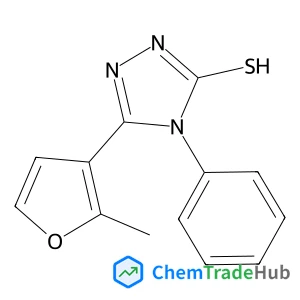
5-(2-Methyl-3-furyl)-4-phenyl-2,4-dihydro-3H-1,2,4-triazole-3-thione
CAS号:
346464-59-3
分子式:
C13H11N3OS
推荐供应商




免责声明
本页面提供的学术期刊信息仅供参考和研究使用。我们与任何期刊出版商均无关联,也不处理投稿事宜。如有投稿相关咨询,请直接联系相关期刊出版商。
如发现页面信息有误,请发送邮件至 support@chemtradehub.com 联系我们。我们将及时核实并处理您的问题。